



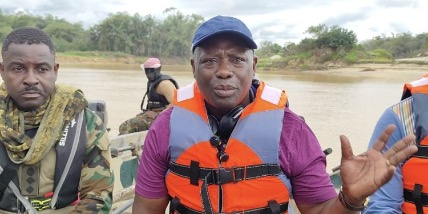
The Ankobra River, one of Ghana’s most devastated waterways, has been cleared of thousands of Changfan machines and illegal mining operators following a year of sustained military and intelligence-led operations, Minister for Lands and Natural Resources Emmanuel Armah-Kofi Buah has declared .
The Minister made the disclosure after joining the National Anti-Illegal Mining Operations Secretariat (NAIMOS) and Navy Special Forces on a 16-kilometre patrol of the river from Dominase to Gwira Banso in the Western Region, marking approximately one year since he first inspected the waterway in September 2025 when illegal mining activities were visibly rampant along its banks .
A River Transformed
Buah said Thursday’s patrol revealed a dramatic improvement, with the Changfan machines and operators previously seen along the stretch no longer present.
“It clearly shows that we are turning the corner. We are using more intelligence-led operations. We are being very intentional about these operations, and the results are showing,” Buah stated .
The Minister acknowledged that concerns had been raised about worsening pollution of the Ankobra, but insisted the situation observed during the patrol did not support that assessment. He stressed, however, the need to sustain operations to consolidate gains and allow the river to fully recover .
The Scale of the Offensive
The Ankobra River, which flows approximately 190 kilometres through the gold-rich Western Region before discharging into the Gulf of Guinea, has long been a battleground between government forces and illegal miners. The river basin, covering roughly 2,892 square kilometres across the Prestea-Huni Valley and Nzema East districts, has experienced devastating environmental degradation from mining activities .
The Minister revealed that the broader operation, known as Operation Water Shield, has resulted in the removal of close to 3,000 Changfan machines, not only from the Ankobra but also from other rivers, including the Offin. Several arrests have been made, including foreign nationals .
“If you had visited this Ankobra River in the last one year, the whole River was a workshop where the chanfan machines were being manufactured left and right all over the river body, but today I can tell you through all the miles we have covered, Ankobra is cleared off from chanfan machines,” Buah said .
NAIMOS Operations Intensify
Colonel K.S. Appiah, Director of Operations at NAIMOS, said the Secretariat had intensified operations across the Western Region in recent months. “For the past two months, my 130-man team has conducted special operations across six districts of the Western Region, with 19 operations conducted in August alone. Eleven of these operations were on the Ankobra River. We successfully cleared galamsey operators, destroyed several pieces of mining equipment and arrested several operators,” he said .
Beyond Enforcement: A New Strategy
The successes on the Ankobra reflect a fundamental shift in government strategy away from sporadic raids toward sustained, intelligence-led operations with permanent security presence at critical hotspots .
“We have shifted from sporadic raids to permanent deployment and it is actually showing this result,” Buah noted .
The Minister highlighted an encouraging transformation: “I was proud to see a shift where a lot of young men who were on the river last year have been moved into cooperative mining and enrolled onto the responsible small-scale mining programme through training and capacity building. We have combined training, building capacity and basically showing a lot of young people that there is a better way of looking for gold, you can look for gold without destroying our water bodies and our forests” .
The Hidden Enemy: Sponsors and Financiers
While celebrating the progress, Buah signaled that the fight is far from over, vowing to target the powerful forces behind the illegal operations.
“The machines we destroyed, the excavators we seized, those behind them are powerful forces that are hiding in the dark, and in our next phase is to continue to fish them out and we are going to continue to fight all the way those sponsors, those financiers until we win this fight,” he pledged .
Historical Context and Environmental Toll
The Ankobra’s plight is emblematic of a national crisis. Nearly three decades of illegal mining have severely damaged major Ghanaian rivers including the Pra, Offin, Birim and Ayensu, using crude and destructive methods involving improper use of excavators and toxic chemicals .
The environmental impact has been devastating. Satellite assessments show that bareland and mining areas in the Ankobra basin expanded from less than 1% in 1986 to approximately 3.7% by 2025, while combined forest cover declined throughout the study period . Water quality has suffered enormously, with turbidity ranging from approximately 114 to more than 1,000 NTU and total suspended solids from around 100 to nearly 3,000 mg/L—levels far exceeding safe standards .
The consequences extend beyond the river itself. Municipal water treatment plants serving mining-impacted catchments, such as those at Daboase, Bonsa, and Sekyere Hemang, experience recurrent operational disruptions due to excessive sediment loads, extreme turbidity, and high contaminant concentrations. These conditions accelerate filter clogging, increase chemical dosing requirements, and frequently compel temporary plant shutdowns. Reported expenditures on alum and polymer coagulants have risen by approximately 30-60% in mining-affected districts .
National Scale of the Problem
The challenge has been immense. Nationally, Ghana has lost an estimated 8,900 hectares of forest reserves to illegal mining—an area equivalent to about 12,500 football fields—with nine of the country’s 288 forest reserves severely affected .
Enforcement figures up to July 2026 show 258 arrests, with 234 excavators, 2,728 pumping machines, 1,724 changfan machines, and 461 motorbikes and tricycles seized or immobilised . More than 4,000 excavators are also being held at Ghana’s ports pending compliance with new documentation and clearance requirements .
However, the Minister acknowledged a persistent challenge: “The challenge we are having is not the arrest. It is the prosecution,” noting engagement with the Attorney-General’s Department to address bottlenecks in the justice system .
Commitment to Integrity
Buah reiterated his personal commitment to the fight, making a poignant pledge: “I will choose to fight with integrity and die than being corrupted in this dangerous work that will destroy all of us” .
He commended the Commander of NAIMOS, Col. Kwame Sam Appiah, and his team, along with their collaboration with the Special Forces, stating that the nation is proud of their work and that the President is deeply interested in their success .
A Community-Driven Future
The government has recruited and trained approximately 2,000 Blue Water Guards to provide intelligence and support efforts to protect water bodies from illegal mining, while simultaneously pushing for reforms to the mining licensing regime, including reducing the maximum initial duration of large-scale mining leases from 30 to 20 years and requiring exploration licence holders to demonstrate actual work on their concessions .
Buah expressed confidence that the good people of Ghana are with the government in this fight and called for continued dedication to secure the gains made on the Ankobra and other water bodies. “We have not gotten to where we want to see the river blue, but we have made great progress,” he concluded .


