



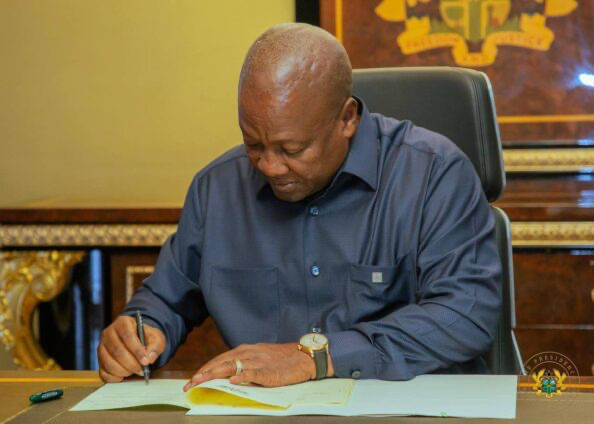
President John Dramani Mahama has formally assented to ten Bills passed by Parliament, giving legal effect to a wide-ranging package of legislative reforms across Ghana’s economic, agricultural, and justice sectors. The signing, which completes the legislative process for the bills, marks a significant milestone in the administration’s policy agenda .
The suite of new laws includes the Customs Bill, 2026; Income Tax (Amendment) Bill, 2026; Value Added Tax (Amendment) Bill, 2026; Excise Bill, 2026; and the Energy Sector Levies (Amendment) Bill, 2026. These pieces of legislation represent the government’s efforts to overhaul fiscal policy, enhance revenue mobilisation, and plug leakages within the tax framework . Other bills cover justice administration, maritime offences, and national defence.
Cocoa sector overhaul and justice reforms
A landmark piece of legislation is the Ghana Cocoa Board Bill, 2026, which repeals the decades-old Ghana Cocoa Board Act, 1984 (PNDCL 81). The new law introduces a modernised framework for the regulator, COCOBOD, aimed at enhancing transparency and curbing institutional corruption . It legislates a farmer price guarantee of at least 70% of the gross Free-on-Board (FOB) price and mandates that at least 50% of Ghana’s cocoa beans be processed locally to drive industrialisation . The bill also designates all cocoa farms as protected lands in a bid to combat the destructive impact of illegal mining, commonly known as galamsey .
In the justice sector, the Community Service Bill, 2026, and the Tribunal Bills, 2026, have been enacted to decongest the country’s prisons. The Community Service Act establishes a legal framework to allow courts to sentence minor and non-violent offenders to perform unpaid work for the community as an alternative to custodial sentencing, promoting rehabilitation while reducing pressure on the correctional system .
Defence and energy legislation
The National Defence University Bill, 2026, creates the legislative basis for a dedicated university to consolidate tertiary education programmes of the Ghana Armed Forces. This new institution is expected to serve as a premier centre of excellence for defence and security education, offering diploma, undergraduate, and postgraduate programmes to military personnel and civilians .
Regarding the energy sector, the Energy Sector Levies (Amendment) Bill aims to reform the administration of fuel subsidies. The law replaces the upfront subsidy arrangement with an ex-post model, where eligible beneficiaries pay the applicable levy first and then apply for reimbursement. This change is intended to eliminate abuse within the system and reduce revenue leakages .
Customs and fiscal adjustments
The Customs Bill introduces strict reforms to bolster border security and revenue collection. It establishes statutory maximum warehousing periods for imported goods—three months for perishables, six months for general goods, and twelve months for raw materials—to curb the abuse of the warehousing framework and prevent duty evasion . Furthermore, the Income Tax (Amendment) Act provides targeted relief by exempting the National Daily Minimum Wage from income tax and raising the presumptive tax turnover threshold to GH¢750,000 to simplify compliance for small businesses .


