



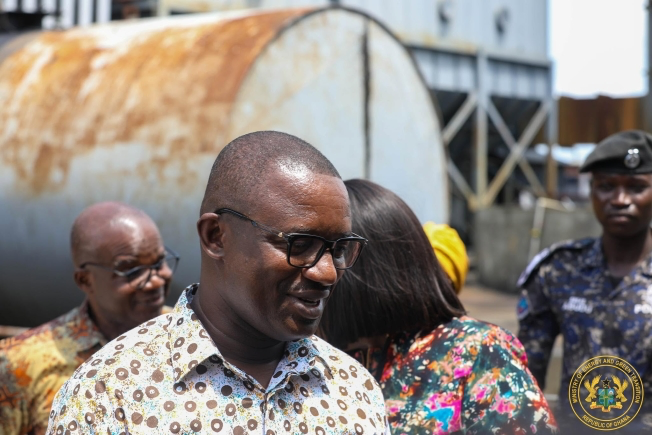
Ghana is determined to diversify its energy mix with nuclear power to provide affordable, reliable and low-carbon electricity to support industrialisation and economic growth, the Minister of Energy and Green Transition, John Abdulai Jinapor, has said .
Speaking at the opening of the third US-Africa Nuclear Energy Summit in Accra, held under the theme “Building and Sustaining Africa’s Nuclear Workforce,” Mr. Jinapor stressed that the government is strengthening stakeholder engagement to ensure citizens fully understand the benefits, risks and safety measures associated with nuclear energy .
The Rationale: Rising Demand and Depleting Hydro Potential
Mr. Jinapor explained that increasing electricity demand, the depletion of the country’s hydroelectric potential and the high cost of thermal generation had made it crucial for the country to explore other sources of affordable power such as nuclear energy .
He highlighted the dramatic shift in Ghana’s electricity needs, noting that the peak electricity demand in the early years of the Akosombo Dam was about 300 megawatts, compared with the more than 1,000 megawatts the dam generates today. However, the situation has fundamentally changed, with the country’s peak demand now standing at about 4,500 megawatts . This aligns with recent data showing Ghana’s peak load has surged past historical levels, reaching 4,294 MW in 2026 and continuing to rise .
The minister noted that the high cost of thermal generation has contributed to increased energy costs, making diversification of the energy mix necessary . This economic rationale is supported by Nuclear Power Ghana, which argues that fluctuations in imported fuel prices highlight the importance of a more stable energy source .
Building a Nuclear Workforce
Mr. Jinapor said the successful deployment of nuclear energy requires a broad range of professionals, including engineers, operators, regulators, technicians, welders, project managers and leaders . He also called for political leaders to be trained to understand nuclear energy and its implications for national development, assuring that the country would pursue its nuclear programme in accordance with the highest international standards on safety, security and non-proliferation .
“Behind every reactor is a scientist. Behind every safety decision is a trained professional. Behind every regulatory licence is a competent regulator,” said Professor Abdulai Baba Salifu, Chairman of the Governing Board of the Ghana Atomic Energy Commission (GAEC) . He emphasized that African countries should place greater emphasis on developing scientists, engineers, technicians, operators, regulators and other professionals required across the nuclear energy value chain .
Ghana as a Regional Hub
Prof. Salifu said the country was positioning itself as a regional hub for nuclear workforce development with the establishment of the Regional Energy Training Centre, with support from the United States Department of Energy . The center, launched in Accra in 2023, is Africa’s first regional training hub for civil nuclear energy programs and serves Ghana and other African countries considering nuclear energy .
He also noted that the School of Nuclear and Allied Sciences at the University of Ghana has been designated a regional centre for nuclear education . Ghana is advancing the second phase of its nuclear power programme under the IAEA’s milestone approach and is committed to contributing to nuclear expertise development across Africa .
The Nuclear Power Institute (NPI) of GAEC has acquired a nuclear power plant simulator, the only one in Africa, which is already being used to train Ghanaian personnel and participants from Nigeria and Kenya . The simulator, based on a small modular reactor (SMR) design, enables personnel to practice operating a nuclear power plant in a controlled environment before an actual plant is built .
Plans for 1,000 Megawatts by 2030
Prof. Salifu said plans are being made to integrate 1,000 megawatts of nuclear power into the country’s national grid by 2030 . He noted that Africa’s projected electricity demand, expected to rise by 47 percent by 2030 and almost sevenfold by 2050, required countries to develop new and reliable sources of power .
Dr. Archibold Buah-Kwofie, Director of the Nuclear Power Institute, has explained that nuclear is complementary to renewables in developing a green-based energy system, as solar and wind are intermittent and cannot serve baseload needs of the nation . “No country has industrialised on renewables alone,” he noted .
US Commitment and the Role of AI
The Principal Deputy Assistant Secretary of the Office of Nuclear Energy at the United States Department of Energy, Dr Michael Goff, expressed the US’s commitment to strengthening nuclear cooperation with African countries and supporting the skilled workforce required for the continent’s nuclear ambitions .
“The United States really wants to be your partner in that future,” he said . Dr. Goff said the US-Ghana Regional Energy Training Centre is providing training and technical exchanges covering reactor technologies, operations, cybersecurity, quality assurance and spent fuel management .
He also highlighted the growing role of artificial intelligence in nuclear energy, saying it could accelerate reactor design, improve licensing processes, transform manufacturing, construction and enhance the operation of nuclear facilities . Dr. Goff noted that advances in reactor technology, streamlined licensing processes and strengthened nuclear fuel supply chains are creating opportunities for African countries to adopt nuclear energy without the lengthy timelines traditionally associated with nuclear projects .
Challenges Ahead: Financing and Regulatory Gaps
Despite the ambitious plans, Ghana’s nuclear programme faces significant hurdles. The country remains in Phase Two of the IAEA’s Milestones Approach, which focuses on grid capacity, institutional capabilities, financing and site procurement . Site characterisation and evaluation are still pending, which would move the country to Phase Three .
Financing new nuclear investment is challenging for any country. Ghana has been negotiating with several vendor countries, but increased geopolitical risks and the country’s financial situation have substantially affected the costs and risks of its nuclear plans . The financial challenge extends beyond covering the cost of the plant, with parallel investments needed in networks, regulation, safety, security, fuel management, waste management and workforce development .
Additionally, a recent investigation revealed that Ghana’s nuclear power programme faces a setback due to a legal gap, with no nuclear regulatory instruments passed by Parliament in nearly a decade . The Nuclear Regulatory Authority requires complementary regulations for licensing and enforcement duties, but the country’s regulatory framework remains incomplete . Experts caution that finalising the regulatory framework is crucial for the successful construction and operation of the nuclear plant .
Dr. Buah-Kwofie acknowledged the pace of progress, stating, “Are we progressing? Yes. Are we progressing at the pace that we hoped? Maybe not,” citing funding constraints and competing national priorities as challenges .
Diaspora Engagement
The Minister of Lands and Natural Resources, Emmanuel Armah-Kofi Buah, called for greater involvement of the African diaspora in the continent’s nuclear development . He said African scientists and professionals working abroad should be viewed as part of Africa’s human capital and advocated mechanisms to facilitate the exchange of knowledge and expertise between the diaspora and institutions on the continent .
The summit, jointly organised by the Ghana Atomic Energy Commission (GAEC), US Department of Energy, Regional Energy Training Centre and other partners, brought together government representatives, experts and international partners from across Africa, including delegations from Angola and Djibouti .


