



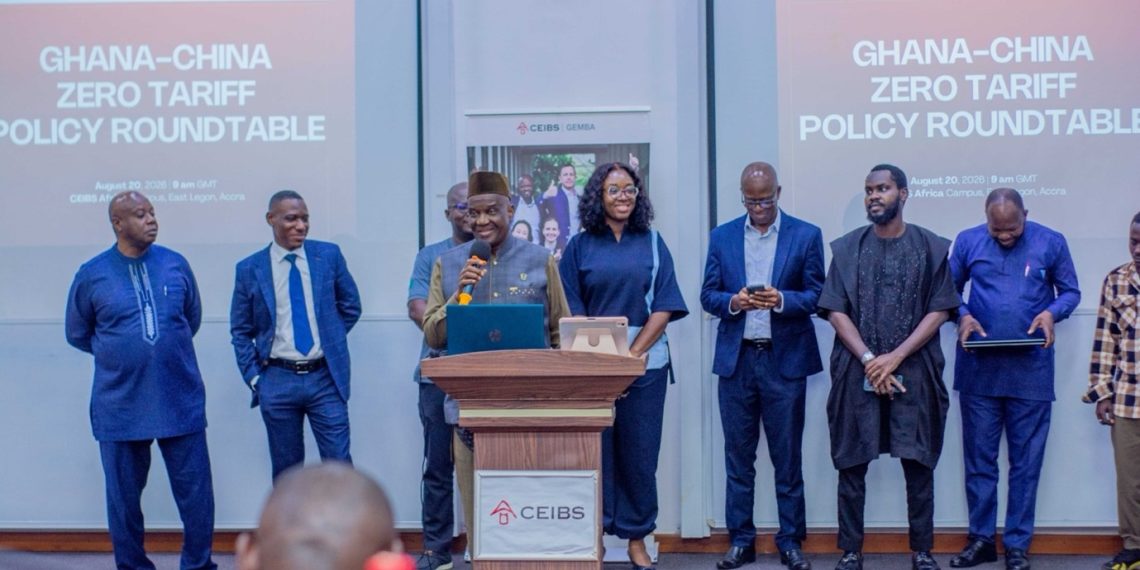
In a strategic move to ensure Ghanaian businesses fully capitalise on China’s landmark zero-tariff policy, a coalition of government officials, financial institutions, regulators, private sector leaders and academics has proposed the establishment of a dedicated Ghana–China Zero-Tariff Fund .
The proposal emerged during the Ghana–China Zero Tariff Policy Roundtable in Accra, convened by the China Europe International Business School (CEIBS Africa) and the Africa–China Centre for Policy and Advisory (ACCPA) . The high-level gathering brought together Ghanaian and Chinese stakeholders to examine the practical barriers preventing expanded market access from translating into increased exports.
The Policy Context: A New Era of Trade
The roundtable discussions are set against the backdrop of China’s decision, effective May 1, 2026, to grant zero-tariff treatment to all products from 53 African countries with diplomatic ties to Beijing . This initiative, the first of its kind by a major economy, aims to significantly reduce the cost of African goods in the Chinese market .
Speaking at the event, China’s Ambassador to Ghana, Cong Song, highlighted the potential of the policy, noting that it presents a “strategic opportunity” for Ghana to deepen trade engagement and diversify its export base beyond traditional commodities . He cited Ghanaian cocoa as a prime beneficiary, which previously faced tariffs of between 8 and 22 percent .
Recent trade data underscores the scale of the opportunity. Bilateral trade between Ghana and China reached a record US2.67 billion . Following the implementation of the zero-tariff policy in June 2026, China’s imports from Ghana reached US$290 million, a 166 percent month-on-month increase .
Addressing the Financing Gap
Despite this promising outlook, stakeholders at the roundtable identified access to finance as the most critical constraint, particularly for Small and Medium-sized Enterprises (SMEs) looking to increase production, aggregate supply, and respond to potential Chinese market orders . The interactive “Zero Tariff Policy Lab” session concluded that conventional lending models are insufficient to meet the emerging demands of the Ghana-China trade corridor.
The proposed fund is designed to address this gap by supporting businesses seeking to export under the zero-tariff framework . The discussions urged financial institutions to look beyond traditional loans and develop products specifically tailored for this opportunity .
Financing the Entire Export Chain
Key stakeholders emphasised that the financing challenge extends beyond providing individual export loans. Using the cashew value chain as a case study, participants noted that firms seeking to increase exports require capital to aggregate produce from farmers and expand processing capacity .
To this end, the roundtable proposed several innovative financing mechanisms:
· Contract farming finance to support outgrowers and secure more reliable supply chains .
· Warehouse financing to allow producers to store goods and access credit against their inventory .
· Fintech-enabled financing and equipment leasing to address constraints at different stages of the value chain .
The Role of Development Finance Institutions
The role of development finance institutions also featured prominently in the discussions, with participants questioning how institutions like Ghana EXIM Bank and Development Bank Ghana can be more effectively deployed to support export-oriented businesses .
This aligns with recent strategic shifts at Ghana EXIM Bank, which has committed to a “reset” to intensify the country’s export capacity. The bank’s CEO, Sylvester Mensah, has outlined a vision to move beyond conventional lending by introducing a wider range of products, including export credit guarantees, invoice discounting, and warehouse receipt financing . “Many firms do not fail for lack of ambition. They struggle because capital is expensive or mismatched,” Mr. Mensah noted earlier this year .
A Call for Action and Preparedness
Beyond financing, the roundtable stressed that tariff-free access alone will not guarantee success . Experts including Prof. Gordon Adomdza, Director of CEIBS Africa, and Paul Frimpong, Executive Director of ACCPA, called for a holistic approach that addresses certification, quality standards, packaging, and market intelligence .
The current preferential arrangement is scheduled to run until April 2028, creating a critical window for Ghanaian businesses to become certified, organised, and connected to Chinese buyers .
ACCPA has indicated that it will consolidate the roundtable’s recommendations into a policy document to be submitted to relevant government agencies for consideration . As the government prepares to leverage this transformative trade opportunity, the proposed fund represents a vital step toward ensuring that Ghanaian businesses can compete effectively and turn policy promise into tangible economic growth.


