



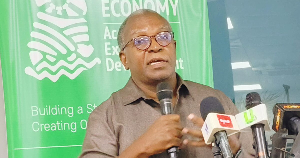
The 24-Hour Economy Secretariat has declared that sustainable job creation will be driven not by government programmes alone, but by increased production, modernised agriculture, manufacturing, and a coordinated national development plan.
Speaking at a media engagement in Accra, Kyeretwie Opoku, Coordinator of the Secretariat, said the strategy was aimed at addressing the employment needs of millions of Ghanaians, particularly the youth. He emphasised that the Secretariat would work closely with the media to improve public understanding of the programme and its objectives. “Working with you is something we desperately want to do going forward. And tonight is the beginning,” he said.
A Paradigm Shift: From Consumption to Production
Mr Opoku explained that the Secretariat was established to help transform the organisation of the economy, create wealth, retain it locally, and support reinvestment for future generations. He stressed that sustainable employment would result from overall economic growth, particularly in agriculture and manufacturing, rather than government programmes alone.
“Our task, as we understand it, is to plant production first, because the jobs will come from production. We can’t all be banking seven years all the time. We must make things that are bought and sold,” he said.
Modernising Agriculture, Reviving Manufacturing
The Coordinator outlined that the Government would seek to reorganise and modernise agriculture to make it less labour-intensive and more attractive to the youth, while improving the processing and distribution of agricultural products. Manufacturing would also be critical to job creation, particularly through the processing of agricultural raw materials into finished and semi-finished products.
Mr Opoku cited Ghana’s post-independence industrialisation under the late President Kwame Nkrumah as an example of how coordinated planning and industrial policy could support economic transformation. He noted that the development of factories, agricultural estates, ports, power infrastructure and other facilities during that period formed part of a coordinated national development plan.
“Our task today, in the 21st century, as a 24-hour programme, is to revive a plan, to revive national coherence, national mobilisation around a plan that delivers very specific social support,” he said.
Programme Background and Progress
Launched on July 2, 2025, by President John Dramani Mahama, the 24-Hour Economy initiative seeks to integrate modernised agriculture, manufacturing, logistics and financing through eight sub-programmes, including Grow24 for crop production, Make24 for manufacturing, Connect24 for supply chains and Fund24 for small and medium-sized enterprises. The programme aims to create 1.7 million decent jobs by the end of 2028, reduce Ghana’s unemployment rate to below 5% by 2034, and drastically reduce the nation’s reliance on expensive imports.
Parliament passed the 24-Hour Economy Authority Bill, 2025, on February 6, 2026, and President Mahama assented to it later that month, establishing the legal and regulatory framework for the programme. The government has allocated GH¢110 million in the 2026 Budget to operationalise the initiative.
Incentives and Private Sector Commitment
The government has proposed duty- and tax-free importation of equipment for factories registered under the initiative. Other incentives include tax rebates on electricity consumed during off-peak hours, enhanced security for night-shift workers, and a 25% corporate tax rebate for companies operating two shifts.
Access to these incentives will be strictly performance-based, tied to verifiable indicators such as employment records and electricity consumption. As of May 2026, the Secretariat had secured **Joint Development Agreements worth approximately US11.5 billion. Some 268 fuel stations and 33 manufacturing companies are already operating under the programme’s multi-shift production model. Major projects include the 250 million Kambonwule oil palm project.
“The right measure of programme success is the investment the programme mobilises and the production, exports, and jobs it generates,” the Secretariat has stated.
Mr Opoku’s call for a production-first approach reinforces the government’s vision of a transformed economy centred on agriculture, manufacturing, infrastructure and investment.


