



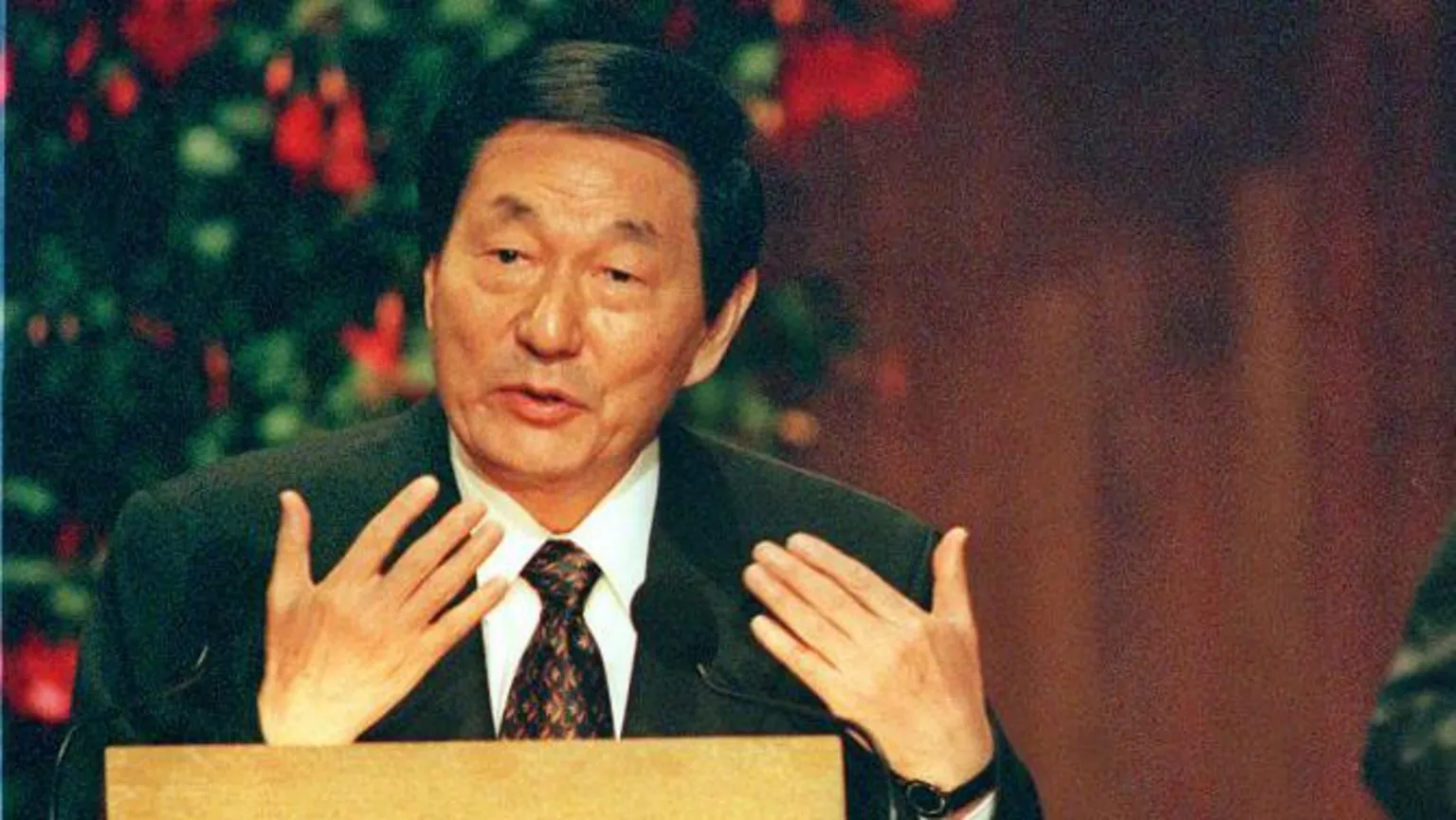
Zhu Rongji, the tough-minded technocrat who steered China through wrenching market reforms, tamed runaway inflation, overhauled its bloated state sector and secured its entry into the World Trade Organization, died on Wednesday in Beijing. He was 97.
His death from illness was announced by the official Xinhua News Agency, which said he died at about 11 a.m. after medical treatment failed. A joint obituary issued by the Communist Party Central Committee, the National People’s Congress Standing Committee, the State Council and the Chinese People’s Political Consultative Conference hailed him as “an outstanding member of the Communist Party of China,” a “loyal Communist fighter,” and “an outstanding leader of the Party and the state.” State media described his life as one of “revolution, struggle and brilliance.”
Zhu served as China’s premier from 1998 to 2003 under then-President Jiang Zemin, after earlier stints as vice premier and de facto economic czar. He is widely regarded as one of the most consequential economic reformers of the post-Mao era, second only to Deng Xiaoping in advancing the shift from a rigidly planned economy toward a more market-oriented system integrated with global trade. Under his leadership China laid the foundations for two decades of explosive growth that turned it into the world’s manufacturing powerhouse and second-largest economy.
From political exile to economic command
Born on October 23, 1928, in Changsha, the capital of Hunan province (also Mao Zedong’s home province), Zhu was orphaned young — his father died before his birth and his mother when he was about nine — and raised by uncles. He excelled academically, ranking top in Hunan on the entrance exam for the elite Tsinghua University, where he studied electrical engineering from 1947 to 1951 and served as student union president. He joined the Communist Party in October 1949, the year the People’s Republic was founded.
His early career at the State Planning Commission was derailed by politics. During the Hundred Flowers Campaign he criticized Mao’s economic policies as promoting “irrational” high growth. In 1957–58 he was labeled a “rightist,” expelled from the party, demoted and later sent to teach colleagues. During the Cultural Revolution he was purged again and spent roughly five years (around 1970–1975) performing manual labor at a May Seventh Cadre School farm, raising pigs and cattle and carrying waste. He was politically rehabilitated only after Mao’s death and Deng Xiaoping’s return to power.
Zhu rose steadily thereafter. Appointed mayor of Shanghai in 1988 and party secretary in 1989 (succeeding Jiang Zemin), he promoted foreign investment, cut red tape and kick-started development of the Pudong New Area, helping transform the city into a modern financial hub. Deng noticed his results and brought him to Beijing as vice premier in 1991. By 1993 he was executive vice premier and took personal charge of the People’s Bank of China to combat inflation that had soared above 20–25 percent. Through austerity, tighter credit, temporary price controls and other measures, he engineered a soft landing without crushing growth — a performance that cemented his reputation as China’s economic steward.
Painful reforms and global opening
As premier, Zhu pursued an ambitious agenda of structural change. He recentralized tax and fiscal powers from local governments, strengthening Beijing’s ability to manage the economy. He pushed the restructuring, closure or privatization of thousands of loss-making state-owned enterprises, ending the “iron rice bowl” of lifetime employment for many workers. The reforms produced an estimated 30 million layoffs over several years and contributed to rising inequality, drawing criticism even as they improved efficiency and competitiveness. He also overhauled the banking system, reduced the size of government and the military by nearly a million positions, reformed grain distribution and social security, and promoted the privatization of urban housing — measures that fueled a long real-estate boom.
Zhu’s sharp tongue and impatience with incompetence became legendary. He once declared he had prepared “100 coffins — 99 for corrupt officials and one for myself.” He called rogue bankers “half-wits” and described the dikes along the Yangtze River as “as flimsy and porous as tofu dregs.” His blunt style earned nicknames such as “the Boss,” “Iron Premier” and even “Madman Zhu,” but it also made him popular with ordinary Chinese weary of official corruption and inefficiency.
His crowning international achievement was leading the long, difficult negotiations that brought China into the World Trade Organization in 2001. The accession opened Chinese factories to global markets, attracted foreign investment and turbocharged export-led growth. China went on to become the world’s largest manufacturer and exporter; annual growth frequently exceeded 8 percent in the following decade and peaked above 14 percent. Critics later argued that China did not fully honor some WTO commitments, contributing to trade tensions that persist today. Zhu also helped China weather the 1997–98 Asian financial crisis with relative stability.
Legacy and later years
Zhu stepped down after a single term in 2003, succeeded by Wen Jiabao. In retirement he largely stayed out of the public eye, appearing occasionally at major Party events and supporting successive leaderships. He is survived by his wife, Lao An, a retired business executive, and their two children.
Zhu’s reforms delivered sustained high growth and lifted hundreds of millions out of poverty, but they also left lasting challenges: greater inequality, a swollen real-estate sector, debt burdens and the social dislocations of mass industrial restructuring. In the days after his death, Chinese social media filled with nostalgic tributes recalling an era of pragmatic reform and opening, even as the country now faces slower growth and a more constrained economic model.
“He was one of the most important economic architects China has had in the post-1949 period,” said economist Nicholas Lardy, who met Zhu on multiple occasions. “He did more to integrate China into the global economy than anyone.”
Zhu Rongji’s death closes a chapter on the generation of leaders who turned Deng Xiaoping’s vision of “reform and opening” into concrete institutions and policies that remade China — and the world economy — in the late 20th and early 21st centuries.


