



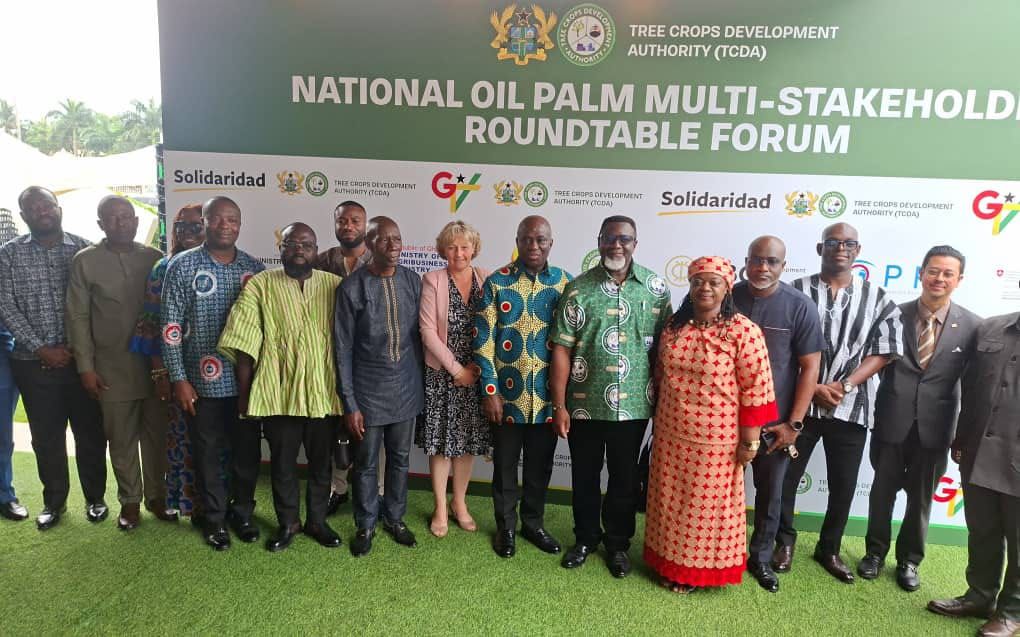
The government has unveiled an ambitious plan to establish 100,000 hectares of new oil palm plantations, a move aimed at drastically reducing Ghana’s reliance on imported palm oil while generating thousands of direct and indirect jobs across the agricultural value chain.
The announcement was made by the Minister for Food and Agriculture, Eric Opoku, during the National Oil Palm Multi-stakeholder Roundtable Forum in Accra on Wednesday. Under the theme “From Policy to Practice: The Role of TCDA in Resetting Ghana’s Oil Palm Industry,” the event convened players from the Tree Crops Development Authority (TCDA), smallholder farmers, industrial processors, investors, and research institutions to map out a concrete roadmap for the sector.
Bridging the Import Gap
Ghana currently faces a staggering production deficit, importing over 150,000 metric tonnes of crude palm oil annually—a figure that bleeds the economy of an estimated $200 million in foreign exchange. Mr. Opoku stressed that this deficit extends far beyond a simple supply lag; it represents idle processing capacity, depressed farmer incomes, and a thriving avenue for smuggling and unfair competition that undercuts local refining businesses.
“Policy acquires value only when it changes lives,” the Minister asserted. “We have had enough studies and white papers. This forum is about shifting gears toward implementation, coordination, and accountability. We must leave here with clear timelines, resource commitments, and measurable targets.”
The TCDA as the Institutional Anchor
Central to the transformation agenda is the Tree Crops Development Authority, established under Act 1010 of 2019. The Minister noted that the TCDA will move beyond a regulatory watch-dog role to become a driver of industrial growth. Key mandates include stringent farmer registration, digital data collection for crop forecasting, and the introduction of a robust traceability system to assure quality from farm to factory.
He was unequivocal in his call for the formalisation of the sector, stating that licensing should not be viewed as a bureaucratic hurdle but rather as the gateway to investor confidence and premium export markets. “We will support the TCDA to enforce standards fairly,” he added, “protecting consumers and the reputation of Ghanaian palm oil on the global stage.”
Sustainable Growth and Inclusivity
The Minister outlined that the 100,000-hectare expansion would not be a reckless race for acreage. Success, he said, would be measured by the quality of planting materials, environmental integrity, and the inclusion of marginalized groups.
He specifically appealed for increased access to high-yielding, climate-resilient, and disease-tolerant seedlings—a call echoed by the CSIR-Oil Palm Research Institute (OPRI), which has developed varieties capable of yielding over 20 tonnes of Fresh Fruit Bunches (FFB) per hectare. Crucially, the Minister assured stakeholders that the expansion would strictly adhere to Environmental Protection Agency (EPA) guidelines, avoiding encroachment on remaining forest reserves and mitigating deforestation risks—a critical concern given Ghana’s alarming rate of forest loss.
To address the perennial issue of land tenure, the government hinted at facilitating long-term lease agreements to give both smallholders and commercial investors the security needed to plant. Furthermore, the strategy prioritises women and youth, who are expected to dominate nursery operations and downstream processing.
Financing and Processing Infrastructure
Access to finance remains a significant bottleneck. Mr. Opoku revealed that discussions are underway with the Agricultural Development Bank (ADB) and commercial banks to provide tailored credit facilities for oil palm cultivation, with special attention to the establishment of satellite mills.
Currently, post-harvest losses are acute because FFB must be processed within 48 hours of harvest to avoid spoilage. The expansion plan is therefore tied to a concurrent push to establish decentralised mini-mills to ensure rural farmers can quickly offload their produce, reducing waste and increasing their profit margins.
A Call to Action
As the forum concluded, the Minister issued a final challenge to all stakeholders: “This is not a government project alone; it is a national project.” He urged traditional authorities to release underutilised lands, research institutions to speed up field trials, and processors to commit to off-take agreements that guarantee market stability.
With the global vegetable oil market still volatile due to geopolitical tensions, Ghana is positioning itself to seize the moment. If the 100,000-hectare target is met, experts predict the nation could slash its import bill by 70% within five years, while creating over 300,000 jobs along the value chain—a transformative economic shift that could finally see Ghana realize its long-dormant potential as a palm oil powerhouse.


