



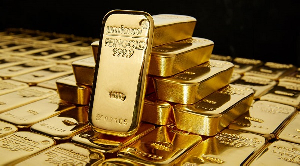
The Government of Ghana is redoubling its efforts to diversify the country’s export earnings away from an increasingly inordinate over-reliance on gold, following a stark warning from the International Monetary Fund (IMF) that the nation’s macroeconomic recovery — while strengthened by the precious metal — has become dangerously vulnerable to it.
Gold now accounts for 68.3% of exports
Fresh data from the Bank of Ghana indicates that by July 2026, gold represented approximately 68.3 percent of total export earnings. This compares with just 12.5 percent from cocoa, 9.4 percent from crude oil, and a mere 9.8 percent from non-traditional exports. The concentration has grown sharply from 39 percent in 2004, highlighting the country’s deepening dependence on a single commodity.
In the first half of 2026, total exports surged to a record **US13.7 billion in the corresponding period of 2025. Gold alone generated approximately **US8.3 billion a year earlier — meaning the precious metal accounted for roughly two-thirds of export earnings in just six months, while every other export category combined generated only one-third.
The risk of a gold price crash
The warning comes at a time when gold is trading at **US1,288 lower (roughly 23 percent) than its all-time peak of US$5,602.22, achieved on January 28, 2026.
The IMF has warned that more than half of Ghana’s exports are now derived from gold, with recent improvements in the external sector being driven largely by exceptionally high global gold prices rather than broad-based economic diversification. Gold accounts for close to 10 percent of GDP and about 21 percent of direct tax revenue.
In a tail-risk scenario modelled by the Fund, a permanent 45 percent decline in gold prices — falling to US$2,283 per ounce, roughly the average price recorded in 2024 — could trigger a 3.7 percentage-point depreciation of the cedi, push inflation up by as much as 2.9 percentage points, and force the Bank of Ghana to tighten monetary policy by about 250 basis points. Government revenue could fall by around 1.5 percent of GDP every year, mainly from lower mining royalties and corporate taxes.
Government acknowledges the risk
Finance Minister Dr. Cassiel Ato Forson has openly described gold concentration as a long-term economic risk, while arguing that Ghana must first maximise the benefits of the commodity boom and simultaneously build alternative sources of foreign exchange.
“This we are aware of. It is indeed a risk, but it’s also an advantage today,” Dr. Forson said on the Citi Breakfast Show. “It is not something that we can fix in two months. It takes a lot more than two months to fix it. You need both planning, action, and resources to be able to fix it in the medium term”.
‘New Economy’ three-year diversification plan
The government is preparing a broader economic transformation programme to reduce Ghana’s dependence on gold over the next three years. The strategy, to be unveiled under a policy framework dubbed the “New Economy,” will prioritise investment in sectors where Ghana holds a comparative advantage — including commercial agriculture, agro-processing (with palm oil expected to feature prominently), mining value addition, energy, and transport infrastructure.
The government aims to spend about 1 percent of GDP on diversification efforts.
Ban on raw gold exports and local refining push
Beyond diversification, Ghana is aggressively moving to capture more value from its gold wealth. The country has signed multiple refining agreements aimed at ending the export of raw gold — a colonial-era model that saw nearly all gold exported unprocessed, ceding both control and millions in refining revenue to foreign facilities in Switzerland, the UAE, and India.
On May 25, 2026, the Ghana Gold Board (GoldBod) signed a refining agreement with Royal Ghana Gold Refinery to supply up to one metric tonne of gold every week for local processing — the second such partnership in 2026, following an earlier deal with Gold Coast Refinery that began operations on February 1.
“When we took office on January 7, 2025, Ghana did not have any functioning gold refinery refining gold locally for export,” said Sammy Gyamfi, CEO of the Ghana Gold Board. “All the gold we produced was exported in raw form, and that narrative must change”.
Effective July 1, 2026, the government directed large-scale mining companies to sell 30 percent of their total gold output to the state-owned GoldBod to supply domestic processing facilities. For decades, Ghana exported up to 99 percent of its gold in raw form.
The government is also seeking London Bullion Market Association (LBMA) accreditation for local refineries — a move officials believe could strengthen Ghana’s position in global bullion markets and improve international confidence in locally refined gold.
Value addition and job creation
According to Finance Minister Dr. Forson, without the monopoly framework established for artisanal and small-scale mining (ASM) gold purchases, about half of the country’s current gold exports would have escaped the formal economy through smuggling.
The government’s drive to expand local processing is expected to reduce the loss of value-added revenue, create jobs, and strengthen Ghana’s mining industry. “The refining fees that used to leave Ghana will now remain in the Ghanaian economy. Jobs will be created here, technical expertise will grow here, and value retention will improve,” Gyamfi said.
A long road ahead
Despite the government’s efforts, the scale of the challenge remains formidable. Gold generated roughly two-thirds of export earnings in just six months — demonstrating the magnitude of the diversification task ahead. The impressive trade performance has also not translated into stronger external buffers; Gross International Reserves declined by US14.16 billion to US$12.94 billion.
As the outgoing Swiss Ambassador to Ghana, Simone Giger, noted in July: “What Ghana needs in the medium term are structural reforms… I want to see the business environment improve beyond the macroeconomic figures. There is still a lot that needs to be done”.
For now, Ghana finds itself in a paradox: gold is both the engine of its recovery and the greatest threat to its long-term stability. Whether the “New Economy” can deliver the structural shift needed to break gold’s grip remains the defining economic question of the Mahama administration.


