



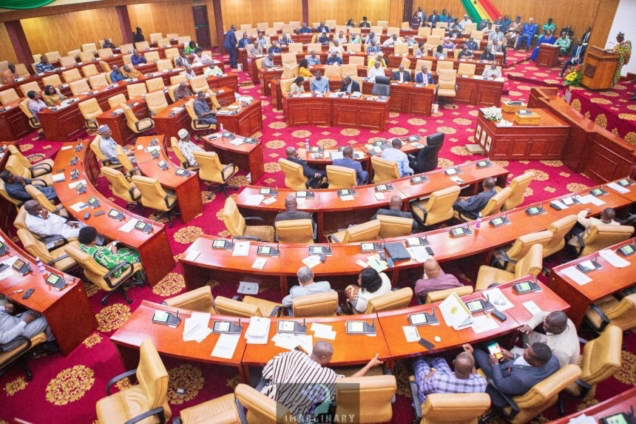
Parliament concluded the Second Meeting of the First Session of the Ninth Parliament by passing 12 key bills spanning taxation, investment, maritime security, defence, justice, local governance, cocoa sector reforms and energy financing .
The legislation forms part of the government’s broader agenda to strengthen public institutions, modernise key sectors of the economy, improve revenue mobilisation and address long-standing structural challenges.
Below is a breakdown of the 12 bills and what they seek to achieve.
- Human Sexual Rights and Family Values Bill, 2025
Passed: 29 May 2026
The bill seeks to promote what it describes as Ghanaian family values by prohibiting activities relating to LGBTQ+ advocacy, promotion and related practices . It also prescribes sanctions for certain acts prohibited under the legislation.
The bill expands existing colonial-era laws criminalising gay sex, with provisions that define and criminalise queer people and their allies . One of its harshest sections targets people who advocate for, fund or indirectly support LGBTQ rights – wording that pro-queer NGOs and public health groups say is aimed squarely at their work. Breaching this provision could lead to a prison sentence of between five and ten years .
The bill also places all people within Ghana’s jurisdiction under a duty to not only report queer people and their advocates, but to promote the bill’s core provisions in homes, schools, religious institutions and the media .
Eight exemptions were added to allow certain bodies and professionals to continue their work, covering legal representation, court submissions, academic research, communications by health organisations, professional medical services, journalism, public health functions and privileged communications under Ghana’s Evidence Act .
The bill has generated significant public, legal and international debate over human rights, constitutional freedoms and cultural values .
- Ghana Investment Promotion Authority Bill, 2025
Passed: 25 June 2026
The bill establishes a new Ghana Investment Promotion Authority (GIPA), replacing the existing investment promotion framework . It seeks to improve Ghana’s investment climate, streamline investor services, strengthen investment regulation and position the country to attract both local and foreign direct investment .
Key changes introduced by the bill include:
· Removal of minimum foreign capital requirements for joint ventures with Ghanaians and wholly foreign-owned enterprises . However, capital and skilled Ghanaian workforce requirements continue to apply to trading enterprises, with a non-citizen required to invest a minimum of USD 500,000 in cash as equity and ensure at least 75% of the workforce comprises skilled Ghanaians .
· Higher expatriate quotas at higher investment levels, ranging from two persons for enterprises with paid-up capital between USD 50,000 and USD 500,000 to a maximum of 12 persons for enterprises with capital exceeding USD 10 million .
· Introduction of an investor grievance mechanism, allowing enterprises to submit complaints within six months of an incident regarding administrative decisions or actions of government institutions .
· Introduction of citizenship by investment, with its framework and details to be provided by legislation .
The bill strengthens enforcement by expressly prohibiting fronting and introducing administrative penalties ranging from GHS 60,000 to GHS 120,000 .
- Maritime and Related Offences Bill, 2026
Passed: 30 June 2026
The legislation strengthens Ghana’s legal framework for combating maritime crimes, including piracy, armed robbery at sea, illegal fishing, trafficking and other offences committed within the country’s maritime domain .
The law outlaws piracy, robbery at sea, and associated offences while implementing the provisions of the 1982 United Nations Convention on the Law of the Sea and the 1988 Convention for the Suppression of Unlawful Acts Against the Safety of Maritime Navigation .
Parliament’s committee on the bill noted that the Gulf of Guinea has witnessed a rise in maritime insecurity over the last decade, including piracy, vessel hijackings, kidnappings for ransom, armed robbery at sea, and the destruction of maritime property . The absence of a dedicated legal framework for maritime offences had created enforcement and prosecutorial challenges in dealing with piracy and related crimes .
The legislation is critical to Ghana’s ambition of becoming a maritime hub in the Gulf of Guinea, bolstering investor confidence while safeguarding Ghana’s territorial waters and maritime economy .
- Community Service Bill, 2026
Passed: 8 July 2026
The bill introduces community service as an alternative sentencing option for certain categories of offenders . The objective is to reduce prison overcrowding, promote rehabilitation and allow offenders convicted of minor offences to make positive contributions to society .
- National Defence University, Ghana Bill, 2026
Passed: 17 July 2026
The bill establishes the National Defence University of Ghana to provide advanced military education, research and professional training for members of the Ghana Armed Forces and other security agencies, while supporting national security policy development .
- Value Added Tax (Amendment) Bill, 2026
Passed: 29 July 2026
The amendment revises aspects of Ghana’s VAT regime to improve tax administration, enhance compliance and implement government tax policy reforms announced in the 2026 Budget . It also seeks to simplify certain VAT processes and improve domestic revenue mobilisation.
- Income Tax (Amendment) Bill, 2026
Passed: 29 July 2026
This amendment updates provisions of the Income Tax Act to reflect government tax policy changes, improve tax administration and provide clarity on selected tax obligations for individuals and businesses .
- Tribunals Bill, 2026
Passed: 30 July 2026
The bill reforms the administration and operation of tribunals in Ghana by providing a modern legal framework governing their establishment, jurisdiction, composition and procedures, with the aim of improving access to justice and the efficiency of dispute resolution . The legislation provides for the establishment of Regional and District Tribunals to help reduce the backlog of cases in the courts .
- Customs Bill, 2026
Passed: 30 July 2026
The Customs Bill modernises Ghana’s customs laws by strengthening border management, facilitating legitimate trade, improving revenue collection and enhancing measures against smuggling and customs-related offences .
- Excise Bill, 2026
Passed: 30 July 2026
The Excise Bill consolidates and modernises the legal framework governing excise duties on selected locally manufactured and imported goods . It seeks to improve tax administration and strengthen domestic revenue collection . The bill also abolishes excise taxes on locally manufactured fruit juices to lower consumer prices, encourage healthier consumption and support local agro-processing industries .
- Ghana Cocoa Board Bill, 2026
Passed: 31 July 2026
The bill reforms the legal framework governing the Ghana Cocoa Board (COCOBOD), with the objective of strengthening governance, improving operational efficiency, enhancing financial management and supporting the long-term sustainability of Ghana’s cocoa sector .
The legislation repeals the decades-old Ghana Cocoa Board Act, 1984 (PNDCL 81), replacing it with a modernised statutory framework .
Key provisions of the bill include:
· Guaranteeing cocoa farmers not less than 70 per cent of the Free on Board (FOB) export price .
· Introducing a new financing arrangement enabling COCOBOD to mobilise funding locally to purchase cocoa from farmers, reducing reliance on external borrowing .
· Mandating at least 50 per cent of cocoa produced to be processed locally to add value and create jobs .
· Designating cocoa farms as protected lands to safeguard them from illegal mining activities (galamsey), which continue to threaten cocoa production .
· Stiffer punitive custodial sentences for individuals caught smuggling cocoa beans or destroying established cocoa farms .
· Mandating COCOBOD to present regular, audited financial statements directly to Parliament and establishing an independent oversight committee to monitor the distribution of critical agricultural inputs .
- Energy Sector Levies (Amendment) Bill, 2026
Passed: 31 July 2026
The amendment revises aspects of the Energy Sector Levies Act by increasing levies on fuel oil and extending the Road Fund Levy to fuel oil .
The amendment raises the Energy Sector Shortfall and Debt Repayment Levy on fuel oil from GH¢0.24 per litre to GH¢1.93 per litre, bringing it in line with the levy charged on diesel and marine gas oil .
Finance Minister Dr Cassiel Ato Forson told Parliament that authorities had identified widespread abuse involving the misclassification of diesel as fuel oil to benefit from tax exemptions . He disclosed that Ghana lost an estimated US$25 million during the first half of 2026 as a result of abuses within the fuel subsidy regime and warned that the country could forfeit nearly GH¢1 billion annually if the loopholes are not addressed .
According to the government, the changes are intended to plug revenue leakages, curb abuse within the fuel subsidy regime and strengthen financing for the energy sector, while maintaining tax refunds for legitimate industrial users through a post-payment refund mechanism .
A Busy Legislative Session
The passage of the 12 bills highlights Parliament’s focus on advancing reforms across several sectors, including taxation, investment promotion, national security, maritime governance, justice, education, energy and agriculture .
Several of the laws implement government policy commitments announced in the 2026 Budget, while others establish new institutional and legal frameworks intended to improve governance, strengthen public service delivery and enhance Ghana’s long-term economic competitiveness .
The House adjourned sine die after concluding debate on the 2026 Mid-Year Budget Review, marking the end of its business for the meeting before the parliamentary recess .


