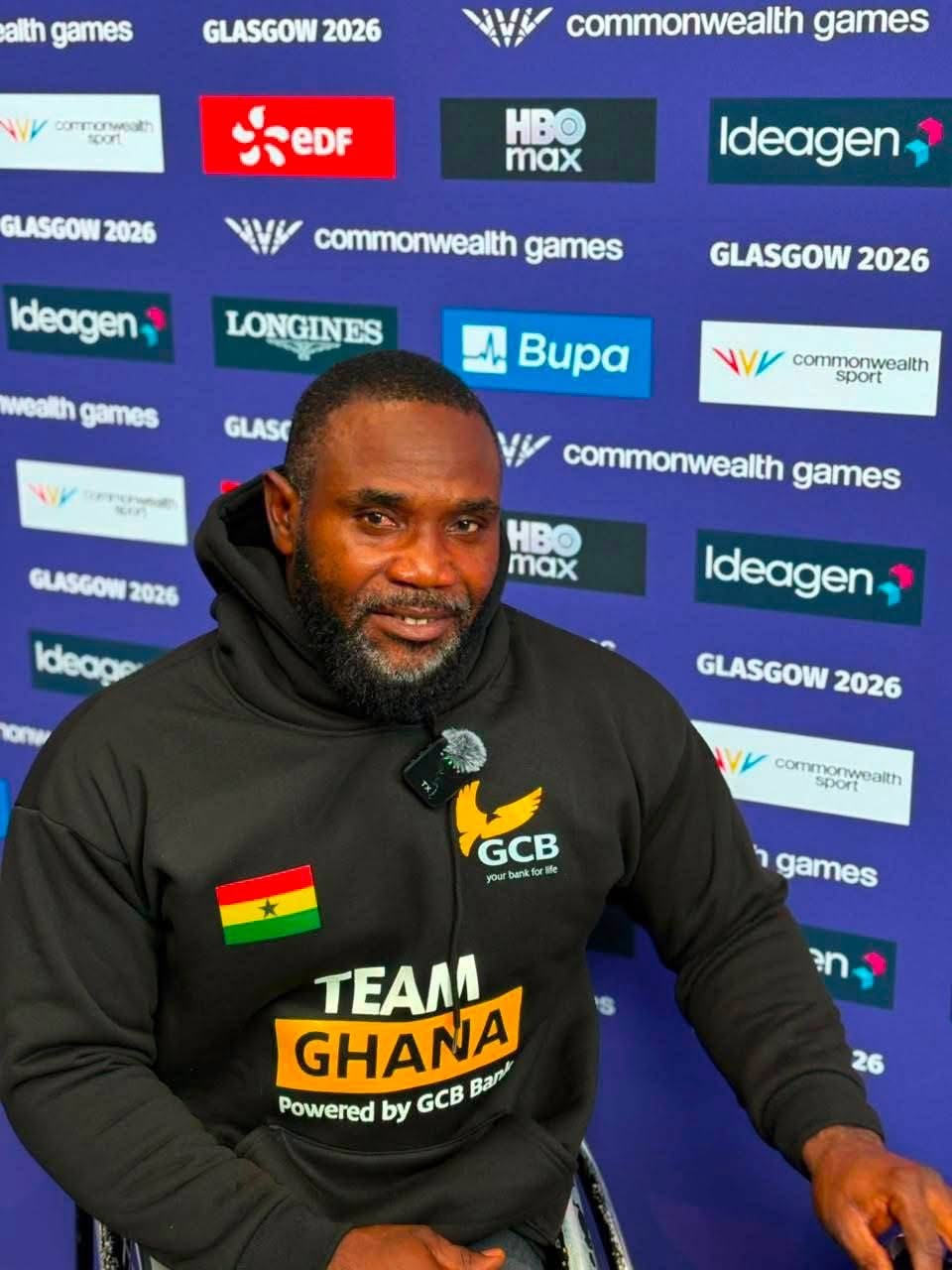
Veteran wheelchair racer Raphael Botsyo Nkegbe has ignited a fierce debate about the future of sports development in Ghana after a characteristically frank intervention at the Glasgow 2026 Commonwealth Games.
The 47-year-old, competing in his final Commonwealth Games, finished eighth in the Men’s 1500m T54 final with a time of 3:48.41 . But it was his words after the race, rather than the result, that have resonated across Ghanaian sport.
“The medals are made by nations that invest. Nations that invest more, win more medals,” Botsyo declared, shifting the focus from individual athletes to the systemic failures that hold them back .
For Botsyo, medals are not won by chance. They are forged through deliberate planning, sustained funding, and long-term athlete development. His message is a challenge to policymakers: if Ghana wants to become a consistent medal-winning nation, investment in athletes must be treated as a national strategy rather than an afterthought.
‘Invest in My Preparation, Not Just My Bonus’
Rather than advocating for larger victory bonuses, Botsyo argued that government resources should be directed towards the foundational elements of elite performance—preparation, equipment, coaching, sports science, and international competition.
“I’d prefer Government invest $9,000 in my preparation and give me $1,000 if I win gold,” he said.
His frustration is grounded in decades of personal experience. A polio survivor from Sunyani, Botsyo has represented Ghana at four Paralympic Games, multiple African Games, and Commonwealth Games since turning professional in 2003 . Yet he has often had to purchase his own specialised racing equipment—a stark contrast to athletes from nations with comprehensive national programmes .
Representing Ghana for more than two decades, Botsyo revealed that he has often had to purchase his own specialised racing equipment while competing against athletes backed by comprehensive national programmes. He believes Ghanaian para-athletes have repeatedly demonstrated that they possess the talent to compete with the world’s best, but talent alone cannot overcome chronic underinvestment.
A National Priority or an Afterthought?
Botsyo was equally clear that responsibility for producing medals cannot rest on one institution. “NPC Ghana cannot carry the burden of a medal-winning mentality alone,” he said.
His remarks point to a broader national challenge: transforming para sport from a largely committee-driven effort into a genuine national priority supported by government, corporate Ghana, and the wider sporting ecosystem.
Yet despite the challenges, Botsyo praised the leadership of the National Paralympic Committee Ghana for consistently standing behind para-athletes despite limited resources. “Every para-athlete in Ghana currently competes for the President of NPC Ghana because he is the one who believes in the para-athletes,” he said.
The Cost of Chronic Underinvestment
Botsyo’s intervention comes as Ghana shows glimpses of para-sporting potential. At Glasgow 2026, Zinabu Issah claimed a superb silver medal in the Women’s Para Shot Put T57 with a throw of 8.65 metres . Seventeen-year-old Hayford Addai became the first Ghanaian T47 sprinter to break the 11-second barrier, clocking 10.99 seconds in the Men’s 100m T47 final .
But Botsyo argues these are isolated achievements against a backdrop of systemic neglect. “We are also Ghanaians and we should be considered in planning and socio-economic development,” he stressed in a 2020 interview after being named SWAG Sports Personality of the Year . He has long called for better equipment and human support for disabled athletes .
A Glimmer of Hope: The Sports Development Fund
There may be cause for cautious optimism. In December 2025, Parliament passed the Ghana Sports Fund Bill, establishing a dedicated, legally backed fund for sports development . The fund is designed to provide a structured financing mechanism to support grassroots development, elite athlete preparation, infrastructure maintenance, and capacity building across federations .
The legislation promises to mobilize billions of Ghana Cedis annually through diverse revenue streams, donations, and government appropriations, with an independent Governing Board overseeing operations .
For Botsyo, the timing could be crucial. He has confirmed that Glasgow 2026 will be his last Commonwealth Games appearance and is now focused on working towards the Los Angeles Olympic Games . Whether the new funding mechanisms will materialise in time to support his final Olympic campaign remains an open question.
A Formula for Success
The veteran’s challenge to policymakers is straightforward: if Ghana wants to become a consistent medal-winning nation, investment in athletes must be treated as a national strategy rather than an afterthought.
For Botsyo, the formula is clear: Investment produces preparation. Preparation produces performance. Performance produces medals.
As Ghana evaluates its performance at Glasgow 2026, Botsyo’s intervention has broadened the conversation beyond race results and medal tables. It has become a debate about priorities, national investment, and whether Ghana is providing its para-athletes with the conditions needed to succeed.
The question he has posed to the nation is simple, but impossible to ignore: Can Ghana realistically expect world-class results without world-class investment?