



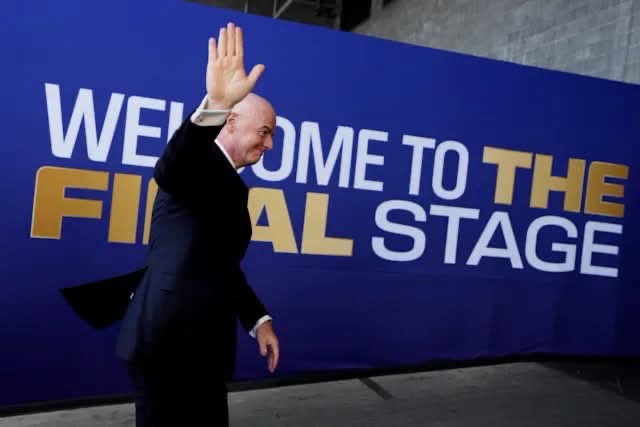
Gianni Infantino’s ambitious project to sell a stake in the World Cup to private investors has collapsed following an unprecedented global backlash, with UEFA threatening a boycott, senior officials resigning in protest, and key backers including JPMorgan and Joshua Kushner’s Thrive Capital pulling out.
The controversial plan, which would have valued a new FIFA commercial subsidiary at $20 billion, is now dead, four sources familiar with the matter told the New York Post. “They are not feeling this. There is no way they want to continue to be involved in this mess,” a source briefed on the collapsed deal said of the investors.
The Proposal
The plan, first revealed by The Times and the Financial Times, would have seen FIFA spin off its commercial businesses—including men’s and women’s World Cups and Club World Cups—into a new for-profit subsidiary called FIFA Forward Enterprise (FFE). Private investors would have been offered a minority, non-controlling stake of up to 20%, raising as much as $4.2 billion.
FIFA said it would “invite third parties to make minority, non-controlling investments” in the new entity. The plan needed approval from a simple majority of FIFA’s 211 member associations—106 votes.
The Investors
The anchor investor was Thrive Capital, the New York-based venture capital firm founded by Joshua Kushner—the younger brother of White House diplomatic adviser Jared Kushner, who is married to Donald Trump’s daughter Ivanka.
FIFA was working with JPMorgan as strategic adviser on the project. The same bank had previously been involved in the failed European Super League project.
The Backlash
The proposal triggered fury across world football. UEFA, governing European football, called an emergency meeting and its 55 member associations voted unanimously to boycott all FIFA competitions—including the World Cup—if the plan proceeded.
“The World Cup cannot be treated as an investment product,” UEFA said in a blistering statement. “It is one of football’s greatest sporting legacies… No part of it should ever be surrendered to private investors. The World Cup is not for sale.”
CONCACAF (41 member associations in North and Central America) rejected the proposal, and the Asian Football Confederation issued a scathing response, stating the plan could not “realistically achieve the necessary broad consensus and unity required to move forward”.
With UEFA (55 votes), CONCACAF (41), and AFC (47) aligned against the plan, at least 136 nations were positioned to vote no—far exceeding the 106 needed to block it.
Internal Chaos
The project also tore FIFA apart from within.
Carlos Cordeiro, a senior adviser to Infantino and a former Goldman Sachs banker who represented FIFA on the White House Task Force for the World Cup, resigned in protest. “I cannot stand by while FIFA considers selling a stake in the World Cup,” Cordeiro said. “It is a bad deal for football… It is mortgaging football’s future without any compelling justification.”
Kevin Lamour, FIFA’s chief operating officer and a long-time colleague of Infantino at both FIFA and UEFA, issued a stunning statement saying staff were “deceived” by Infantino’s lack of openness. “It is the project of one person,” Lamour wrote. “Not only must this project not go ahead, but the time has now come for football political leaders to ask themselves the right questions.” He added: “If that means I lose my job, then so be it. At least I’ll sleep well tonight.”
Political Intervention
UK Prime Minister Andy Burnham became the first leader of a major country to call for Infantino’s resignation. “This was an outrageous suggestion,” Burnham said. “The idea that it could even be brought forward shows that the FIFA president is the wrong man to lead the organisation.”
The U.S. House Judiciary Committee also probed the Trump family links to the deal. President Donald Trump said he had not spoken to Infantino about the plans.
The Deadline That Backfired
Infantino had written to all 211 member associations offering $40 million (£30m) each if they backed the proposal, with a September 19 deadline to access an initial $20m. Critics condemned the offer as a bribe with a deadline.
One insider close to Infantino admitted the plan would have been “the (temporary) end of global football”. Without stars from England, Spain, France, Germany and Italy, a World Cup loses its audience—broadcasters won’t pay top dollar and sponsors will pull their cash.
What’s Next for Infantino?
Infantino has been FIFA president for more than 10 years and had seemed sure to be reelected unopposed next March. That is now in serious doubt. His credibility is “detonated,” his allies have deserted him, and his position is under threat.
Thrive Capital has already begun talks about dropping the idea, sources said. JPMorgan does not expect the deal to proceed and is closing its files.
The World Cup, for now, remains not for sale.


