



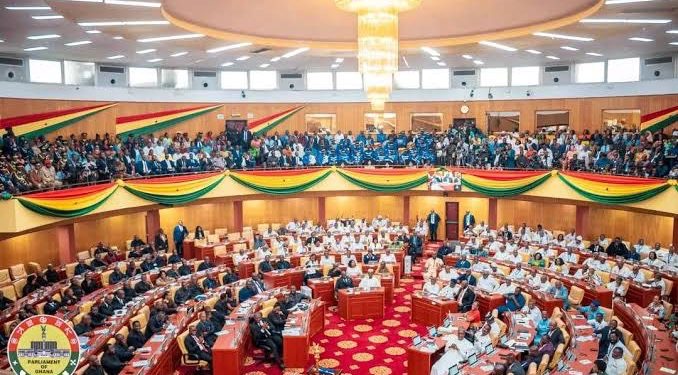
– The government has formally endorsed a constitutional cap on the size of Parliament, setting the maximum number of legislators at 300 – a move that will retain the existing 276 constituency-based seats while introducing a 24-seat proportional representation system designed to dramatically increase the presence of women, young people, and persons with disabilities (PWDs) in the national legislature.
Attorney-General and Minister for Justice, Dr. Dominic Ayine, announced the proposal on Thursday while presenting the government’s White Paper on the Constitutional Review Committee (CRC) recommendations. The reform, if passed, would mark the first major structural change to Ghana’s parliamentary composition since the return to multi-party democracy in 1992.
“The government has accepted that the size of Parliament be capped and we propose a ceiling of 300 members,” Dr. Ayine stated. “The current membership of Parliament is 276 and so these will be elected directly in constituency elections like we already have, and the remaining 24 will be elected or selected through proportional representation among women, persons with disabilities and the youth.”
He added that an independent study would be commissioned to refine the design of the proportional representation element, ensuring that the mechanism is both practical and constitutionally sound.
Why a Cap? Fiscal Prudence and Efficiency
The CRC, chaired by Professor H. Kwasi Prempeh, had recommended capping Parliament at a maximum of 300 seats as part of its broader push to curb the rising cost of governance. Over the past three decades, Ghana’s Parliament has grown from 200 seats in 1992 to 276 today, with each expansion adding significant expenditure on salaries, allowances, office space, and staff. The government has consistently argued that a fixed ceiling will provide fiscal predictability and prevent future presidents or parliamentary majorities from arbitrarily increasing the size of the House for political patronage.
Dr. Ayine emphasised that capping Parliament “saves cost” while the reserve element “opens the doors of our legislature wider to those that our politics have historically kept outside.”
The Proportional Representation Mechanism: A Historic First
The 24 additional seats – approximately 8% of the total – represent a pioneering departure from Ghana’s strict first-past-the-post (FPTP) system. Under the proposal, these seats will be allocated to special interest groups:
· Women: Expected to receive the largest share, given that women currently hold only about 14% of parliamentary seats – one of the lowest ratios in West Africa.
· Youth: Defined as individuals under the age of 35, who are often locked out of electoral contests due to financial barriers and party gatekeeping.
· Persons with Disabilities (PWDs): A group that has historically faced structural barriers to political participation, including inaccessible polling stations, stigma, and lack of party support.
The exact allocation among the three groups will be determined by the independent study, but sources indicate that the government is leaning toward a formula that guarantees at least 10 seats for women, 8 for youth, and 6 for PWDs – though these numbers remain provisional.
How Will the Seats Be Filled?
The CRC recommended a closed-list proportional representation system, where political parties present separate candidate lists for each special interest group, and seats are allocated based on the party’s overall share of the national vote. However, the government has indicated that it may consider an alternative model – such as a separate ballot for special interest seats – to ensure that these representatives are directly accountable to their constituencies.
Dr. Ayine stressed that the independent study will examine best practices from countries like Rwanda, which has achieved over 60% female representation through reserved seats, and Kenya, which uses a mixed system for youth and PWDs. The study will also address potential concerns about whether these additional MPs would be full voting members or have limited rights.
Broader Constitutional Reforms
The parliamentary cap is one of several sweeping amendments in the government’s White Paper. Other endorsed reforms include:
· Capping ministers at 60 (up from the CRC’s 57);
· Moving presidential elections to November;
· Extending the presidential term to five years;
· Lowering the presidential age limit from 40 to 35;
· Separating the Attorney-General’s office from the Ministry of Justice.
All these proposals will require a two-thirds majority in Parliament and a subsequent national referendum to become law.
Reactions: Praise and Caution
Civil society organisations have largely welcomed the proportional representation component. The Ghana Women’s Manifesto Coalition described it as “a game-changer for gender equality in politics,” noting that reserved seats have proven effective in boosting women’s legislative participation across Africa.
However, some political analysts have raised concerns about the cap itself. Professor Ransford Gyampo, a political scientist at the University of Ghana, warned that limiting Parliament to 300 could stifle representation for newly created constituencies, especially as Ghana’s population continues to grow.
“The 276 constituency seats are already fixed by the Electoral Commission based on population data. If we cap total membership at 300, we risk either freezing constituency boundaries permanently or reducing the number of seats available for new districts,” he said. “The government must clarify how it will handle demographic shifts over time.”
The opposition New Patriotic Party (NPP) has offered a guarded response, with its parliamentary spokesman stating that the party supports the principle of inclusivity but will scrutinise the proportional representation design to ensure it does not “dilute the mandate of constituency-elected MPs.”
International Context
Ghana’s move echoes a growing trend across Africa. South Africa, Kenya, and Tanzania have all experimented with reserved seats or proportional systems to boost minority representation. Rwanda’s reserved-seat model is often cited as the gold standard, with women holding over 60% of lower house seats. However, Ghana’s hybrid system – retaining a majority of constituency seats while adding a proportional tier – is unique and could serve as a template for other Commonwealth nations grappling with similar representation gaps.
Next Steps
The government will now draft a constitutional amendment bill for the parliamentary cap, which must first be approved by a two-thirds majority in Parliament. If passed, the bill will go to a national referendum, where a simple majority of voters must endorse it to become law.
The Electoral Commission has already indicated that it is prepared to work with the independent study team to design the proportional representation mechanism, with a target implementation date of the 2028 general election.
As Dr. Ayine concluded, “This is about building a Parliament that looks like Ghana – one that truly reflects the diversity of our people, not just the winners of constituency contests. We believe this reform will strengthen democracy, not weaken it.”


