



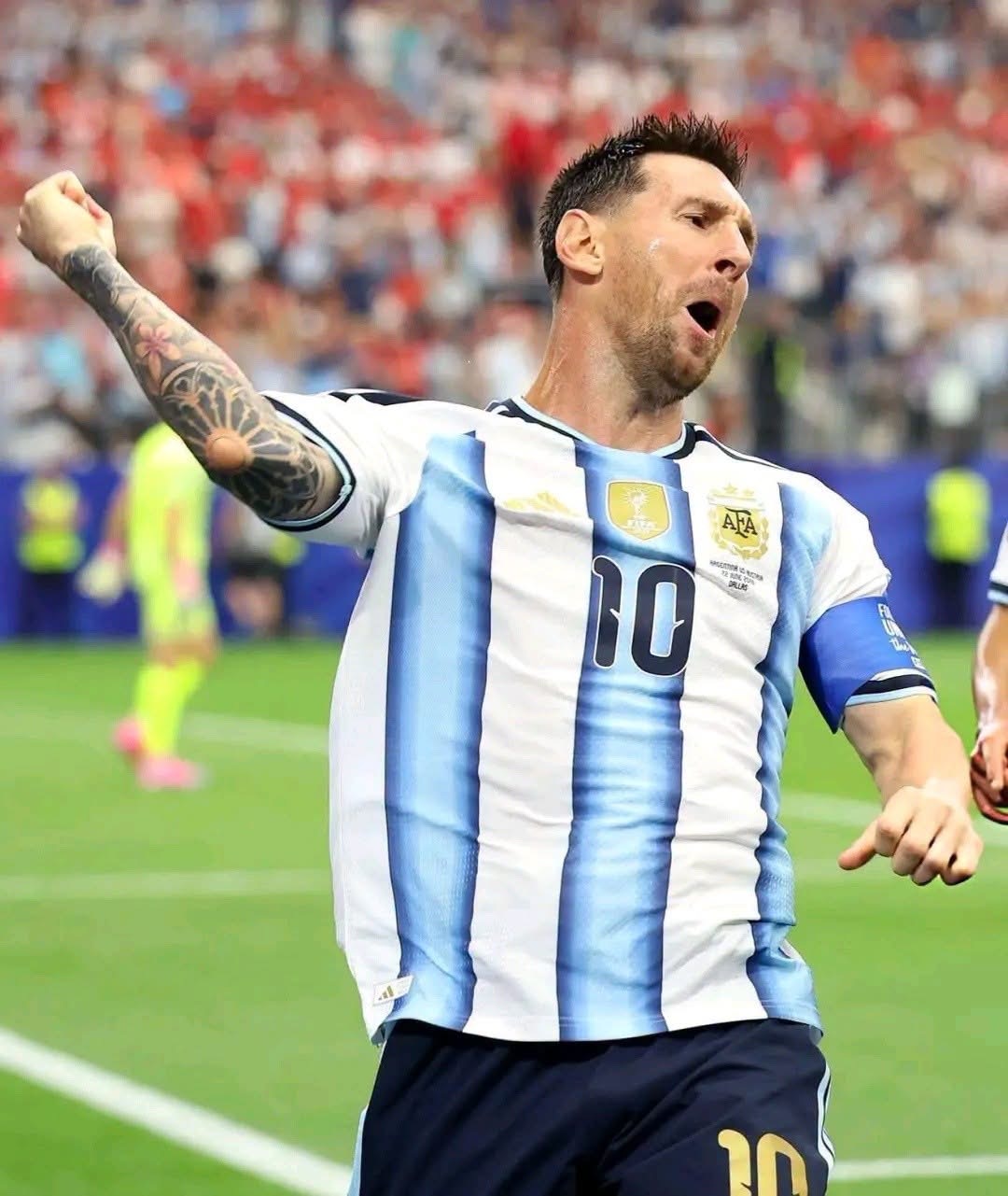
Lionel Messi has cemented his status as the greatest to ever grace a football pitch by becoming the outright leading goalscorer in World Cup history. The Inter Miami star overtook German legend Miroslav Klose during Argentina’s high-stakes Group J encounter with Austria on Monday, netting his 17th career goal at the finals to move past the previous record of 16 held by the German striker.
The historic moment came in the 39th minute at the AT&T Stadium in Arlington, Texas, when Messi swept home a low cross from Facundo Medina to give Argentina a 1-0 lead. It could have arrived much earlier, but the eight-time Ballon d’Or winner sent an early ninth-minute penalty wide of the post. That miss gave him an unwanted statistical double — he has now both taken and missed the most penalties in World Cup history, with seven and three respectively. However, he found redemption 29 minutes later, taking advantage of a clever dummy from Thiago Almada to break the deadlock just before the half-time break.
At 38 years and 363 days old, Messi’s longevity and consistency have allowed him to rewrite the history books once more. His 17 goals have come across six World Cups — 2006 (one), 2014 (four), 2018 (one), 2022 (seven) and 2026 (four to date), with a goalless campaign in 2010. Thirteen of his 17 goals have been struck with his wand of a left foot, and four have come from outside the box. The goal against Austria also made him just the third player in World Cup history to score in six consecutive games, after France’s Just Fontaine in 1958 and Brazil’s Jairzinho in 1970.
The record-breaking goal adds to a collection of accolades that already includes a World Cup trophy from 2022, multiple Copa America titles, and two World Cup Golden Balls — making him the only two-time winner of the tournament’s best player award. Klose’s tally of 16 goals, set across four consecutive podium-finishing World Cup campaigns between 2002 and 2014, was once thought to be untouchable. The German striker’s 16 goals came from just 63 shots — a phenomenal conversion rate of 25.4 per cent.
The All-Time Top Scorers’ List
Messi now stands alone at the summit, but the list of legends beneath him reads like a who’s who of footballing royalty.
16 goals — Miroslav Klose (Germany): The former Germany striker held the record outright from 2014 until Messi’s hat-trick against Algeria drew him level. Klose scored five goals in both 2002 and 2006, four in 2010, and two in 2014 — including the historic strike against Brazil in the semi-final that broke Ronaldo’s previous record.
15 goals — Ronaldo (Brazil): The Brazilian “Phenomenon” scored his 15 goals across four World Cups — four in 1998, eight in 2002, and three in 2006. His 15th and final World Cup goal came in Brazil’s 3-0 second-round victory over Ghana on June 27, 2006. He remains the highest-scoring South American in World Cup history.
14 goals — Kylian Mbappé (France) and Gerd Müller (West Germany): The French superstar, at just 27 years old, has already equalled the total of the legendary “Der Bomber”. Mbappé’s brace against Senegal in France’s tournament-opening win took him to 14 goals across three World Cups — 2018 (four), 2022 (eight) and 2026 (two to date). Müller, by contrast, scored all 14 of his goals in just two tournaments — an astonishing 10 at the 1970 World Cup and four in 1974. His record stood for 32 years before being surpassed.
13 goals — Just Fontaine (France): The late French striker’s feat remains one of the most remarkable in football history — all 13 goals came in a single tournament, the 1958 World Cup in Sweden. He scored in all six matches, including four in the third-place play-off against West Germany. No other player in that tournament scored more than six.
12 goals — Pelé (Brazil): The King of Football scored his 12 goals in 14 World Cup appearances across four tournaments — six in 1958, one in 1962, one in 1966, and four in 1970. At 17 years old, he remains the youngest player ever to score in a World Cup final.
As Argentina look to become the first team since Brazil in 1962 to win back-to-back World Cup crowns, there may yet be more goals to come from the immortal number 10. But for now, Lionel Messi stands alone at the very top — king of the World Cup.


