



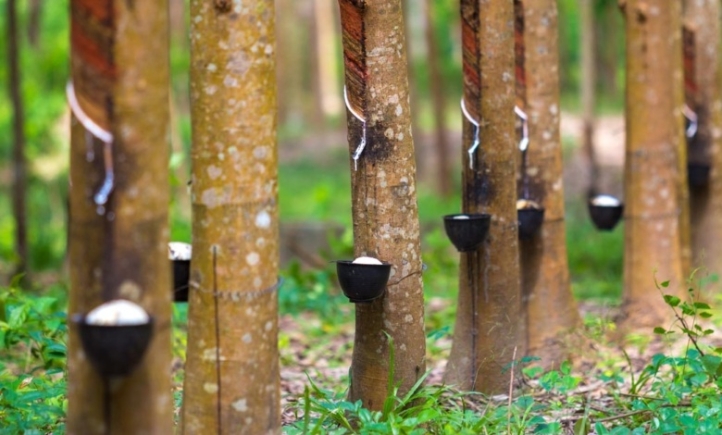
Investigations by the Daily Graphic have uncovered widespread under-invoicing in Ghana’s raw rubber export sector, with more than $70 million in exports undeclared over a two-year period.
The probe reveals a compromised system where export volumes have consistently exceeded official permits, threatening the country’s local processing infrastructure and facilitating what appears to be systematic resource repatriation from the economy.
$70 million in undeclared exports
Data obtained from the Ghana Revenue Authority (GRA) shows that Ghana exported 89.68 million tonnes of raw rubber in 2024 alone. Yet the industry’s supervising body, the Tree Crops Development Authority (TCDA), did not issue a single permit for raw rubber export that year.
In 2025, TCDA issued permits for 13,000 tonnes of raw rubber exports. However, official data covering the entire year — except October and November — shows 39,000 tonnes were exported, representing an excess of 26,000 tonnes, nearly 200 per cent more than permitted volumes.
The scale of under-invoicing has been stark. TCDA set the average minimum price of raw rubber for 2024 and 2025 at GH¢8.62 and GH¢9.08 per kilogramme respectively. Yet exporters declared average Free on Board (FOB) prices of just GH¢0.99 and GH¢1.91 per kilogramme.
This means every kilogramme of exported raw rubber was under-invoiced by an average of GH¢7.63 in 2024 and GH¢7.17 in 2025.
Cumulatively, raw rubber exports were under-invoiced by more than $49.6 million in 2024 alone, and by more than $21 million in 2025. Exporters declared just about 12 per cent of the actual value and volume of raw rubber exports in 2024, and about 22 per cent in 2025.
Forex violations
The under-invoicing has significant implications for foreign exchange repatriation. Section 15 of the Foreign Exchange Act, 2006 (Act 723) requires exporters to repatriate full export proceeds through licensed banks.
By under-invoicing exports, exporters may keep the difference in value offshore, outside Ghana’s economy.
In 2024, complicit exporters repatriated just $6.17 million into the Ghanaian economy out of an actual export value of $55.83 million. In 2025, they shipped out $26.03 million worth of raw rubber but brought back just $4.48 million.
Two companies dominate trade
Customs records indicate two agencies dominated raw rubber exports in 2024 and 2025.
One company exported raw rubber worth $44.96 million in 2024, representing about 91 per cent of raw rubber exports that year. The second company exported $21.23 million worth last year, representing 98 per cent of total raw rubber exports for that period.
In July 2025, the two major exporters stated their FOB prices at $0.069 — equivalent to GH¢0.72 per kilogramme — against TCDA’s minimum price of GH¢9.8.
Local processors starved of raw materials
The situation has left local processing factories struggling to survive. Ghana’s rubber processing factories have a combined capacity of 171,460 tonnes per year, yet industry data shows the country produced only around 110,800 tonnes of raw rubber in 2025.
With approximately 39,000 tonnes exported in 2025, domestic processors were left with only about 60,000 tonnes — a deficit of more than 60,000 tonnes representing about 35 per cent of raw rubber produced locally.
All local rubber processing firms are now producing at less than 40 per cent capacity, with jobs cut by more than 35 per cent. Since 2024, one processing factory, Apex, has not processed a single ounce of raw rubber. Data suggests five of the other six processing factories have scaled down due to raw material shortages.
A rubber cultivator in the Nzema East District, George Eshun, confirmed that raw rubber is sold locally for GH¢8.30 currently. He admitted selling to whoever is willing to buy, noting the market is not restricted to local processors.
Industry frustrations
Correspondence obtained by the Daily Graphic reveals growing frustration from the Association of Natural Rubber Actors of Ghana (ANRAG) over continued raw rubber exports.
In a letter dated July 2, 2025, association President Emmanuel Owusu raised concern over “the continued transportation and apparent export of raw rubber within the Tema Port enclave”.
TCDA responded in a letter dated October 20, 2025, stating: “We do not possess the legal authority to unilaterally ban or suspend the business operations of licensed entities, including the exporters of unprocessed rubber.”
The letter, signed by Chief Executive Officer Dr Andrews Osei Okrah, instead insisted TCDA “has introduced and enforced stricter regulatory controls in the rubber industry, which are already yielding measurable benefits”, adding that “since the introduction of TCDA’s licensing and export permit regime, both the number of exporters and the volume of raw rubber exports have declined significantly”.
Government intervention
In January this year, the Minister of Trade, Agribusiness and Industry, Elizabeth Ofosu-Adjare, announced during the Government Accountability Series that Cabinet had approved restrictions on the export of raw natural rubber to protect domestic industries.
The Minister of Finance, Dr Cassiel Ato Forson, had earlier announced the action during the presentation of the 2026 Budget Statement to Parliament in November last year.
“The truth is that the picture I see is not too pleasant for the industry,” a stakeholder told the Daily Graphic.
Industry observers warn that the situation exposes local processing companies to the risk of collapse, with broader implications for job security, youth employment, investment value in rubber processing infrastructure, and state revenue from taxes.

