



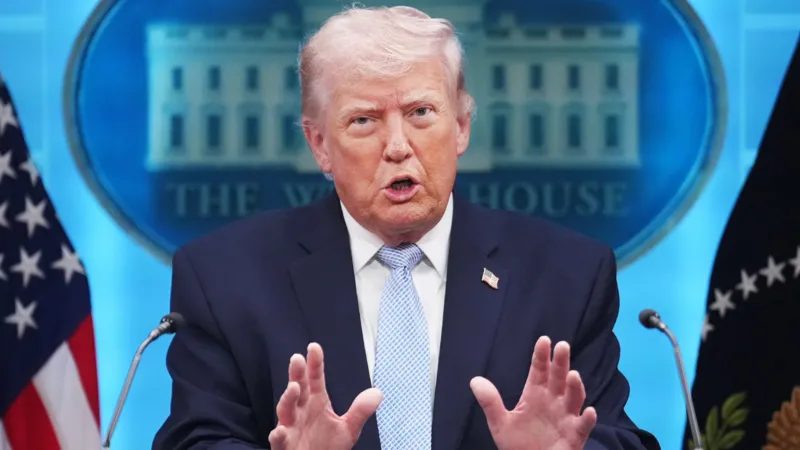
President Donald Trump announced a two-week ceasefire with Iran late Tuesday, pulling back from the brink of large-scale military strikes just 90 minutes before his self-imposed deadline.
The provisional agreement halts hostilities and requires Iran to fully open the Strait of Hormuz to commercial shipping, a key waterway through which roughly 20% of the world’s oil passes. In return, the United States will suspend planned strikes on Iranian energy and transportation infrastructure while both sides enter negotiations.
“We are very far along with a definitive peace agreement,” Trump wrote on his Truth Social platform at 6:32 p.m. Washington time.
The announcement came hours after Trump warned that if no deal was reached by 8 p.m. EDT, “a whole civilisation will die tonight — never to be brought back again.”
Iranian Foreign Minister Seyed Abbas Araghchi said Tehran would halt its “defensive operations” and allow safe passage through the Strait of Hormuz “via coordination with Iran’s armed forces.” He added that the US had accepted the “general framework” of an Iranian 10-point plan — though it remains unclear whether Trump agrees to terms that include withdrawal of US forces from the region and lifting economic sanctions.
Bipartisan criticism of Trump’s rhetoric
Trump’s threats drew sharp condemnation from both Democrats and some Republican allies.
“It is clear that the president has continued to decline and is not fit to lead,” said Democratic Congressman Joaquin Castro, calling for Trump’s removal.
Republican Congressman Austin Scott of Georgia, a senior member of the House Armed Services Committee, told the BBC the president’s comments were “counter-productive” and that he did not agree with them.
Senator Ron Johnson, a frequent Trump loyalist, said following through with the bombing campaign would be a “huge mistake.” Congressman Nathaniel Moran of Texas wrote on social media that he did not support “the destruction of a ‘whole civilisation’.”
“This is not who we are,” Moran said, “and it is not consistent with the principles that have long guided America.”
Senator Lisa Murkowski of Alaska said the threat “cannot be excused away as an attempt to gain leverage in negotiations.”
Economic impact and next steps
Following the ceasefire announcement, oil prices dropped below $100 per barrel for the first time in days, and US stock futures soared.
The two-week window will allow US and Iranian negotiators to pursue a permanent settlement. However, significant obstacles remain. Iran’s enriched uranium stockpile — the foundation of its nuclear weapons programme — has not been addressed, and Tehran continues to exert influence over regional proxy groups such as the Houthi rebels in Yemen.
Trump claimed the US had “met and exceeded” all its military objectives, noting that Iran’s military has been significantly degraded and many of its top leaders killed in recent strikes.
But analysts say the long-term cost of the president’s rhetoric and the broader conflict has yet to be fully assessed. For now, the ceasefire offers Trump a political off-ramp from a potentially damaging escalation — though only a temporary one.

