



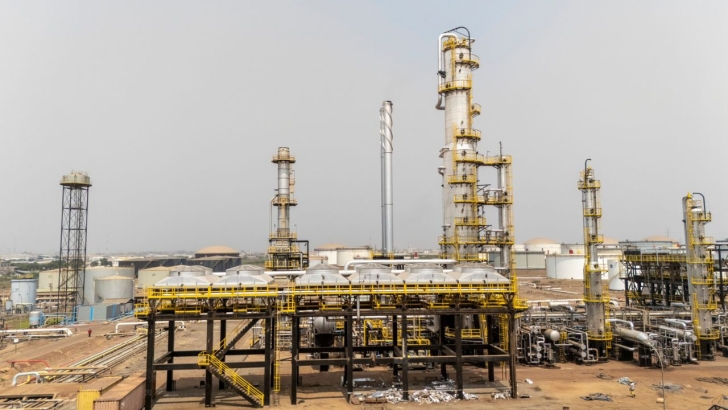
The Tema Oil Refinery (TOR) has reaffirmed its technical capacity to refine crude oil produced from Ghana’s domestic oil fields, pushing back against suggestions that the facility cannot process locally sourced crude.
Godwin Mahama Ayaba, Corporate Affairs Officer in charge of External Affairs at TOR, told the Daily Graphic on Wednesday that the refinery possesses both the necessary equipment and technical expertise to process Ghana’s crude, particularly from the Jubilee and TEN fields.
Ayaba pointed to historical evidence, citing a 2016 arrangement where the government, through the Ministry of Energy, facilitated the supply of approximately one million barrels of crude oil from the TEN Field to the refinery for processing.
“That arrangement is a testament to the fact that TOR has the capacity to refine our local crude,” Ayaba stated.
He further revealed that discussions are currently at an advanced stage between the government, the Ministry of Energy and Green Transition, and the refinery regarding the possibility of supplying additional crude from Ghana’s fields for processing.
Ayaba explained that crude produced from Ghana’s fields is classified as light and sweet crude, which aligns precisely with the type of crude oil the refinery’s facilities were designed to process. Technical assessments conducted by refinery engineers have confirmed that TOR can refine Ghana’s crude even with its current operational equipment.
Currently operating at approximately 28,000 barrels per stream day, TOR is implementing measures to significantly increase output. Plans are underway to connect the F-61 furnace to the Crude Distillation Unit (CDU), complementing the already operational F-1 furnace. This expansion is expected to boost refining capacity from 28,000 to 45,000 barrels per stream day by the end of next month.
“In the medium term, we will further optimise operations to increase capacity from 45,000 to 60,000 barrels per stream day,” Ayaba added.
The refinery is also pursuing a long-term expansion strategy involving the installation of a new refinery unit with a capacity of 100,000 barrels per day. Once completed, this addition would increase the refinery’s total capacity to approximately 160,000 barrels per stream day.
Ayaba indicated that President John Dramani Mahama is expected to lead the official recommissioning of the facility as part of efforts to restore TOR to full operational capacity.
“TOR is back on track, and we will continue to work to expand our capacity and support Ghana’s energy security,” he stated.
Analyst Clarifies Economic Considerations
Meanwhile, energy analyst and Technical Advisor at the Ministry of Energy and Green Transition, Dr. Yussif Sulemana, has issued a clarification regarding recent media comments that he says were misrepresented in some online reports.
Dr. Sulemana explained that his remarks during a March 9 interview with Citi FM focused on the economic considerations guiding decisions on crude oil sourcing for TOR. While confirming that the refinery has the infrastructural capacity to refine locally produced crude, he emphasised that the choice of crude supply should ultimately be determined by price competitiveness and overall economic benefit to the country.
“The decision concerning the source of crude oil for refining is primarily guided by considerations of price competitiveness and overall profitability to the nation,” Dr. Sulemana stated.
He noted that if exporting locally produced crude proves more profitable for Ghana, it could be economically reasonable for the country to import crude to supply the refinery. He stressed that his comments were made strictly within the context of ensuring economic efficiency and safeguarding the national interest in TOR’s operations.

