



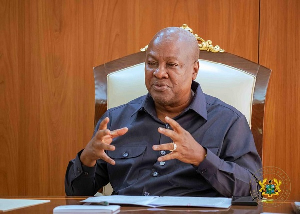
President John DramPresident Mahama declares smuggling and counterfeiting economic sabotage, vows crackdown on illicit tradePresident John Dramani Mahama has declared that smuggling, counterfeiting, and the rebagging of inferior products constitute economic sabotage, warning that his administration will treat such practices as serious economic crimes as part of a broader crackdown on illicit trade.Speaking at the maiden Presidential Dialogue with the private sector in Accra, the President outlined sweeping measures to protect Ghana’s manufacturing sector and safeguard national revenue, announcing intensified border enforcement operations and the prosecution of complicit public officials .Recent seizures underscore crackdown urgencyThe President’s强硬 stance follows a major enforcement operation by the Customs Division of the Ghana Revenue Authority (GRA), which intercepted 18 articulated trucks declared as transit goods destined for Niger. The trucks were moving without the mandatory Customs human escort, a serious violation of transit regulations .Post-clearance inspections uncovered material discrepancies in declared unit values, tariff classifications, and weights of the goods. What was initially assessed as GHC2.6 million in suspended duties and taxes has been revised to more than GHC85 million in potential revenue exposure .Twelve of the trucks have been impounded and are currently secured at the Tema Transit Yard under strict Customs supervision. Six trucks from the original convoy remain unaccounted for, with investigations ongoing to track them down .Deputy Minister for Finance, Thomas Nyarko Ampem, revealed that President Mahama was “very upset” after receiving a briefing on the matter. “When we returned from the border, the President was waiting for us for feedback. He was so upset, and there is no way anybody involved in this is going to be treated with kid gloves,” Mr Ampem stated on the Citi Breakfast Show .Economic crimes designationPresident Mahama emphasised that smuggling, under-declaration, counterfeit goods, and the rebagging of inferior products are not minor regulatory infractions but deliberate acts that undermine Ghana’s economic foundation .”To stem this tide and protect our fledgling manufacturing sector, we will intensify coordinated border enforcement, treat trade infractions as economic crimes, dismiss and prosecute public officers found culpable, deploy technology-driven customs surveillance solutions, and rigorously enforce product standards,” the President declared .He stressed that when companies evade duties through under-declaration or flood the market with substandard products, compliant businesses suffer losses while government revenue declines, ultimately destroying jobs and distorting the domestic market .Sector-specific interventionsPresident Mahama outlined targeted measures across multiple industries to combat illicit trade and support local production:Textiles and garments: Enforcement against counterfeit fabrics, tax exemptions on machinery and inputs, and mandatory local procurement compliance .Cement industry: Enforcement of LI 2491, promotion of local clinker and other component production, resolution of port constraints, and a crackdown on the rebagging of inferior cement .Iron and steel: Border enforcement against smuggled steel, VAT compliance in scrap supply chains, tax exemptions on plants and machinery, and a ban on ferrous and non-ferrous scrap material exports .Pharmaceuticals: Incentives for local Active Pharmaceutical Ingredient (API) production, stronger border enforcement against smuggled drugs, and support for WHO Good Manufacturing Practices compliance .Food and beverages: Stronger port enforcement, cold chain investments, and local raw material substitution requirements .Technology-driven enforcementThe President announced that his administration will deploy technology-driven customs surveillance solutions to track imports and reduce revenue leakages. This includes enhanced monitoring of transit operations and stricter compliance enforcement .In response to the recent transit diversion incident, the Finance Minister has directed the GRA to implement immediate measures, including prohibiting land transit of cooking oil—such consignments must now be routed exclusively through Ghana’s seaports—and subjecting all transactions from land collection points to enhanced monitoring and tracking .Accountability for public officialsA key pillar of the President’s announcement is the commitment to hold public officials accountable. He warned that any customs officers, National Security operatives, or clearing agents found complicit in facilitating illegal trade practices would face dismissal and prosecution .”We want to send a very strong signal that our customs officers have the responsibility to ensure revenue and protect our borders. So, they should not be complicit in this,” Mr Ampem emphasised, while acknowledging that some customs personnel played key roles in exposing the irregularities and would be rewarded for good behaviour .The Commissioner-General of the GRA, Anthony Kwasi Sarpong, has been directed to conclude investigations within one week, with disciplinary action to be initiated against any officers found culpable. Criminal investigations will also extend to importers and clearing agents where evidence supports prosecution .Parallel investigationsIn a related development, the Office of the Special Prosecutor (OSP) has launched investigations into an alleged diversion of 50 containers of palm oil valued at GHC25.8 million, originally declared as goods in transit to Burkina Faso but suspected to have been diverted into the Ghanaian market without payment of required duties .Special Prosecutor Kissi Agyebeng is leading the probe into what officials describe as a suspected corruption scheme, with preliminary findings indicating possible involvement of some Customs officers, National Security operatives, and clearing agents. The OSP estimates the state may have lost approximately GHC10.5 million in tax revenue from that scheme .Protecting Ghana’s industrial futurePresident Mahama emphasised that Ghana’s ambition to build a competitive industrial base cannot succeed if local industries remain vulnerable to unfair trade practices. He assured the private sector that the government is determined to create a level playing field where law-abiding businesses can thrive, invest, and expand production .”We cannot ask our manufacturers to scale up while we allow the market to be undermined by illegality,” he indicated, adding that protecting local industries is central to Ghana’s broader industrial transformation agenda .The President also linked the crackdown on illicit trade to broader industrialisation efforts, noting that industrialisation requires secure land tenure and protection of agricultural resources. He announced plans to accelerate litigation-free industrial land banks, reform land tenure to support commercial contract farming, strengthen action against illegal mining, expand irrigation systems, and invest in storage and cold chain infrastructure .The impounded goods from the recent seizures will be auctioned in accordance with applicable laws, with proceeds going to the state .
Speaking at the maiden Presidential Dialogue with the private sector in Accra, the President outlined sweeping measures to protect Ghana’s manufacturing sector and safeguard national revenue, announcing intensified border enforcement operations and the prosecution of complicit public officials .
Recent seizures underscore crackdown urgency
The President’s强硬 stance follows a major enforcement operation by the Customs Division of the Ghana Revenue Authority (GRA), which intercepted 18 articulated trucks declared as transit goods destined for Niger. The trucks were moving without the mandatory Customs human escort, a serious violation of transit regulations .
Post-clearance inspections uncovered material discrepancies in declared unit values, tariff classifications, and weights of the goods. What was initially assessed as GHC2.6 million in suspended duties and taxes has been revised to more than GHC85 million in potential revenue exposure .
Twelve of the trucks have been impounded and are currently secured at the Tema Transit Yard under strict Customs supervision. Six trucks from the original convoy remain unaccounted for, with investigations ongoing to track them down .
Deputy Minister for Finance, Thomas Nyarko Ampem, revealed that President Mahama was “very upset” after receiving a briefing on the matter. “When we returned from the border, the President was waiting for us for feedback. He was so upset, and there is no way anybody involved in this is going to be treated with kid gloves,” Mr Ampem stated on the Citi Breakfast Show .
Economic crimes designation
President Mahama emphasised that smuggling, under-declaration, counterfeit goods, and the rebagging of inferior products are not minor regulatory infractions but deliberate acts that undermine Ghana’s economic foundation .
“To stem this tide and protect our fledgling manufacturing sector, we will intensify coordinated border enforcement, treat trade infractions as economic crimes, dismiss and prosecute public officers found culpable, deploy technology-driven customs surveillance solutions, and rigorously enforce product standards,” the President declared .
He stressed that when companies evade duties through under-declaration or flood the market with substandard products, compliant businesses suffer losses while government revenue declines, ultimately destroying jobs and distorting the domestic market .
Sector-specific interventions
President Mahama outlined targeted measures across multiple industries to combat illicit trade and support local production:
Textiles and garments: Enforcement against counterfeit fabrics, tax exemptions on machinery and inputs, and mandatory local procurement compliance .
Cement industry: Enforcement of LI 2491, promotion of local clinker and other component production, resolution of port constraints, and a crackdown on the rebagging of inferior cement .
Iron and steel: Border enforcement against smuggled steel, VAT compliance in scrap supply chains, tax exemptions on plants and machinery, and a ban on ferrous and non-ferrous scrap material exports .
Pharmaceuticals: Incentives for local Active Pharmaceutical Ingredient (API) production, stronger border enforcement against smuggled drugs, and support for WHO Good Manufacturing Practices compliance .
Food and beverages: Stronger port enforcement, cold chain investments, and local raw material substitution requirements .
Technology-driven enforcement
The President announced that his administration will deploy technology-driven customs surveillance solutions to track imports and reduce revenue leakages. This includes enhanced monitoring of transit operations and stricter compliance enforcement .
In response to the recent transit diversion incident, the Finance Minister has directed the GRA to implement immediate measures, including prohibiting land transit of cooking oil—such consignments must now be routed exclusively through Ghana’s seaports—and subjecting all transactions from land collection points to enhanced monitoring and tracking .
Accountability for public officials
A key pillar of the President’s announcement is the commitment to hold public officials accountable. He warned that any customs officers, National Security operatives, or clearing agents found complicit in facilitating illegal trade practices would face dismissal and prosecution .
“We want to send a very strong signal that our customs officers have the responsibility to ensure revenue and protect our borders. So, they should not be complicit in this,” Mr Ampem emphasised, while acknowledging that some customs personnel played key roles in exposing the irregularities and would be rewarded for good behaviour .
The Commissioner-General of the GRA, Anthony Kwasi Sarpong, has been directed to conclude investigations within one week, with disciplinary action to be initiated against any officers found culpable. Criminal investigations will also extend to importers and clearing agents where evidence supports prosecution .
Parallel investigations
In a related development, the Office of the Special Prosecutor (OSP) has launched investigations into an alleged diversion of 50 containers of palm oil valued at GHC25.8 million, originally declared as goods in transit to Burkina Faso but suspected to have been diverted into the Ghanaian market without payment of required duties .
Special Prosecutor Kissi Agyebeng is leading the probe into what officials describe as a suspected corruption scheme, with preliminary findings indicating possible involvement of some Customs officers, National Security operatives, and clearing agents. The OSP estimates the state may have lost approximately GHC10.5 million in tax revenue from that scheme .
Protecting Ghana’s industrial future
President Mahama emphasised that Ghana’s ambition to build a competitive industrial base cannot succeed if local industries remain vulnerable to unfair trade practices. He assured the private sector that the government is determined to create a level playing field where law-abiding businesses can thrive, invest, and expand production .
“We cannot ask our manufacturers to scale up while we allow the market to be undermined by illegality,” he indicated, adding that protecting local industries is central to Ghana’s broader industrial transformation agenda .
The President also linked the crackdown on illicit trade to broader industrialisation efforts, noting that industrialisation requires secure land tenure and protection of agricultural resources. He announced plans to accelerate litigation-free industrial land banks, reform land tenure to support commercial contract farming, strengthen action against illegal mining, expand irrigation systems, and invest in storage and cold chain infrastructure .
The impounded goods from the recent seizures will be auctioned in accordance with applicable laws, with proceeds going to the state .

