



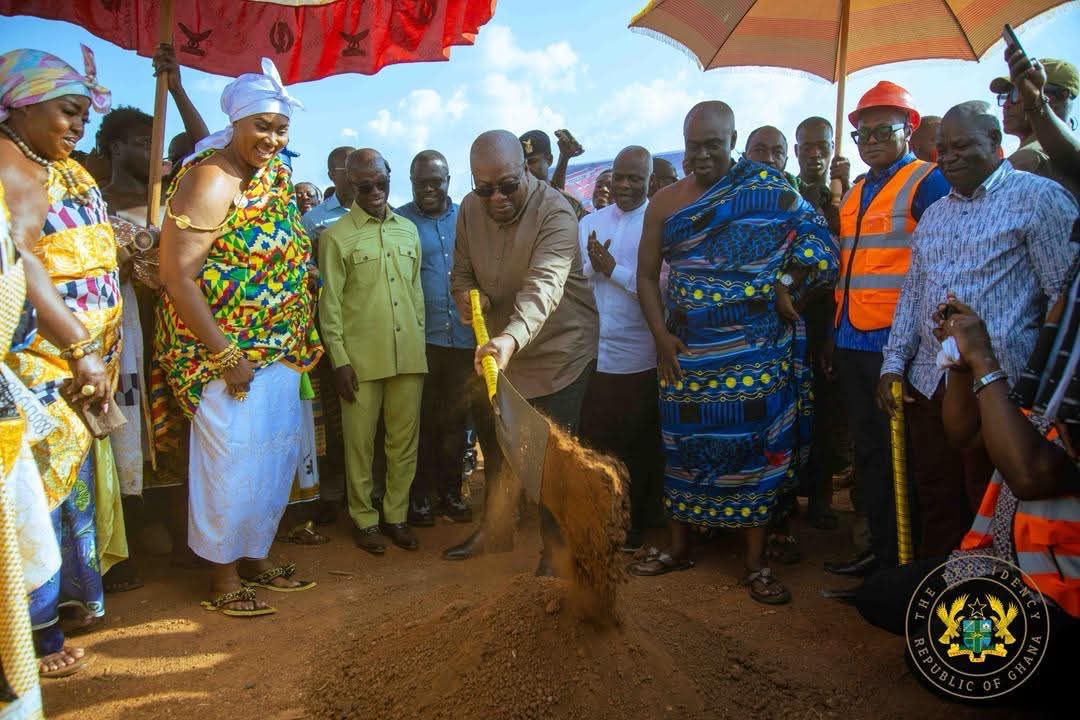
President John Dramani Mahama has cut the sod for the construction of a 24-hour economy model market at Dormaa Ahenkro in the Bono Region, officially launching the first phase of a nationwide initiative that will see all 261 districts benefit from similar modern trading hubs.
The ceremony, held on Wednesday as part of the President’s “Resetting Ghana” nationwide Accountability Series, marks a significant milestone in the implementation of his administration’s flagship 24-hour economy policy .
Addressing chiefs, traders, and community members, President Mahama described the groundbreaking as more than a construction milestone. “Today’s groundbreaking ceremony is not just about infrastructure, but about opportunity. Markets remain the backbone of our local economies. They support livelihoods, encourage trade, and serve as centres of community life,” he stated .
Comprehensive Facilities to Support Round-the-Clock Trading
The Dormaa Ahenkro market is designed as a one-stop economic hub featuring an extensive range of amenities to support continuous commercial activity. Facilities will include a police station, fire service post, clinic, model school, restaurants, administrative offices, and banking facilities—including a dedicated women’s development bank .
Additional infrastructure comprises cold storage units, childcare centres, a transport terminal, and designated trading spaces for clothing, electrical goods, and foodstuffs . The integrated design ensures traders have access to essential services and security arrangements that facilitate operations beyond traditional daylight hours.
President Mahama assured traders who will be displaced during construction that they would receive first priority in the allocation of shops upon the project’s completion .
National Rollout Across All Districts
The Dormaa facility represents the first of 261 modern markets the government is rolling out across all Metropolitan, Municipal, and District Assemblies (MMDAs) nationwide .
“The purpose of this exercise is simple: to account to the people of Ghana and to ensure that development reaches every region. Across the country, we are rolling out 261 modern markets in districts to expand economic activity beyond traditional hours and create more opportunities for traders and young people,” President Mahama said .
Construction has already commenced in other regions, with the Upper West Region currently undertaking works across all 11 municipalities and districts as part of the initial phase. District-level markets there are expected to cover between two and three acres, while municipal markets will span three to four acres, depending on population size and commercial activity levels .
Policy Framework and Economic Impact
The Minister for Local Government, Chieftaincy and Religious Affairs, Hon. Ahmed Ibrahim, has previously explained that the 24-hour market model is designed to ease overcrowding and trading pressure during daytime hours by extending operations into the night. The markets will operate 24 hours a day, seven days a week, allowing traders to expand operations, access new customer segments, and improve their incomes .
The initiative aligns with the Local Economic Development (LED) Policy (2024–2029), which emphasises modern economic infrastructure to support Micro, Small, and Medium Enterprises (MSMEs)—businesses that account for over 85 per cent of Ghana’s commercial sector .
Four prototype designs have already been completed, incorporating global best practices and amenities such as digital payment infrastructure, proper sanitation systems, and reliable lighting to ensure safety and convenience for both traders and customers .
Job Creation and Economic Transformation
Beyond providing trading spaces, the markets are expected to generate significant employment opportunities. The round-the-clock operational model will require additional health workers, police officers, fire service personnel, transport operators, and auxiliary service providers alongside the traders themselves .
President Mahama noted that women are expected to dominate market stalls, in line with existing trading patterns, while the youth will benefit from new opportunities in commerce, logistics, and service provision .
The 24-hour economy policy, officially launched in July 2025, is estimated to cost US$4 billion with government committing between US$300 million and US$400 million as seed capital. The programme is envisaged to create 1.7 million jobs over four years .
Economic Progress and Regional Development
Speaking at the ceremony, President Mahama highlighted broader economic gains achieved during his first year in office. He reported that inflation had dropped from 23.4 per cent, and the cedi had strengthened from 17 cedis to approximately 10.7 cedis to the dollar. The debt-to-GDP ratio has also been reduced from 66 per cent to the 45 per cent target within a year .
“These gains did not happen by chance—they are the result of discipline, careful management, and a clear focus on restoring confidence in the economy,” he emphasised .
The President also addressed a matter raised by the Dormaahene regarding Ghanaian traders facing difficulties in Burkina Faso, pledging to personally engage the President of Burkina Faso to resolve concerns over the confiscation of goods and find a lasting solution .
Ongoing Development Agenda
The Dormaa ceremony opened the first leg of the President’s nationwide Accountability Series, which continues with visits to assess other infrastructure projects across the Bono Region. These include an inspection of the 80-kilometre Jinijini-Sampa road, awarded to Rango Construction Company, which is expected to significantly improve connectivity and economic activity within the enclave .
President Mahama also announced plans to commission the National Signals Bureau building and visit the Sunyani Airport site, where government has secured land and will soon begin procurement for construction. A visit to Sunyani Secondary School to assess GETFund-funded works is also scheduled .
He closed with a broader pledge, stating that every region would benefit from ongoing and future projects, and that his goal before leaving office was to ensure Ghana’s road network ranked among the best in West Africa .
The Bono Region engagement marks the starting point of the President’s nationwide “Resetting Ghana Citizen Engagement Tour,” an initiative designed to promote accountability and direct interaction with citizens, providing opportunities for residents to ask questions and share concerns about governance and development .

