



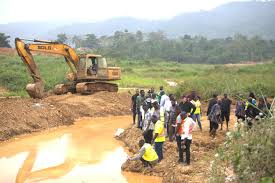
An associate professor at the Kwame Nkrumah University of Science and Technology has raised serious scientific and economic concerns over the Environmental Protection Agency’s newly deployed technology to clean water bodies polluted by illegal mining activities.
Professor Bright Kwakye-Awuah of the Department of Physics has questioned both the scientific validity and cost-effectiveness of the copper-based nano liquid technology, which the EPA began trialling on the Birim River in the Eastern Region on February 24.
While the EPA has released images showing visibly clearer water in diverted and stagnant sections of the river following the pilot application, Professor Kwakye-Awuah argues that visual improvement does not equate to genuine environmental remediation.
Scientific Validity Questioned
According to the physicist, although copper nanoparticles exhibit established antimicrobial and catalytic properties under controlled laboratory conditions, real-world application in polluted rivers presents significant challenges.
He noted that rivers affected by illegal mining contain complex pollutants including extreme turbidity from clay and silt, dissolved and particulate heavy metals (mercury, arsenic, lead, cadmium, manganese), potential cyanide residues, and high suspended solids.
“With copper itself being a heavy metal, introducing copper nanoparticles into an open river system raises significant concerns regarding secondary contamination, bioaccumulation in aquatic life, sediment enrichment with copper, and long-term ecological risks,” Professor Kwakye-Awuah stated.
He warned that while rapid water clarification may be observed, nanoparticles could disperse downstream, accumulate in sediments, or become resuspended during flooding events.
The professor called for robust scientific validation, including ICP-MS analysis of residual metals, total copper quantification, and sediment and ecotoxicity studies before any technology can be deemed environmentally sound.
“Without comprehensive chemical and ecological assessments, the approach may yield superficial results rather than true environmental remediation,” he cautioned.
Economic Concerns
The EPA has estimated that cleaning each kilometre of river would cost approximately $200,000. However, Professor Kwakye-Awuah questioned the economic assumptions underlying this projection.
“This assumes homogenous contamination, uniform effectiveness, and a one-off treatment capable of resolving pollution permanently,” he explained. “If illegal mining persists upstream, continuous or repeated applications would be necessary, causing total costs to escalate well beyond initial projections.”
He warned that treating symptoms rather than eliminating pollution at its source risks creating a cycle of recurring public expenditure without sustainable outcomes.
Alternative Solutions Proposed
The KNUST physicist recommended source-based interventions that target pollution at entry points rather than treating entire river segments.
He advocated for treatment technologies that physically remove suspended solids and adsorb dissolved heavy metals without introducing additional toxicants. Professor Kwakye-Awuah proposed modular deployment at pollution nodes, coupled with water recycling systems that minimise river discharge.
“When enforced alongside the cessation of in-stream mining and a polluter-pays model requiring miners to fund water treatment, the economic burden shifts from the public to those responsible for contamination,” he noted.
By focusing on discharge points rather than the entire river, the treated volumes decrease, making capital and operational costs more manageable and enhancing long-term sustainability.
Call for Caution
Professor Kwakye-Awuah emphasised that environmental restoration must not introduce new hazards, stressing that rivers are dynamic, living ecosystems whose water chemistry differs significantly from laboratory systems.
“Effective remediation begins at the source of contamination,” he concluded. “By intercepting pollution from illegal mining, treating it with advanced adsorption and flotation systems, and responsibly reusing treated water, we can safeguard our rivers without imposing further chemical burdens.”
He urged Ghana to prioritise science-based, economically sound, and ecologically responsible solutions to ensure the preservation of rivers for future generations.
The EPA has yet to respond to the professor’s concerns regarding its $35 million technology deployment.

