



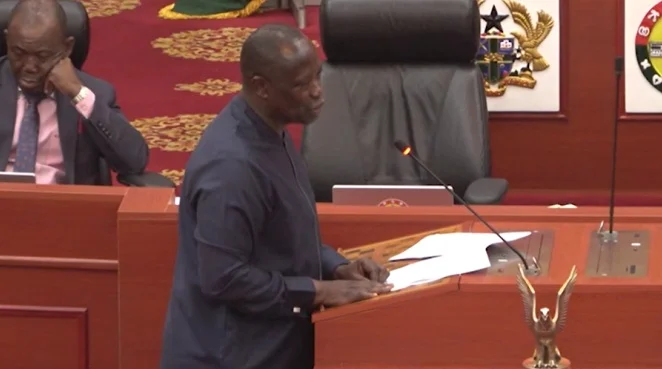
Parliament has officially ratified a mining lease for the extraction of lithium and other minerals in the Central Region, a move designed to propel Ghana into the ranks of key players in the global green energy market. The agreement with Barari DV Ghana Limited was approved on Thursday, but not without significant opposition and sharp criticism from the Minority Caucus.
The 15-year lease, which covers a 42.63-square-kilometer area in Mankessim within the Mfantsiman Municipality, is renewable under the Minerals and Mining Act, 2006 (Act 703). The government has touted the deal as a significant improvement on past agreements, highlighting a revised fiscal regime designed to maximize state revenues.
Presenting the agreement to the House, the Minister of Lands and Natural Resources, Emmanuel Armah-Kofi Buah, emphasized the benefits of a newly introduced sliding-scale royalty system. This system links the royalty rate—ranging from five to 12 percent—directly to international lithium prices, ensuring the country earns more when commodity prices are high.
“We wanted to be sure that under this mining, lithium will not come to add to the destruction of roads,” Mr. Buah stated, outlining a key provision that requires the company to conduct a feasibility study for a new jetty or mini-port system within six months.
Other key terms of the ratified agreement include a 12 percent free carried interest for the government—higher than the standard 10 percent for other minerals—and a one percent annual revenue contribution to a community development fund for areas affected by the mining operations.
Minority Voices Strong Opposition
Despite the ratification, the Minority Leader, Alexander Afenyo-Markin, led his caucus in firmly rejecting the deal, arguing that it is based on unverified financial projections and could ultimately deliver less revenue than a previous agreement rejected by the current government when it was in opposition.
“Ghana’s lithium endowment is a generational asset,” Mr. Afenyo-Markin cautioned. “The terms on which it is leased will outlast this Parliament and will define the revenue, employment, and community development benefits that flow to Ghana for the duration of the mine’s life.”
The core of the Minority’s argument centers on the new royalty regime. They pointed out that under the previous agreement, which featured a fixed 10 percent royalty, a benchmark price of $2,250 per tonne would have yielded a 10 percent return. Under the new sliding scale, that same price point falls within the seven percent band, resulting in a lower immediate return.
“This is not an improvement on the NPP’s terms,” Mr. Afenyo-Markin asserted, criticizing the government for proceeding with ratification despite what he described as unresolved concerns regarding the underlying legislative framework.
He also raised issues with the reduction of the Growth and Sustainability Levy (GSL) from three percent to one percent, arguing the government had not provided Parliament with a comprehensive cost-benefit analysis to justify the overall financial package. He called for a delay in the ratification to allow for further scrutiny, a call that went unheeded.
Environmental and Viability Questions Raised
Adding to the criticism, a former Finance Minister, Dr. Mohammed Amin Adam, flagged what he termed inadequate environmental safeguards within the agreement. He warned of potential risks including water pollution and soil degradation, and called for the establishment of a mandatory environmental bond and a dedicated mitigation fund.
“They must set up an environmental mitigation fund so that a certain percentage of the revenue from the sale of the product will be put into the fund to be used to mitigate against any disaster when it occurs,” Dr. Adam proposed. He also suggested increasing the community development fund from one percent to three percent to adequately address the potential negative footprint of the mining operations.
The Minority also questioned the viability claims made by Atlantic Lithium, Barari DV’s parent company, which cited falling global prices. Citing independent analyses that contradicted this position, Mr. Afenyo-Markin insisted that Parliament must be furnished with transparent, comparative revenue data before approving such long-term national agreements.
Despite the heated opposition and calls for further scrutiny, the majority in Parliament voted to ratify the agreement, paving the way for commercial lithium production to begin.

