



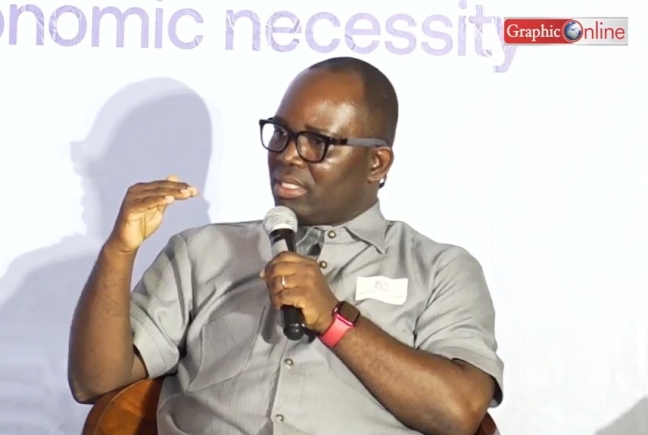
An Associate Professor at the University of Education, Winneba, has issued a stark warning that Ghana’s over-reliance on road transport is a costly economic mistake, urging the government to implement a fully integrated system that utilises rail and other modes of transit.
Speaking at the Graphic–Stanbic Bank Breakfast Meeting in Accra on Tuesday, February 24, Prof. Enoch F. Sam argued that the current focus on roads is not only inefficient but exposes commuters and businesses to significant, avoidable risks.
Prof. Sam stressed that a strategic shift is required to harness underutilised options. “We should implement an integrated transport system. In Ghana, we focus so much on road transport, often to the detriment of others. We have rail and other options, and these are areas we should also be banking our hopes on so that we can get the best out of them,” he told the gathering.
He highlighted the particular dangers of transporting hazardous materials exclusively by road, pointing to international best practices where such goods are moved via safer, more efficient rail networks.
“If you go to other countries, some of the goods we transport on the road naturally should not be on the road. Some are even hazardous. If we have other modes, these could go on them, while freeing road space for passenger commuting,” Prof. Sam explained.
Data, Not Instinct, Must Drive Policy Reset
The academic insisted that any meaningful overhaul of the urban transport system must be anchored in rigorous research and clear policy priorities, rather than political expediency.
“In terms of budgeting, especially in this era of resetting, we need to understand what is happening. First, what is our priority? What are we seeking to achieve?” he asked. “As someone from academia, I will always push for data and science, and that is what we fail at in this country.”
Drawing on his experience studying in Belgium, Prof. Sam emphasised the crucial role of collaboration between universities and industry in solving real-world infrastructure challenges.
“I studied in Belgium, and there, private-sector industries would bring resources to the university and say, ‘This is a problem we see. What can you do for us? Give us data, conduct research, so that we can find a solution.’ We cannot solve problems without first understanding their root causes,” he noted.
A Call for Citizen-Centred Planning
Prof. Sam further argued that transport planning must move away from a one-size-fits-all model and instead reflect the diverse travel patterns and needs of Ghanaian citizens. He concluded that resetting the system is not merely about building more roads, but about prioritising efficiency, safety, and evidence-based decisions to drive productivity and unlock economic growth.

