



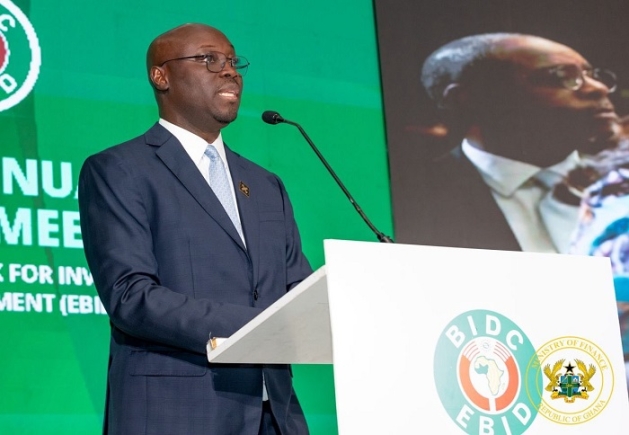
Ghana’s Finance Minister, Dr Cassiel Ato Forson, has raised the alarm over unpaid arrears totalling approximately $256 million owed to the ECOWAS Bank for Investment and Development (EBID), warning that continued delays by member states are severely constraining the bank’s operations.
Speaking at the opening of the 24th Ordinary Session of the EBID Board of Governors in Accra on Tuesday, Dr Forson disclosed that only four of the 15 Economic Community of West African States (ECOWAS) member countries have fully honoured their commitments under a capital call agreed in 2022. The compliant nations are Ghana, Côte d’Ivoire, Guinea and Togo, leaving 11 others yet to complete their payments.
“Timely capital payments are critical. It strengthens EBID’s leverage and sustains its growth and impact across our region,” Dr Forson said.
He explained that the board had approved an increase in the bank’s authorised capital to $3.4 billion in 2022, subsequently issuing a third tranche subscription call of $411.4 million with a deadline set for December 2025. Although $102.5 million was received in 2025, a significant shortfall remains, affecting the bank’s ability to fully deliver on its development mandate. The minister did not name the defaulting countries but urged all governors present to act swiftly to meet their obligations.
Bank records growth despite funding gap
Despite the capital constraints, Dr Forson noted that EBID recorded steady growth, with its balance sheet expanding from $1.97 billion in 2024 to $2.39 billion by the end of 2025. Profit rose by 13.3 per cent, from $8.55 million to $9.75 million, over the same period.
Project approvals increased by 50 per cent, while financial commitments surged by more than 83 per cent to $813.77 million, largely directed towards energy and transport infrastructure. The bank also mobilised over $510 million and €310 million for priority projects, alongside an additional $100 million in capital mobilisation.
International credit rating agencies Moody’s and Fitch Ratings have reaffirmed EBID’s ratings at B2-Stable and B-Stable respectively, Dr Forson added. The bank has also secured accreditation with the Green Climate Fund, opening avenues for climate financing.
Capital expansion essential
However, the Finance Minister stressed that the bank’s capacity to finance projects remains constrained by the existing capital gap.
“Expanding our capital base is essential to strengthening our ability to finance development projects and support economic growth in all member states,” he said.
Dr Forson also announced the opening of EBID’s regional office in Abidjan to deepen engagement with member countries and enhance operational efficiency. He commended EBID President George Agyekum Donkor and his team for steering the institution through a challenging global economic environment.
The meeting continues, with governors expected to deliberate further on the bank’s strategic direction and outstanding capital contributions before adopting final resolutions.

