



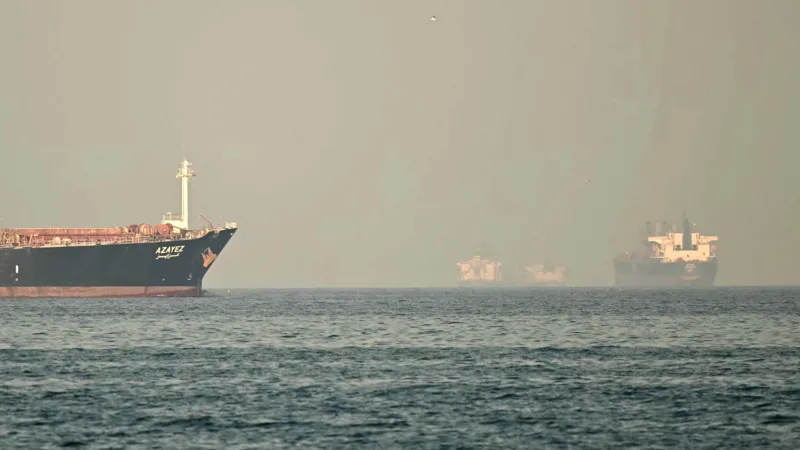
Global oil prices climbed sharply Monday after at least three ships were attacked near the Strait of Hormuz, a critical chokepoint for the world’s energy supplies, as Iran launched retaliatory strikes across the Middle East following U.S.-Israeli attacks that killed its Supreme Leader.
Two vessels were struck directly, and an “unknown projectile” exploded in “very close proximity” to a third, according to the UK Maritime Trade Operations Centre (UKMTO). Iran has warned ships to avoid the strait, through which approximately 20 percent of the world’s oil and gas passes daily.
International shipping has come to a near-standstill at the strait’s entrance, with at least 150 tankers dropping anchor in open Gulf waters beyond the waterway, according to ship-tracking platform Kpler. Only a handful of Iranian and Chinese vessels have transited the area.
Prices jump but stop short of panic
In early Asian trade Monday, Brent crude surged more than 10 percent before paring gains. By 02:00 GMT, the international benchmark stood 4 percent higher at $76.16 per barrel, while U.S.-traded oil rose a similar margin to $69.67.
“The market isn’t panicking,” said Saul Kavonic, head of energy research at MST Research. “There is more clarity that so far, oil transport and production infrastructure hasn’t been a primary target by any side.”
Kavonic suggested prices could subside if traffic through the Strait of Hormuz resumes. However, other analysts warned that a prolonged conflict could push crude above $100 per barrel.
Critical artery under threat
Iran’s Islamic Revolutionary Guards Corps (IRGC) claimed responsibility for striking three tankers belonging to the UK and U.S., though neither country has commented on the assertion.
The UKMTO reported “multiple security incidents” across the Arabian Gulf and Gulf of Oman and advised ships to “transit with caution.” Four incidents were logged, including one involving crew evacuation, though the cause remains unclear. Private maritime security firm Vanguard Tech identified affected ships flagged to Gibraltar, Palau, the Marshall Islands, and Liberia.
“Because of Iran’s threats, the strait is effectively closed,” said Homayoun Falakshahi of Kpler. “The vessels have taken a precautionary measure not to enter as the risks are too high and their insurance costs have sky-rocketed.”
Falakshahi noted that U.S. intervention to protect shipping routes could prevent a sustained price spike, but a prolonged closure would send prices “much, much higher.”
OPEC+ responds, shipping giants reroute
The OPEC+ group of oil-producing nations, including Saudi Arabia and Russia, agreed Sunday to increase output by 206,000 barrels per day to cushion potential price rises. Some analysts questioned whether the move would be sufficient.
Danish container shipping giant Maersk announced it would pause sailings through the Bab el-Mandeb Strait and the Suez Canal, rerouting vessels around Africa’s Cape of Good Hope.
The attacks follow a dramatic escalation in regional conflict. U.S.-Israeli strikes killed Iran’s Supreme Leader Ayatollah Ali Khamenei on Saturday, triggering retaliatory Iranian strikes across multiple countries. Fresh aerial exchanges between Iran and Israel continued Sunday, with additional strikes reported in Dubai, Doha, Bahrain, and Kuwait.
Consumer impact warning
Edmund King, president of the AA, warned that motorists globally could feel the effects at the pump.
“The turmoil and bombing across the Middle East will surely be a catalyst to disrupt oil distribution globally, which will inevitably lead to price hikes,” King said. “The magnitude and duration of pump price increases depends on how long the conflict goes on.”

