



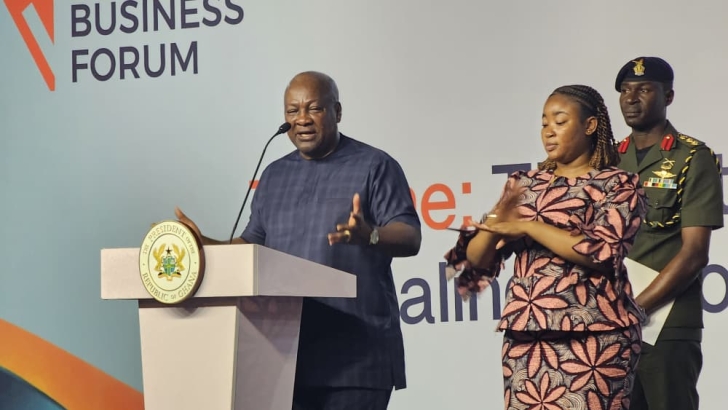
President John Dramani Mahama has moved to allay public fears of an impending fuel shortage, assuring Ghanaians that the country holds sufficient petroleum reserves to last for at least six weeks despite escalating tensions in the Middle East.
Speaking at the 2026 Kwahu Business Forum in Mpraeso on Saturday, the President acknowledged growing anxiety over the ongoing conflict involving the United States, Israel, and Iran—a situation that has driven up global crude oil prices and led to sharp increases at the local pump.
“As we have always said, shocks will come and you cannot always predict these external events. However, you must build an economy that is resilient enough to withstand them,” President Mahama told participants.
“I know Iran and Israel are fighting, but so far, our economy has shown remarkable resilience,” he said, adding: “We have six months of export cover and six weeks of petroleum stocks, so there is no danger of us running out of petroleum products. Even as we utilise the reserve stock, we are simultaneously replenishing it.”
Emergency Cabinet Meeting
The President disclosed that he has convened an emergency Cabinet meeting to assess the impact of the global situation on domestic fuel prices and to consider measures to cushion consumers.
“I have called for this emergency cabinet meeting to decide on specific measures we can take to cushion petroleum prices while we hope the conflict comes to an end,” President Mahama stated.
“There are adjustments we can make, particularly in the margins, to help maintain relatively stable prices as we pray for the war to cease. The government remains fully committed to easing the burden on citizens.”
Sharp Rise in Fuel Prices
His assurance follows a steep hike in fuel prices since April 1, 2026. Data from the National Petroleum Authority (NPA) shows that petrol prices have risen by about 15 percent to approximately GH¢13.30 per litre, while diesel has jumped by nearly 19 percent to around GH¢17.10 per litre for the April 1–15 pricing window.
The increases—among the steepest in recent months—are driven largely by global supply disruptions and rising crude oil prices. While the relative stability of the cedi has helped moderate the impact, there are mounting concerns over potential knock-on effects on transport fares and inflation.
Economy Will Not Collapse
Dismissing fears that the external shock could destabilise Ghana’s economic outlook, President Mahama expressed confidence in the economy’s resilience.
“I can confidently tell you that the economy will not collapse because of the war in Iran,” he emphasised.
Government sources indicate that policy options under review include adjustments to fuel margins and levies, as part of efforts to mitigate the impact on households and businesses.

