



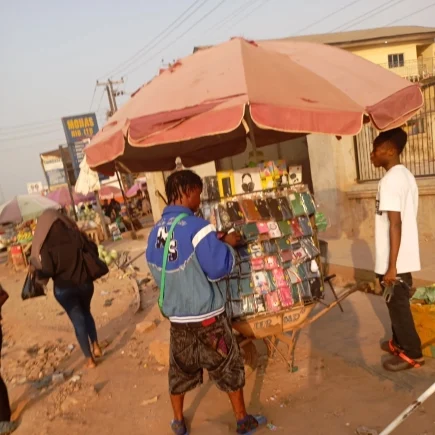
The 2024 IBES I report exposes the vast scale of the informal economy, with over half of mobile traders earning below the subsistence level of GH₵100 a day.
A groundbreaking new survey has revealed that more than three-quarters of a million businesses in Ghana operate not from offices or shops, but from pavements, roadside stalls, and the momentum of hawkers.
The 2024 Integrated Business Establishment Survey (IBES I), released by the Ghana Statistical Service (GSS), has for the first time systematically mapped the vast universe of mobile and open-space enterprises that have long existed beyond the reach of official statistics.
The data paints a new picture of the national business landscape, identifying a total of 2,644,358 enterprises. While 1.87 million operate from fixed structures, the report’s headline finding lies in the remaining 30 per cent: 693,748 open-space businesses (operating at fixed locations without permanent structures) and 82,920 mobile businesses (hawkers, cart pushers, and motorcycle traders).
Combined, these nearly 800,000 enterprises are not marginal; they are central to how millions of Ghanaians earn a living and access goods.
A Female-Dominated Sector with Stark Income Disparities
Open-space businesses alone employ 922,177 people, making them a formidable source of employment. Women dominate this space, accounting for 79.5 per cent of workers and 84 per cent of business owners, positioning open-air commerce as one of the most significant channels for female economic participation in the country.
The sector’s activity is heavily concentrated in urban hubs, with Greater Accra accounting for 23.5 per cent of open-space enterprises and Ashanti a further 17.1 per cent. Food and beverage retail dominates, representing 68.4 per cent of all activity, underscoring the role these traders play in household food security.
Despite their resilience—the average business has operated for about six years, with 63.7 per cent open at least six days a week—earnings are starkly uneven. Approximately 31.3 per cent of open-space businesses take home GH₵100 or less daily, while one in five earn GH₵500 or more, revealing deep income stratification within a sector often treated as homogenous.
Mobile Traders and the Challenge of Child Labour
Mobile businesses, though smaller in number, tell a parallel story of hard graft and modest returns. Women are again in the majority at 77.5 per cent, with youth aged 15 to 34 making up over 60 per cent of operators—confirming street trading as a critical entry point into economic activity for young Ghanaians navigating a tight formal labour market.
Earnings are precarious: 57.1 per cent of mobile operators earn less than GH₵100 daily, reflecting the subsistence-level income that characterises much of the sector.
A troubling dimension of the data concerns child involvement. The survey found 2,087 children aged 10 to 14 engaged in mobile business activities, 80 per cent of whom are girls. More than 80 per cent of these children work for others rather than owning the goods they sell, pointing to vulnerabilities that extend beyond economic participation into labour exploitation. The phenomenon is most pronounced in districts across the Upper East, Northern, and Oti regions.
Cross-Border Trade and Digital Integration
Non-Ghanaian operators, numbering nearly 5,000, are concentrated in border regions—Upper West, Volta, North East, and Northern—with a distinct commercial profile. Unlike their Ghanaian counterparts, more than half engage in non-food retail, reflecting cross-border trade dynamics that have until now been poorly captured in national data.
The report also highlights the potential of digital finance to reshape the sector. More than 53,000 open-space businesses now operate as mobile money agents, suggesting that even within the informal economy, there is a growing appetite for digital integration that could, with the right support, improve credit access and record-keeping.
Call for Targeted Policy
In presenting the findings, Government Statistician Dr. Alhassan Iddrisu stressed that the evidence should serve as a foundation for targeted policy.
He called for investments in market infrastructure, including sanitation, lighting, and storage, particularly in the high-density trading zones where open-space businesses cluster. He further urged financial institutions to develop microcredit products and digital payment tools tailored to informal traders, and for metropolitan, municipal, and district assemblies to integrate mobile traders into urban planning rather than treating them as an afterthought.
The survey was conducted by the GSS with support from the World Bank, employing tablet-based data collection across 10,240 enumeration zones and capturing GPS coordinates to apply automated international standard industrial classifications. It represents the most ambitious attempt yet to measure the informal economy at scale.

