



President urges African leaders to brace for economic fallout as tensions threaten global oil supplies
President John Dramani Mahama has issued a stark warning that the escalating conflict in the Middle East could trigger sharp increases in fuel prices and worsen the cost of living crisis in Ghana, should the violence spread to key oil-producing Gulf states.
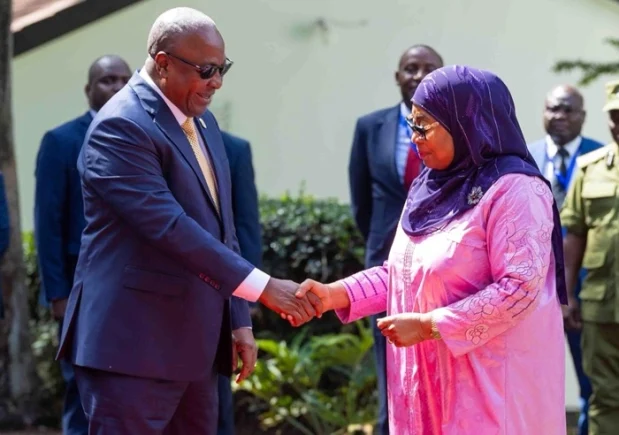
The President delivered the caution during bilateral talks with Tanzanian President Samia Suluhu Hassan on March 3, 2026, held on the sidelines of the African Court on Human and Peoples’ Rights’ 2026 Legal Year opening in Arusha, Tanzania.
Mahama expressed concern that the ongoing confrontation involving the United States, Israel and Iran poses significant risks to global oil supply chains, particularly if counterattacks extend to Gulf states that dominate energy production and transportation routes.
“Any sustained increase in oil prices would reflect directly in fuel costs, transport fares, food prices and the general cost of doing business,” President Mahama warned, noting that Ghana’s heavy reliance on imported crude oil and refined petroleum products leaves the country exceptionally vulnerable to international price shocks.
The President highlighted the strategic vulnerability posed by the Strait of Hormuz, a critical maritime chokepoint through which a substantial portion of the world’s daily oil supply must pass. He cautioned that any disruption to shipping through this route could trigger an immediate and sharp rise in global oil prices, with direct and severe consequences for Ghana’s economy.
Such external shocks, Mahama noted, threaten to undermine ongoing efforts to stabilise inflation and the exchange rate following Ghana’s recent successful debt restructuring programme.
Beyond the economic warning, President Mahama used the meeting to showcase Ghana’s recent economic reforms, announcing that restructuring in the small-scale gold sector had boosted exports from 63 to 104 metric tonnes within just nine months, contributing approximately US$10 billion to the national economy.
He further disclosed that Ghana plans to finance cocoa purchases locally while processing at least 400,000 metric tonnes annually, signalling a strategic shift toward value addition and reduced dependency on raw commodity exports.
In a significant diplomatic move, President Mahama revealed that Ghana will present a resolution at the United Nations General Assembly on March 25, seeking formal recognition of the transatlantic slave trade as a crime against humanity. Tanzania has already indicated its intention to support the resolution.
The warning comes as Ghana’s Ministry of Foreign Affairs has advised citizens planning Umrah pilgrimages to delay travel due to the escalating tensions, while the country has already evacuated its embassy staff from Iran.
President Mahama’s caution reflects growing anxiety among African nations that the Middle East conflict could have severe ripple effects across the continent, particularly for fuel-importing economies still recovering from recent global economic turbulence.

