



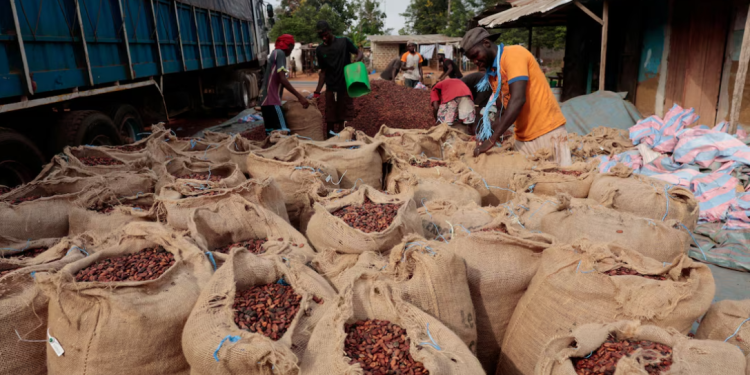
A dramatic fall in global cocoa prices has left cooperatives in Ivory Coast, the world’s top producer, with thousands of tonnes of unsold beans, leaving farmers unpaid and threatening the stability of the upcoming mid-crop season.
In the western town of Duékoué, warehouses are filled to the brim with stock that exporters are refusing to buy. Sekou Dagnogo, who runs a local cooperative, told Reuters that his organization is caught in a standoff between the government’s fixed pricing and the realities of the international market.
Exporters are balking at the guaranteed farmgate price of 2,800 CFA francs ($5.09) per kg set by the government for the 2025/26 season. With global prices hitting a two-year low last week due to weakening demand, intermediaries claim the Ivorian beans have become too expensive to move.
“Things haven’t been going well for quite some time now, so everything is at a standstill,” Dagnogo said. “We currently owe farmers a lot of money.”
Dagnogo is now pinning his hopes on the Coffee and Cocoa Council (CCC), the industry regulator, to intervene. In January, the CCC launched a program to purchase 100,000 metric tons of stranded beans. Earlier this month, it was forced to accelerate those purchases amid growing concerns that stocks held in poor conditions were beginning to deteriorate.
“They have assured us that they will buy back the product,” Dagnogo added.
Farmers Forced to Accept Illegal Prices
The crisis is hitting the country’s growers hardest. In the small village of Remikro, farmer Frederic Kouassi Kouassi described the impossible choices facing producers. While the government has set a minimum price, some desperate buyers are offering as little as 1,500 or 1,800 CFA francs per kilogram—rates that are technically prohibited by the regulator.
“They offer us a choice that doesn’t suit us, and due to a lack of resources, we are forced to accept these prices,” Kouassi Kouassi said as he harvested pods on his farm.
With the April-to-September mid-crop fast approaching, he is worried about his mounting stockpile. Faced with debt and the need to keep his farm running, he says many farmers have no choice but to sell at a loss.
“If someone comes and offers you at least 500 CFA francs to sell what’s there, since the trees are still alive, you accept and never get discouraged,” he said.
The situation highlights the fragility of Ivory Coast’s cocoa sector, which supports millions of livelihoods but remains highly vulnerable to global demand shocks.

