



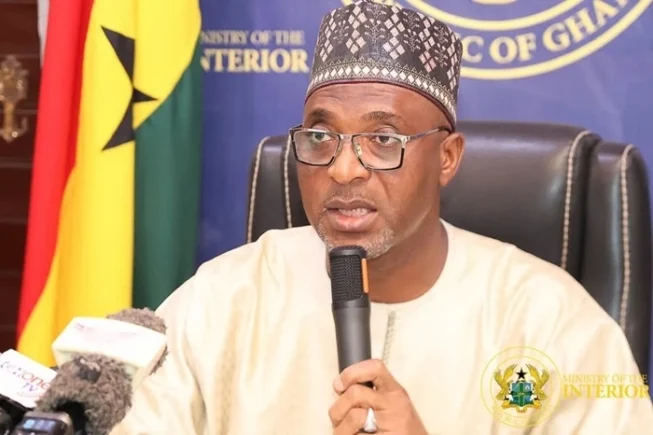
The Minister for the Interior, Mubarak Mohammed Muntaka, has announced a significant shift in the government’s recruitment policy for internal security agencies, stating that priority will be given to applicants who are currently unemployed.
The new directive, which aims to target state resources toward jobless Ghanaians, will see the Ministry cross-checking applicant data against the government’s payroll to filter out those who are already drawing a salary from the public purse.
“We want to give priority to those who do not have jobs. If you are somebody who is already engaged, you already have a job and you are part of the government payroll, we want to give the opportunity to those who are unemployed,” Mr. Muntaka disclosed during an interview on Citi FM on Wednesday.
However, the Minister noted that exceptions will be made for critical specialized professionals. He explained that health workers, including nurses, doctors, and pharmacists, would still be considered to fill gaps in essential services, citing a police medical facility in Kumasi that has been unable to operate effectively due to a lack of staff.
Over 500,000 Applications for 5,000 Slots
The Minister revealed that the ongoing recruitment exercise for the Ghana Police Service, Ghana Immigration Service, Ghana National Fire Service, and the Ghana Prisons Service has been met with overwhelming interest.
According to Mr. Muntaka, the initial applications totaled approximately 390,000, but after accounting for individuals who applied to multiple services, the figure rose to more than 500,000. This is in stark contrast to the mere 5,000 positions currently available.
He added that over 100,000 applicants successfully passed the aptitude test with a score of at least 65%, highlighting the intense competition for the limited vacancies. Mr. Muntaka attributed the low absorption rate to financial constraints, noting that the annual wage bill for the four agencies, which employ nearly 100,000 personnel, stands at approximately GH¢13 billion.
Mental Health and Drug Tests Introduced
In a move to enhance the quality and resilience of recruits, the Ministry is introducing mandatory mental health assessments and drug tests as part of the medical examination process.
“We are adding mental health and then the drug tests to our medical,” Mr. Muntaka stated. He stressed that the screening is crucial to prevent candidates with underlying health conditions from endangering themselves during the rigorous training regime.
He further indicated that the data of qualified applicants will be retained for future exercises. Candidates who have already passed the aptitude test may be fast-tracked directly to the medical stage in subsequent recruitment rounds without re-sitting for the exam. The Minister hinted that another recruitment phase could be launched later this year should the country’s economic situation improve.
Nunoo-Mensah Questions Narrow Focus on Security Jobs
The revelations have sparked a broader conversation about youth employment in the country. A former Chief of Defence Staff and National Security Adviser, Brigadier General Joseph Nunoo-Mensah (retd), expressed concern over the desperation for public sector jobs.
“Is that the only work you have in Ghana? We can’t create work for young people to do except to be policemen, immigration or military?” he questioned.
Gen. Nunoo-Mensah, who will turn 90 in December, urged political leaders to set an example by investing in agriculture and other productive sectors to create diverse opportunities, rather than allowing the youth to rely solely on government employment. “Leadership is by example. You don’t direct them. You march with them,” he advised.

