



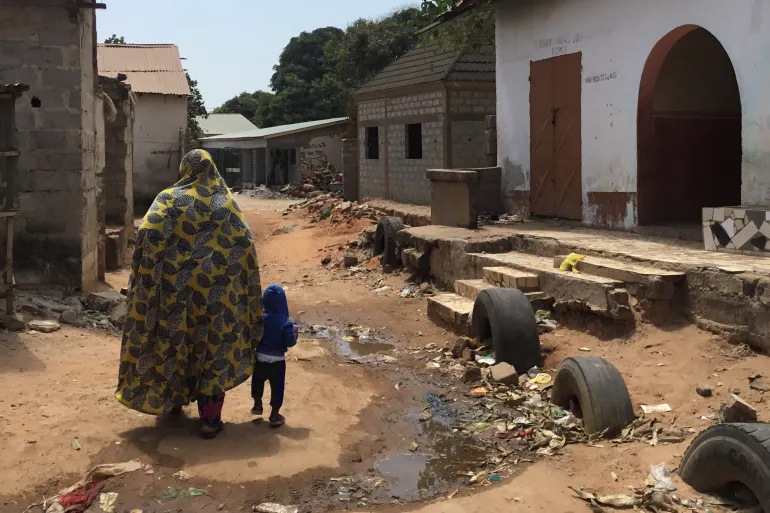
For nearly seven decades, families in a small fishing village along The Gambia’s Atlantic coast have lived, worked and raised children in a country that refuses to recognise them as citizens.
About 850 of the 900 residents of Ghana Town lack Gambian citizenship, passports or national identification cards, according to the village’s development committee. The community was founded in the late 1950s by 10 Ghanaian fishermen who sailed from what was then the Gold Coast and settled along The Gambia’s coastline.
Despite being born and raised in The Gambia — many across multiple generations — descendants of the original settlers remain trapped in a legal grey zone. Under Section 9 of The Gambia’s 1997 Constitution, citizenship by birth is determined by descent alone. Being born in the country does not confer nationality; at least one parent must be Gambian.
“We are all stateless,” said Amina Issaka, 64, whose grandparents were among the earliest settlers. Issaka, her six adult children, 11 grandchildren and four great-grandchildren are all undocumented. “If we cannot get Gambian citizenship, where else would we go?”
For residents, the lack of documentation blocks access to public education, formal employment, healthcare, property ownership and legal protection. Marie Mensah, 30, a mother of four, said her children were turned away from tuition-free public schools because she cannot produce the required identity documents. She now pays for three of them to attend a private school.
“I know they may reject me,” Mensah said after a recent failed attempt to obtain a national ID card at an immigration office 15 kilometres away. “But I still have to try.”
Some residents have faced detention during immigration operations for failing to produce identification, though they are typically released once officials understand their circumstances.
In 2014, former President Yahya Jammeh issued a directive allowing some Ghana Town residents to obtain national ID cards. But the measure lacked permanent legal backing and was not continued after Jammeh lost power in 2017. When those documents expired, renewals were refused.
Emmanuel Dadson, 36, a teacher and secretary of the village development committee, obtained documents under that directive but is now undocumented again. He recently sent his wife and three children to Ghana, where citizenship based on descent remains possible.
“The future here is uncertain,” he said. “I didn’t want my children to remain trapped.”
Joseph Oddoh, 28, earned a scholarship to study medicine abroad after placing among the region’s top performers in the 2017 West African Senior School Certificate Examination. Without a passport or travel documents, he never left. He now works as a fisherman.
“My dream of becoming a medical doctor ended because of a single paper,” Oddoh said.
The Gambian Ministry of Justice told Al Jazeera that citizenship law remains governed by the 1997 Constitution, which does not grant automatic citizenship solely for being born in the country. The ministry acknowledged that existing legal provisions offer no automatic safeguards for children born to non-citizen or undocumented parents.
The Gambia Commission for Refugees has said it is working with the UN refugee agency to regularise residents’ status, though limited funding continues to slow progress. A 2024 assessment found that of 686 stateless individuals identified in the area, only 53 possessed Gambian passports — all obtained under Jammeh’s 2014 directive.
Human rights expert Madi Jobarteh said legal reforms are needed, including guaranteed nationality for children who would otherwise be stateless and stronger birth registration systems.
“The residents of Ghana Town have lived here for decades, integrated fully, and contributed to the country,” he said. “There is absolutely no reason why they should still be treated as non-citizens.”

