



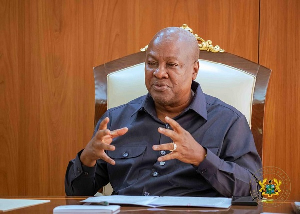
President John Dramani Mahama continues to command strong public confidence just under a year into his tenure, with a new survey by the Institute of Economic Affairs (IEA) placing his approval rating at 68%.
The December 2025 poll, which sampled over 1,000 respondents across all 16 regions, found that only 22% of Ghanaians disapprove of the President’s performance, while 10% remain undecided. The figures suggest a resilient political base for Mr Mahama, who returned to office on January 7, 2025, amid high public expectations and formidable governance challenges.
Despite the strong personal approval rating, the IEA survey reveals deepening public anxiety over the cost of living. A staggering 71% of respondents expressed concern about rising prices of food and other household essentials—an indication that economic recovery is yet to translate into tangible relief for ordinary Ghanaians.
Unemployment remains a major flashpoint, cited by 46% of respondents as a pressing national issue. Illegal mining, or galamsey, was flagged by 30%, reflecting sustained public frustration over environmental degradation and its impact on livelihoods and water bodies.
The IEA noted that while some macroeconomic indicators are beginning to show improvement, substantial socioeconomic difficulties persist. “The divergence between the President’s approval rating and public dissatisfaction with economic conditions suggests that citizens are willing to extend goodwill, but expect concrete results,” the report observed.
The Mahama administration inherited a fragile economy marked by high debt levels, stubborn inflation, and persistent currency depreciation. While officials have pointed to early signs of stabilisation, the IEA findings underscore the urgency of translating policy measures into visible improvements in living standards.
Political analysts say the 68% approval rating offers the government a window of opportunity to deepen reforms and broaden public confidence. However, with economic grievances running high, the margin for patience may narrow as 2026 approache

