



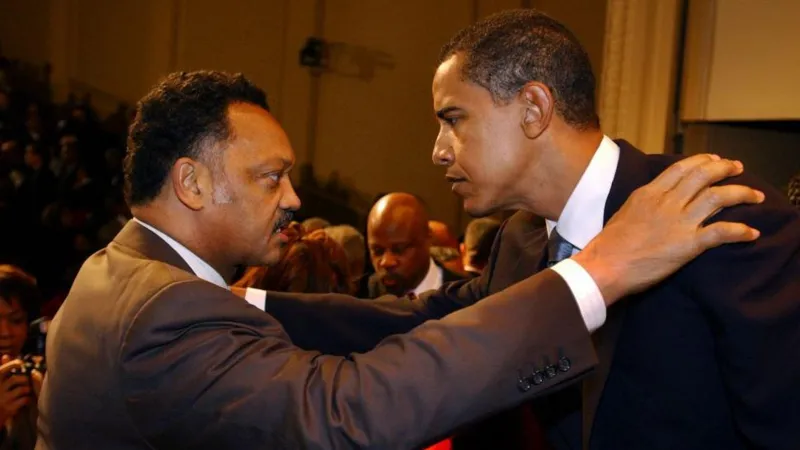
The civil rights leader and two-time presidential candidate, who died this week at 84, fundamentally altered American politics by proving that a Black candidate could mount a credible, nationwide campaign for the White House.
Jackson, a protégé of Martin Luther King Jr., was the first African American to make the leap from activism to major-party presidential politics—achieving significant success at the ballot box and laying the groundwork for those who followed.
From Segregated South to National Stage
Born Jesse Louis Burns on Oct. 8, 1941, in Greenville, South Carolina, Jackson grew up under Jim Crow segregation. The son of a 16-year-old mother and married neighbor, he was adopted by his stepfather Charles Jackson and raised in the church—a traditional hub of Black political resistance.
After a football scholarship took him to the University of Illinois, Jackson transferred to North Carolina A&T, a historically Black college, where he became immersed in the civil rights movement. In 1960, he was arrested during a sit-in at a whites-only library—one of his first acts of defiance.
By the mid-1960s, he had moved to Chicago and caught the attention of King, who put him in charge of Operation Breadbasket, an economic justice initiative.
On April 4, 1968, Jackson was standing in the parking lot of the Lorraine Motel in Memphis when King was assassinated. Moments before the shot, the two had been speaking playfully. Jackson would later describe cradling King’s head as he died—a moment that thrust him into the national spotlight as King’s heir apparent.
Two Historic Presidential Runs
Jackson’s 1984 and 1988 presidential campaigns shattered expectations.
In 1984, he won more than 3 million votes and finished third in the Democratic primaries, introducing the nation to his “rainbow coalition” vision—a multiracial, multiethnic alliance of working-class and disadvantaged Americans.
“Our flag is red, white, and blue, but our nation is a rainbow—red, yellow, brown, Black, and white—and we’re all precious in God’s sight,” he declared at the 1984 Democratic National Convention.
Four years later, he performed even better, winning nearly 7 million votes and more than 1,000 delegates. His speech at the 1988 convention, with its refrain “keep hope alive,” would echo two decades later in Obama’s “hope and change” campaign slogan.
“He brought issues like universal healthcare and reparations to the forefront and gave them traction,” said Vermont Sen. Bernie Sanders at a tribute event last year. “This movement wasn’t just about bringing us together, but about bringing us together around a progressive agenda.”
Controversy and Complexity
Jackson’s career was not without blemish. He faced persistent allegations of antisemitic remarks, and as an ordained minister, he opposed abortion—a stance that complicated his relationship with the Democratic Party’s mainstream.
In 2001, he publicly acknowledged an affair with a staff member that had produced a child, taking a leave from public life to “revive my spirit and reconnect with my family.” The scandal damaged his credibility with some religious leaders.
His later years were also marked by family turmoil. His son, former Illinois Rep. Jesse Jackson Jr., was sentenced to 30 months in prison in 2013 for misusing campaign funds.
The Obama Moment
Despite occasional tensions with Obama—including a 2007 incident in which Jackson criticized the future president for “talking down to Black people”—the two men shared a historic connection.
On election night 2008, as Obama prepared to address a crowd in Chicago, television cameras captured Jackson standing in the audience, tears streaming down his face. Many observers noted that Jackson’s success in boosting Black voter turnout in previous campaigns had helped pave the way for Obama’s victory.
Jackson later compared the fight for same-sex marriage to the struggle against laws banning interracial marriage, showing his willingness to apply civil rights principles to new frontiers.
Final Years and Legacy
In 2017, Jackson was diagnosed with Parkinson’s disease, later revised to progressive supranuclear palsy, a degenerative brain condition. He largely withdrew from public life but made rare appearances, including at the 2024 Democratic National Convention in Chicago, where Kamala Harris was nominated.
High-profile delegates paid tribute to the man they said had done much to ensure a Black woman had a significant chance of reaching the White House.
“We learned at his feet,” said the Rev. Al Sharpton, who worked with Jackson at Operation Breadbasket decades ago.
Rep. Pramila Jayapal of Washington state addressed Jackson directly from the convention stage: “For every elected official we will see on that stage—we are here because you laid the path for us.”
Jackson is survived by his wife, Jacqueline, and their five children.
This article is based on reporting from the BBC and other sources

