



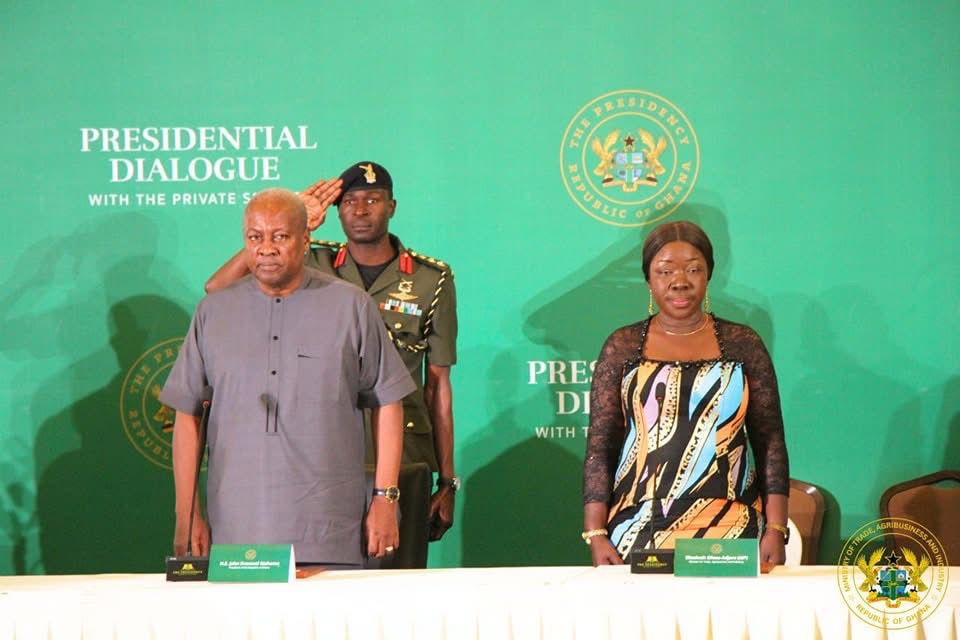
The government has intensified its efforts to foster economic recovery and industrial growth through a high-level engagement with the private sector, culminating in a pledge to fast-track a comprehensive Agribusiness Policy.
The Presidential Dialogue, held on Monday, February 23, 2026, brought together President John Dramani Mahama, key cabinet ministers, and captains of industry for what participants described as a frank and constructive exchange aimed at restoring confidence and accelerating private sector-led growth.
Addressing the gathering, President Mahama announced that the long-awaited draft of the National Agribusiness Policy is ready and will be presented to Cabinet for approval shortly. The policy is designed to serve as a strategic blueprint to boost value addition, strengthen agro-industrial development, and position Ghana as a competitive hub within the West African region.
The discussions focused heavily on the government’s strategy to revitalize domestic production. Minister for Trade, Agribusiness and Industry, Elizabeth Ofosu-Adjare, outlined the administration’s plan to place industrialization and private sector competitiveness at the core of the national economic reset.
“We are rolling out targeted interventions to support agribusiness, manufacturing, and agro-processing,” the Minister stated. “Our goal is deliberate: to expand value addition in priority commodities, reduce our reliance on imports, and create sustainable jobs, especially for the youth.” She stressed the urgent need for Ghana to transition from a raw material exporting economy to a value-driven industrial power capable of supplying both domestic and regional markets.
Minister Ofosu-Adjare also highlighted ongoing efforts to improve the overall business climate by addressing regulatory bottlenecks, streamlining trade processes, and enhancing access to finance for Small and Medium-sized Enterprises (SMEs). She reaffirmed that sustained collaboration between the public and private sectors is essential for long-term economic expansion.
Reinforcing this message, the Minister for Finance detailed the fiscal and macroeconomic measures being implemented to restore stability. These include strategies for improved revenue mobilization and prudent expenditure management aimed at bolstering investor confidence. He called on the private sector to work with the government to ensure that macroeconomic gains translate into tangible benefits for Ghanaian consumers.
Felix Kwakye Ofosu, Minister for Government Communications, described the dialogue as part of a broader strategy to institutionalize engagement with the business community. He emphasized that this approach ensures policies are informed by the real-world experiences of businesses and households across the country.
Participants welcomed the open and candid exchanges, describing the forum as a timely and necessary step toward building a more resilient and inclusive economy.

