



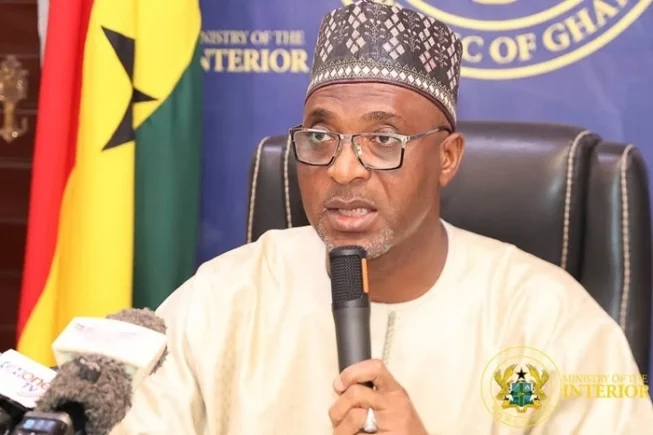
The government has unveiled stringent new entry requirements for Ghana’s nascent medicinal cannabis industry, mandating that prospective investors secure confirmed buyers for their produce before they can be licensed to operate.
The Minister for the Interior, Mr. Muntaka Mohammed-Mubarak, announced the new directive at a press briefing in Accra on Thursday, explaining that the measure is designed to prevent the diversion of cannabis into illegal markets and safeguard public safety.
“We won’t give you the licence if you don’t show us who you are going to sell it to. You need to have an off-taker,” Mr. Mohammed-Mubarak stated emphatically. He stressed that the government will not authorise cultivation without a clear and verifiable market pathway, effectively barring speculative entry into the sector.
The directive introduces a rigorous operational framework for Ghana’s medicinal cannabis programme, which is legally anchored in the Narcotics Control Commission Amendment Act, 2023, and the Cannabis Regulations, 2023. These laws permit the cultivation and management of cannabis strictly for industrial and medicinal purposes, while explicitly maintaining the prohibition on recreational use.
“For the avoidance of doubt, cannabis with more than 0.3 per cent THC remains a prohibited narcotic,” the Minister clarified.
A Multi-Licence Regime and Strict Oversight
Mr. Mohammed-Mubarak outlined a comprehensive control regime that prospective operators must navigate. He revealed that a total of 11 distinct licences are required across the value chain, covering activities such as cultivation, processing, transportation, import, and export. Each licence is activity-specific and non-transferable.
“You cannot cultivate and assume you can transport. You need another licence for that,” he explained, underscoring the segmented nature of the regulatory approval.
On the issue of seed supply, the Minister noted that Ghana currently lacks the capacity to produce the specialised low-THC cannabis seeds required. Consequently, all seeds must be imported under licence, presenting a commercial opportunity for importers. He encouraged local research institutions to begin developing indigenous seed varieties over time.
To ensure compliance and prevent abuse, the Interior Ministry, in collaboration with the Narcotics Control Commission and other security agencies, will deploy advanced surveillance and enforcement measures. These include GPS tracking, drone monitoring, and unannounced inspections of all licensed facilities. Security agencies including the Police, Immigration Service, Prisons Service, and the National Investigations Bureau will be actively involved in enforcement.
Further controls stipulate that licensed facilities cannot be located within 100 metres of schools or residential areas. Operators are also mandated to submit quarterly returns or face sanctions.
Public Safety First, Economic Benefits to Follow
While acknowledging the sector’s significant revenue potential, Mr. Mohammed-Mubarak emphasised that the government’s primary focus is on security and public safety.
“Our emphasis is more on security and public safety than the money. If we do it right, the benefits will come,” he said.
He warned that any failure to adhere to the regulations could have severe international repercussions. “If we get it wrong, Ghana could easily be blacklisted, and all the efforts will come to nothing,” he cautioned.
The introduction of the mandatory off-taker requirement is expected to significantly shape the landscape of the industry. By demanding proof of commercial readiness from production to sale, the policy effectively raises the entry barrier, limiting participation to investors with secured market arrangements and substantial capital.
For local farmers and smaller enterprises, this directive signals that entry into the cannabis sector will require more than just land and interest; it demands firm, pre-arranged business contracts and significant financial resources.
The Minister concluded by affirming the government’s openness to engagement with stakeholders, but reiterated its commitment to enforcing the rules. “Our doors are open 24-7, but we will make sure the intent of the law is fully achieved,” he said.

