



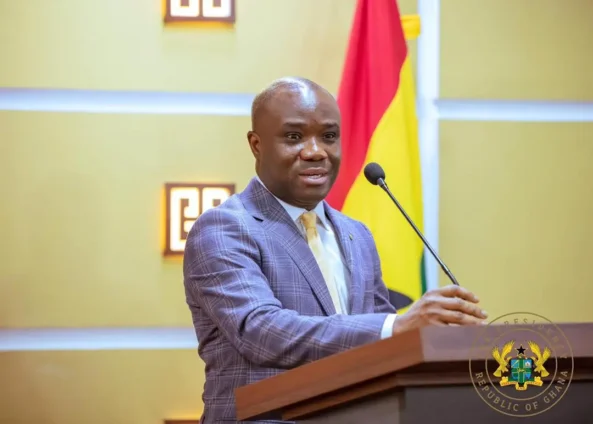
The government has strongly defended its decision to significantly scale down Ghana’s Independence Day celebrations, revealing that the move has slashed the cost of the event by approximately 90 per cent.
Felix Kwakye Ofosu, the Minister for Government Communications, stated that the pared-back ceremony, now held at the forecourt of Jubilee House, cost the state roughly GH¢1.5 million last year—a steep decline from the nearly GH¢20 million it would have cost to host the traditional parade at Black Star Square.
Appearing on JoyNews’ Newsfile programme on Saturday, Mr Kwakye Ofosu explained that the initiative was driven by President John Dramani Mahama shortly after the new administration took office. The President, he said, raised fundamental questions about the value of the elaborate national parade given its growing financial burden and the physical toll on participants.
“The feedback has been great,” Mr Kwakye Ofosu told the programme. “When we first came to power and the independence celebrations were inching closer, the President just called us one day and said, ‘Is it really worth all this pageantry given the cost?'”
Beyond the expense, the minister highlighted significant welfare concerns, particularly for schoolchildren and military personnel involved in the event. He noted that participants often endure long hours of standing under the sun during both rehearsals and the main ceremony.
“There was also the sheer stress that we put on schoolchildren and military officers,” he said. “We have had instances where some of the military officers and schoolchildren have passed out because they had to stand in the sun for several hours.”
From GH¢15 Million to GH¢1.5 Million
Mr Kwakye Ofosu acknowledged that the previous New Patriotic Party (NPP) administration had also attempted to mitigate these pressures, such as by having contingents arrive just before their turn to march. However, concerns over the spiraling cost of the celebrations persisted.
Upon requesting detailed figures, the ministry found that the most recent Independence Day celebration organized by the previous government cost approximately GH¢15 million. This event had been rotated among regional capitals, including Tamale, Ho, and Sunyani.
However, when officials calculated the cost of returning the event to its traditional home at Independence Square in Accra, the figure rose even higher. The minister explained that a full-scale parade at the Square typically requires about 60 contingents from the security services and schools, involving roughly 3,600 marching personnel.
“Ordinarily, you will need 60 contingents of men and women each. That right away gives you about 3,600 people marching on the day, so you have to take care of their transportation, feeding and all the costs that come with it,” he detailed.
The projected cost for this large-scale event was estimated at nearly GH¢20 million—a figure President Mahama firmly rejected. “So the President said he was not going to have any of this,” Mr Kwakye Ofosu stated.
In response, the government opted for a smaller, more dignified ceremony at the forecourt of Jubilee House, which the minister described as a “vast, sprawling complex” suitable for the occasion. The number of participants was drastically reduced to about 300, with attendance largely limited to invited guests.
A ‘Regrettable’ but Necessary Trade-Off
Mr Kwakye Ofosu acknowledged that this new format inevitably limits public participation, a key feature of the traditional celebrations held at larger venues like Independence Square or regional capitals.
“That is a regrettable effect of having to cut down,” he admitted. “At the Independence Square or regional capitals, people can come in their numbers and support the process.”
Despite this trade-off, he maintained the decision was in the national interest, emphasizing the significant fiscal savings. “When everything was done and said, we cut down the budget by about 90 per cent,” he said, confirming that a similar allocation of GH¢1.5 million has been maintained for this year’s event.

