



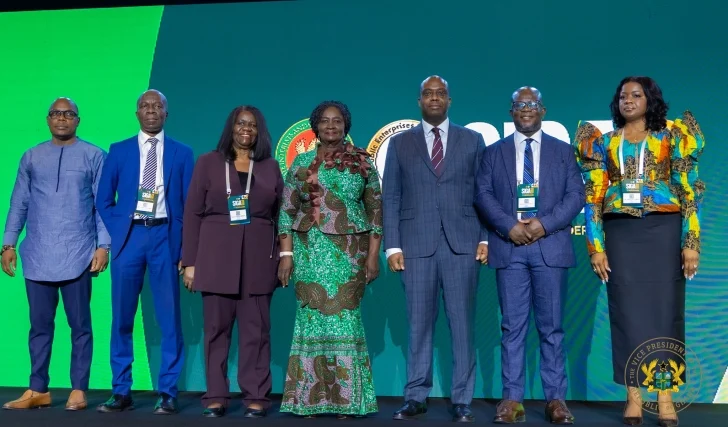
Vice-President Jane Naana Opoku-Agyemang has announced that the government is considering a performance-based remuneration framework for managers of state-owned enterprises (SOEs) as part of efforts to strengthen accountability and improve efficiency.
Speaking at the annual stakeholder conference of the State Interests and Governance Authority (SIGA) in Accra on Wednesday, March 19, 2026, the Vice-President said the proposed system would tie the salaries and incentives of specified entity managers to their performance, marking a shift towards results-driven public sector management.
She explained that the framework, if implemented, would be enforced by the Ministry of Finance and SIGA to help curb financial losses within public institutions.
The conference, held under the theme “The State as a Partner in Progress: Leveraging Public Assets for Shared Prosperity”, reviewed findings from SIGA’s 2024 State Ownership Report (SOR) and the Annual Governance and Institutional Performance Assessment Report (AGIPAR). Discussions focused on strengthening governance, improving operational performance and reducing audit infractions across the public sector.
SOEs as critical national assets
Describing public enterprises as critical national assets that must drive transformation and economic growth, Prof. Opoku-Agyemang said: “Since assuming office, our administration has been committed to repositioning specified entities as engines of value creation. Legacy issues and past operational challenges should not justify persistent underperformance. SOEs must deliver and offer an attractive value proposition to Ghanaians who are the shareholders.”
She noted that more than 170 specified entities operate across key sectors of the economy, managing substantial assets and employing a significant workforce. Despite generating considerable revenue, she observed that some continue to record operational losses and rising liabilities, placing pressure on public finances.
She stressed that weak accountability and financial indiscipline must not define the future of state institutions and called for a shift towards performance-driven management.
Comprehensive review and reforms
The Vice-President disclosed that last year SIGA, in collaboration with the Ministry of Finance, began a comprehensive review of the state’s equity portfolio to assess the financial health and strategic relevance of public enterprises.
According to her, the outcome of the review would guide decisions on restructuring underperforming entities, while profitable ones could attract increased state investment or potential listing on the stock exchange.
She added that the government was strengthening oversight through expanded performance contracts, improved board accountability, stricter corporate reporting standards and enhanced transparency in the management of public assets.
Prof. Opoku-Agyemang noted that Ghana’s reform agenda aligns with similar efforts in countries such as South Africa, Kenya, Rwanda and Morocco, where improved governance has yielded stronger institutional performance and economic growth.
“Our nation’s public enterprises are central to our national development story. If they succeed, and they must succeed, then Ghana succeeds,” she said.
Call for value-driven management
The Deputy Minister of Finance, Thomas Nyarko Ampem, underscored the need to treat SOEs as public assets that must deliver measurable value.
“SOEs are not private estates. They are public assets. It is how we manage them, optimise them and leverage them that determines their value,” he said.
He emphasised the importance of improved service delivery, stressing that reliability, access and efficiency must be enhanced.
Mr Ampem said Ghana had entered a new phase of economic management anchored on discipline and results. “The era where macroeconomic instability was an excuse is over. With stability restored, the responsibility now shifts to performance,” he said.
He added that SOEs must evolve into efficient stewards of national assets, partners in development and reliable contributors to fiscal sustainability. “This is how we turn public assets into shared prosperity. This is how we deliver tangible benefits to the Ghanaian people,” he said.
SIGA outlines reform agenda
The Director-General of SIGA, Michael Kpessah-Whyte, said the authority had intensified its oversight and engagement with boards and management of state enterprises, resulting in improvements in compliance, revenue growth and operational performance.
He stressed that performance contracting must become universal, while governance lapses, conflicts of interest and weak internal controls must be addressed to sustain credibility.
He further outlined SIGA’s reform priorities, including the introduction of dividend payment guidelines, the development of a 10‑year portfolio management strategy, and efforts to strengthen investor relations. These measures, he said, are aimed at repositioning state enterprises from fiscal burdens into financially sustainable national assets.

