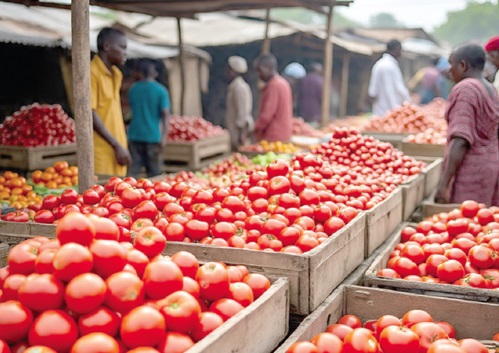
Ghana continues to grapple with a costly agricultural paradox: while the country produces hundreds of thousands of metric tons of tomatoes annually, it still spends tens of millions of dollars importing both fresh and processed tomato products. This persistent contradiction highlights deep structural weaknesses in the nation’s agricultural value chain, according to a new analysis by a Ghanaian agricultural researcher.
Despite tomatoes being a staple ingredient in Ghanaian cuisine—essential for stews and jollof—the sector remains plagued by inefficiency. Farmers frequently experience devastating losses during peak harvest seasons when prices collapse below production costs, leading to tonnes of produce being dumped or left to rot. Conversely, consumers face high prices during seasonal shortages, a gap often filled by imports from Burkina Faso or processed tomato paste from countries like Italy and China.
Sheila M. De-Heer, a PhD Candidate in Agricultural Sciences at Southern Illinois University Carbondale, argues that the problem is not a lack of production but a fragmented and underdeveloped value chain.
“The numbers tell a troubling story,” Ms. De-Heer stated in her analysis. She noted that while Ghana produces hundreds of thousands of metric tons of tomatoes annually—largely from the Upper East, Bono, and Northern regions—post-harvest losses range from 20% to 50% depending on the season and location.
The Core Challenge: A Weak Value Chain
Ms. De-Heer suggests that decades of policy focused on increasing production through improved seeds and fertilizers have missed the root issue. Because tomatoes are highly perishable, increased production without the infrastructure for storage, aggregation, and processing only leads to increased losses.
“The real problem: Weak value chains,” she wrote. “What Ghana lacks is not tomatoes, but the systems to manage them efficiently.”
A key overlooked factor, according to the researcher, is the mismatch between tomato varieties and local growing conditions. Many farmers rely on varieties susceptible to heat stress and disease, leading to inconsistent supply.
She advocates for a greater push towards climate-adapted varieties—heat-tolerant and disease-resistant seeds—developed by local institutions like the Council for Scientific and Industrial Research (CSIR). However, she emphasized that innovation must move beyond research stations into farmers’ fields through better coordination with seed companies and extension services.
The Import Competition
The dominance of imported tomato paste from Europe and Asia is attributed to longer shelf life, consistent quality, and lower prices driven by large-scale production. Conversely, Ghana’s local processing industry remains limited and inconsistent, often crippled by unreliable raw material supply and high operational costs.
While Ghana occasionally turns to Burkina Faso for fresh tomato imports to stabilize supply during shortages, Ms. De-Heer warns that this creates a dependency exposed to price volatility and transport disruptions.
A Call for Systemic Reform
To resolve the crisis, the researcher is calling for a shift from “production-focused thinking to system-wide solutions.” Recommendations include:
· Decentralized processing facilities to absorb surplus during glut seasons.
· Improved market coordination to provide farmers with better price and demand information.
· Investment in storage, transport infrastructure, and farmer cooperatives.
She also urged a transformation of agricultural extension services to focus less on production and more on market-oriented agriculture, including post-harvest handling and value addition.
“Reducing food imports requires more than ambition, it requires targeted investment in infrastructure, irrigation, processing industries, and agribusiness financing,” Ms. De-Heer concluded. “Without these, Ghana will continue to produce what it cannot manage—and import what it already grows.”
The analysis serves as a policy brief for stakeholders, suggesting that with coordinated action on climate-smart production and value chain development, Ghana can stabilize supply, reduce import dependency, and improve the livelihoods of its smallholder farmers.