



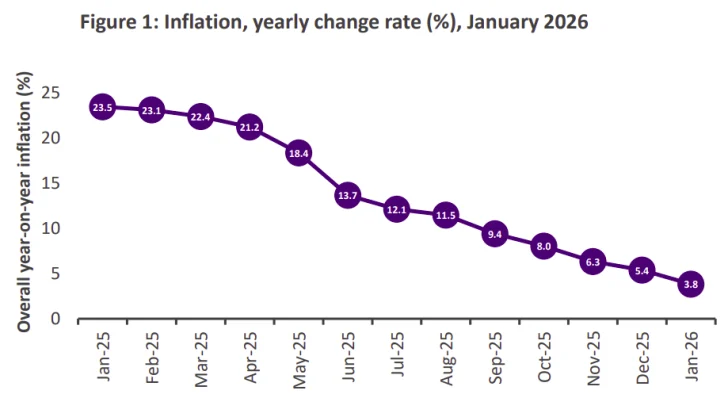
Ghana’s inflation rate has fallen for the thirteenth consecutive month, reaching 3.8% in January 2026, the lowest level recorded since the rebasing of the Consumer Price Index (CPI) in 2021, according to the Ghana Statistical Service (GSS).
The latest data shows a sharp decline from the 23.5% rate recorded in January 2025 and a drop of 1.6 percentage points from the 5.4% recorded in December 2025.
Government Statistician Dr. Alhassan Iddrisu announced that the CPI rose to 262.3 in January 2026 from 252.6 in the same month last year, resulting in the year-on-year inflation rate of 3.8%.
Food and Non-Food Inflation Converge
For the first time in recent periods, food and non-food inflation converged at 3.9% in January, down from 4.9% and 5.8% respectively in December 2025. However, month-on-month data indicated a 1.1% rise in food prices, while non-food prices fell by 0.4%.
A detailed analysis of price movements revealed significant variations within the CPI basket. While prices for garden eggs and fresh tomatoes fell sharply by 58.7% and 42.5% respectively, essential items such as charcoal and green plantain saw steep year-on-year increases of 53.7% and 67.9%.
Significant Regional Disparities Persist
The national decline masked wide regional disparities. The North East Region recorded the highest inflation rate at 11.2%, while the Savannah Region experienced deflation at -2.6%. The GSS attributed these gaps to differences in local supply chains, transport costs, and market access.
The Greater Accra and Ashanti regions, which together account for nearly half of the national consumption basket, recorded modest inflation rates of 3.0% and 4.0%, respectively.
Domestic Pressures Now Outpace Imported Inflation
Inflation for locally produced items eased to 4.5%, while imported item inflation fell to 2.0%. This indicates a shift, with domestic cost pressures now a more significant driver of price changes than imported inflation.
Inflation for goods slowed to 3.6% from 5.8% in December, while services inflation moderated to 4.0% from 4.5%.
Policy Implications and Outlook
Economists suggest the sustained disinflation could create room for monetary policy easing and bolster business and consumer confidence. In its release, the GSS recommended the government maintain fiscal discipline and invest in storage, irrigation, transport, and market access to reduce regional price disparities.
The GSS advised households that the low inflationary environment is “a good time to plan budgets with greater confidence, prioritise essentials, avoid non-essential spending, and save where possible.”

