



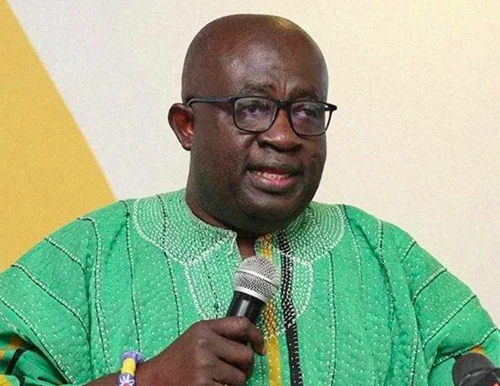
The Chief Executive Officer of the Petroleum Hub Development Corporation (PHDC), Dr. Tony Aubynn, has reaffirmed government’s commitment to developing the Ghana Petroleum Hub as a transformative industrial project, emphasizing that its long-term success hinges as much on transparency and inclusion as on engineering and financing.
Speaking at a strategic engagement with Civil Society Organisations (CSOs) in Accra on March 4, 2026, Dr. Aubynn described the Petroleum Hub as a flagship national investment designed to reposition Ghana as a regional energy security corridor while delivering broad-based economic benefits.
The meeting, held under the theme “Advancing Ghana’s Energy Future through Dialogue, Accountability and Collaboration,” marked what he termed the beginning of a structured partnership between the corporation and civil society actors.
Building Trust Around a Flagship Project
In his opening remarks, Dr. Aubynn stressed that public trust would be decisive in determining the project’s trajectory.
“We at PHDC hold the view that no major national infrastructure project can succeed without public trust, transparency, and continuous engagement with the people it is meant to serve. As such, your presence is something we take very seriously,” he stated.
Drawing on more than two decades of experience in Ghana’s extractive sector, he warned that infrastructure projects often falter not because of technical shortcomings but because stakeholders are sidelined.
“Projects do not fail because of engineering or financing alone. They fail when communities are not heard, when stakeholders are excluded, when social and environmental concerns are treated as secondary issues, and when policy decisions are not in sync with the central pillars of development,” Dr. Aubynn explained.
He added: “That is why today’s engagement is not a formality. Rather, it is a deliberate step by PHDC to build a culture of openness and co-creation around the Petroleum Hub Project.”
Positioning Ghana as an Energy Corridor
Dr. Aubynn described the Petroleum Hub as “one of the most ambitious industrial undertakings in Ghana’s recent history,” anchored on large-scale infrastructure designed to deepen value addition within the petroleum sector.
“At its core is a design to position this country as an energy security corridor, achieve petroleum price stability for citizens through our key infrastructure such as refineries, storage tanks, petrochemical plants and port infrastructure at Jomoro,” he said.
The integrated complex, located in the Western Region, is expected to combine refining, storage, petrochemical and port operations within a single coordinated framework capable of serving domestic and international markets.
By expanding local refining capacity, the project aims to reduce Ghana’s reliance on imported refined petroleum products while strengthening export potential and enhancing price stability.
Jobs, Investment and Industrial Expansion
A major highlight of the project is its projected employment impact. Dr. Aubynn indicated that estimates point to up to 700,000 jobs across the various phases of development and operations.
“Ultimately, the Hub will create jobs for Ghanaians, attract investment, and expand our industrial base as a country,” he noted.
Beyond direct employment, the initiative is expected to stimulate activity in construction, engineering, logistics, services and allied sectors, while creating opportunities for small and medium-sized enterprises within the supply chain.
He however cautioned that ambition must be matched with responsible execution.
“But ambition alone is not enough. Herein lies the real question: how do we build a Petroleum Hub that is economically viable, socially inclusive, environmentally sustainable, and beneficial to us and future generations?”
Civil Society as Accountability Partners
Dr. Aubynn underscored the role of CSOs in shaping development outcomes, positioning them not as adversaries but as accountability partners.
“Civil Society Organisations play a central role in national development. You operate between the fine margins of policy and the people. You amplify community voices, interrogate public projects, and ensure that development is not just about macroeconomic figures, but about real human outcomes, protecting livelihoods and fairness,” he stated.
He noted that the engagement had two key objectives: to deepen understanding of PHDC’s mandate and project structure, and to gather feedback that would influence planning and implementation.
“PHDC does not see CSOs as critics; instead, we view you as partners in accountability and sustainable development,” he affirmed.
He acknowledged legitimate concerns around land use, environmental protection, livelihoods and governance transparency, noting that these issues were central to the project’s success.
Aligning with Global ESG Standards
With the global oil and gas industry undergoing significant transformation, Dr. Aubynn said investors and communities increasingly demand higher environmental, social and governance standards.
“With your collaboration, PHDC is committed to aligning its operations with these global standards,” he said.
He cited rigorous environmental and social impact assessments, local content development, gender inclusion and transparent governance processes as key pillars of the framework.
“We are building not just an infrastructure project, but a governance model for how strategic assets with transformative economic potential should be developed in the 21st century,” Dr. Aubynn emphasized.
Reinforcing the emphasis on participatory governance, he added: “Trust is not built through exclusion. It is built through inclusion and participatory dialogue.”
He assured participants that stakeholder input would directly shape the project’s evolution.
“In view of this, I encourage you to speak freely today. Challenge our assumptions. Offer practical ideas. And hold us to high standards.”
Long-Term National Investment
Dr. Aubynn concluded by reiterating that the Petroleum Hub is more than a physical infrastructure project; it is a strategic instrument for diversifying revenue streams, strengthening energy security and anchoring long-term industrial growth.
“We share a common goal: that this project must serve Ghana’s economy and long-term public interest,” he said.

