



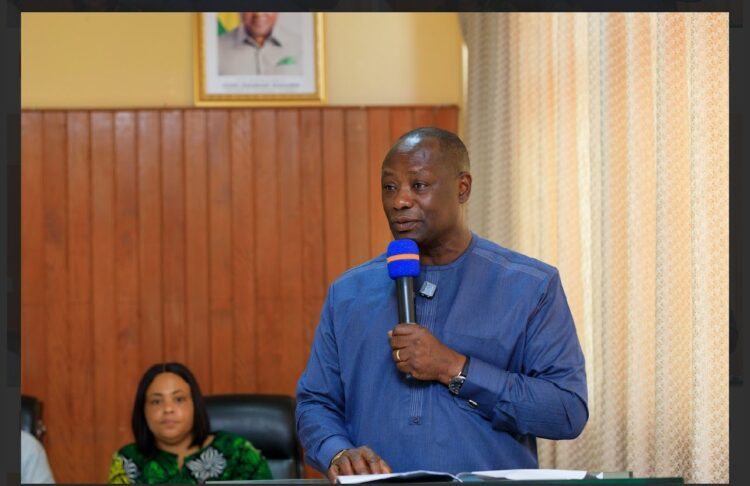
In a sweeping reform of public land administration, the Ghanaian government has approved a new policy setting the premium for leasing state-owned lands at a minimum of 70% of the assessed market value. The decision, announced by the Minister for Lands and Natural Resources, Hon. Emmanuel Armah Kofi Buah, marks a definitive end to decades of undervaluation that have cost the state billions in potential revenue.
The new framework, which follows Cabinet’s approval of a comprehensive review into public land allocations, directly addresses a long-standing anomaly in the system. Minister Buah revealed that previously, premiums for public land leases fluctuated wildly, ranging from a negligible one percent to a maximum of 30 percent of actual market value. This inconsistency, particularly prevalent in prime urban areas, not only failed to deliver fair value to the state but also fostered a perception of inequity and abuse.
“The ministry, in consultation with the Lands Commission, has therefore proposed a new premium framework for public land leases,” Minister Buah stated. “Under this new framework, a minimum of 70 percent—not one to 30 percent—a fixed 70 percent of the assessed market value of public land will be payable upfront as a premium, with the remaining 30 percent structured over the turnover of the lease as ground rent.”
The Minister emphasized that all future assessments will be rooted in actual market values, moving away from arbitrary estimates to ensure transparency and fairness. To facilitate this, the Ministry is collaborating closely with the Lands Commission to strengthen valuation standards and eliminate the discretionary practices that permitted such wide pricing variances.
Reinforcing State Oversight
Beyond the new pricing structure, Minister Buah used the occasion to clarify the legal status of public lands allocated to state institutions. He issued a firm reminder that such allocations confer only user rights, not ownership. Consequently, beneficiary institutions are prohibited from transacting any business related to these lands without prior written approval from his ministry.
This directive aims to curb a growing trend where some public entities have treated allocated lands as private assets, engaging in unauthorized transactions that undermine state oversight and policy coherence.
A New Era of Transparency: The National Land Value Database
A cornerstone of the reform is the creation of a comprehensive, publicly accessible national land value database. The Ministry, in partnership with the Lands Commission, will compile and maintain market value data for defined land clusters across all cities, towns, and zones in the country.
This initiative is designed to standardize valuations and make them publicly verifiable. “There will be no doubt on the values of properties across every part of this country, every city, every cluster,” Minister Buah declared. “This will be publicly known so that transactions, especially public lands, will not be undersold.”
By publishing this data on the Lands Commission’s website, the government aims to significantly reduce opportunities for arbitrary valuation. The availability of benchmark values will provide predictability for investors and institutions while equipping the state with the tools to ensure every transaction delivers value for money.
A Strategic National Asset
The Minister framed the reforms as a crucial step in strengthening public finances and promoting national development. He stressed that public land is a strategic asset, the proper management of which is essential for funding infrastructure, guiding urban planning, and fostering economic growth.
“Undervaluation deprives the state of resources needed to invest in these priorities,” he noted.
The new 70% premium framework is a key component of a wider “reset agenda” in the lands sector, which includes stricter oversight, standardized applications, and enhanced public disclosure. As the government begins implementation, the Ministry plans to engage valuers, public institutions, and other stakeholders to ensure a smooth transition. The overarching goal, Minister Buah concluded, is simple but profound: to ensure that public lands are managed transparently, priced fairly, and utilized to advance the national interest.

