



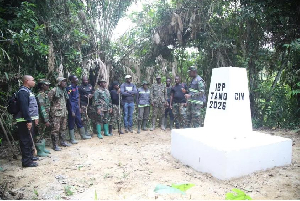
In a significant move to enhance national security and fortify diplomatic ties, the Ghana Boundary Commission has announced the imminent commencement of work to construct permanent boundary pillars along the country’s border with Côte d’Ivoire. The project, scheduled for completion by March 2026, is designed to provide clear territorial demarcation and prevent future disputes between the two West African neighbours.
The initiative follows extensive field inspections and groundwork conducted by officials from the Commission, who have been assessing the terrain and verifying geographical coordinates along the approximately 700-kilometre frontier. Historically marked by natural landmarks and aging monuments, the border is now set to be reinforced with durable, internationally compliant pillars that will serve as unmistakable markers of national sovereignty.
“Proper boundary demarcation is fundamental to peace and security,” a spokesperson for the Ghana Boundary Commission stated. “By constructing these pillars, we are not only safeguarding Ghana’s territorial integrity but also fostering an environment of trust and cooperation with Côte d’Ivoire. This is about preventing misunderstandings before they occur.”
Enhancing Security and Regional Cooperation
The boundary pillars are expected to play a critical role in modern border management. They will provide clear reference points for security agencies, including the military, police, and immigration services, enabling more effective monitoring of cross-border activities. This is particularly vital in combating smuggling, illegal mining, and other transnational crimes that thrive in ambiguously defined border zones.
Furthermore, the project underscores the commitment of both Ghana and Côte d’Ivoire to regional stability and integration. Clear borders facilitate legitimate trade and movement, allowing communities on both sides to interact economically and socially without the fear of inadvertently violating national boundaries.
Community Engagement and Support
Local residents living along the border have expressed strong support for the initiative. For farmers, traders, and families whose lives span both countries, the new markers promise to end years of uncertainty regarding land ownership and jurisdictional limits.
“Sometimes, it is difficult to know exactly where Ghana ends and Côte d’Ivoire begins,” explained a community leader from a border town. “This has led to small disputes between neighbours. Having these pillars will bring clarity and peace of mind to everyone.”
The Ghana Boundary Commission has emphasized the importance of community awareness and cooperation, engaging with local authorities and residents during the preliminary inspection phase to ensure the project proceeds smoothly and with broad public understanding.
A Commitment to Peaceful Relations
The construction project is a tangible expression of Ghana’s foreign policy, which prioritizes peaceful coexistence and diplomatic engagement with its neighbours. By proactively addressing potential friction points, Ghana is reinforcing its role as a pillar of stability within the Economic Community of West African States (ECOWAS).
International relations experts have lauded the move, noting that well-defined borders are a cornerstone of good governance and sustainable development. They reduce the potential for cross-border tensions, protect the rights of citizens, and provide a clear legal framework for business and governance.
As the March 2026 deadline approaches, the Ghana Boundary Commission is poised to begin the physical construction phase. For the nation and its western neighbour, the new pillars will stand not just as markers of division, but as symbols of a shared commitment to order, security, and mutual respect.

