



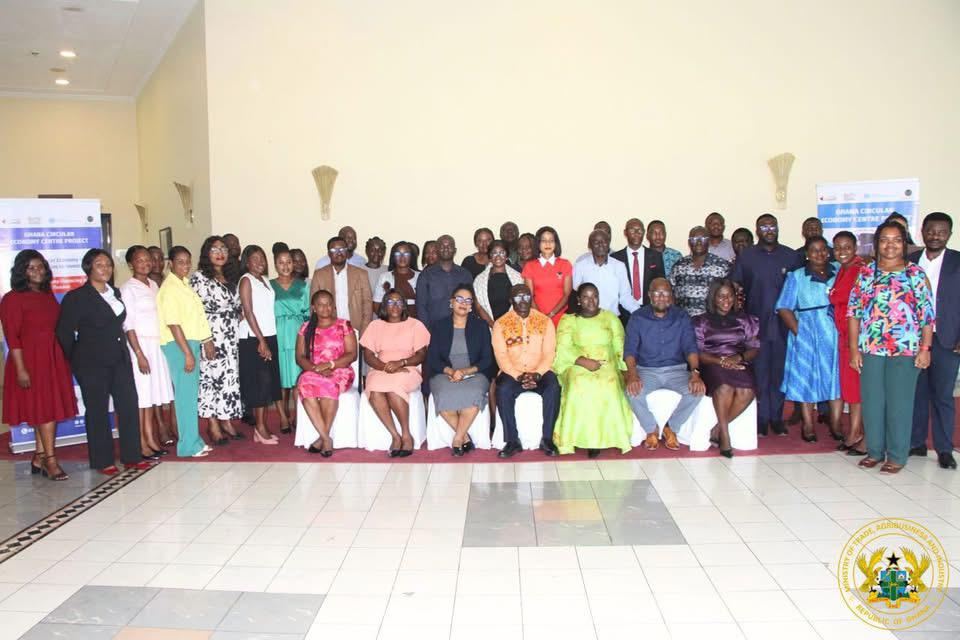
Ghana has launched a four-day capacity-building workshop to accelerate the country’s shift toward sustainable industrialisation, bringing together government officials, industry players, and development partners under a shared circular economy agenda.
The Training of Trainers (ToT) programme opened in Accra on Tuesday, April 7, 2026, under the Ghana Circular Economy Centre (GCEC) Project. The initiative is supported by the United Nations Industrial Development Organization (UNIDO) and Global Affairs Canada.
In her opening address, Madam Cynthia Djokoto, Director of SME Development at the Ministry of Trade, Agribusiness and Industry, described the training as a cornerstone of Ghana’s industrial transformation agenda. She said the programme reflects the Ministry’s commitment to fostering inclusive growth while ensuring environmental sustainability.
“This initiative demonstrates our ongoing dedication to building a resilient industrial sector,” Djokoto said. She also acknowledged UNIDO’s partnership, noting that its support is helping Ghana move away from the traditional “take–make–dispose” model toward a more efficient and regenerative circular system.
UNIDO Circular Economy Expert, Dr. Halid Abu-Bakar, led participants through interactive sessions blending theoretical instruction with practical application. He linked global sustainability challenges to Ghana’s current consumption patterns, prompting critical reflection on environmental and economic impacts.
Through group discussions, participants examined how existing production systems affect public health, environmental integrity, social equity, and economic efficiency. The sessions also focused on communication strategies, equipping trainees to translate complex circular economy concepts into clear, compelling messages for diverse audiences.
As part of the hands-on exercises, participants developed and refined presentations on the relevance of circular economy principles in Ghana, receiving constructive feedback to improve their delivery.
The training is expected to generate a ripple effect across Ghana’s micro, small, and medium enterprise (MSME) landscape, enabling participants to champion sustainable practices within their institutions and influence policy, business operations, and community engagement.
Officials described the initiative as a forward-looking commitment by Ghana to embrace innovation, sustainability, and long-term economic resilience.

