


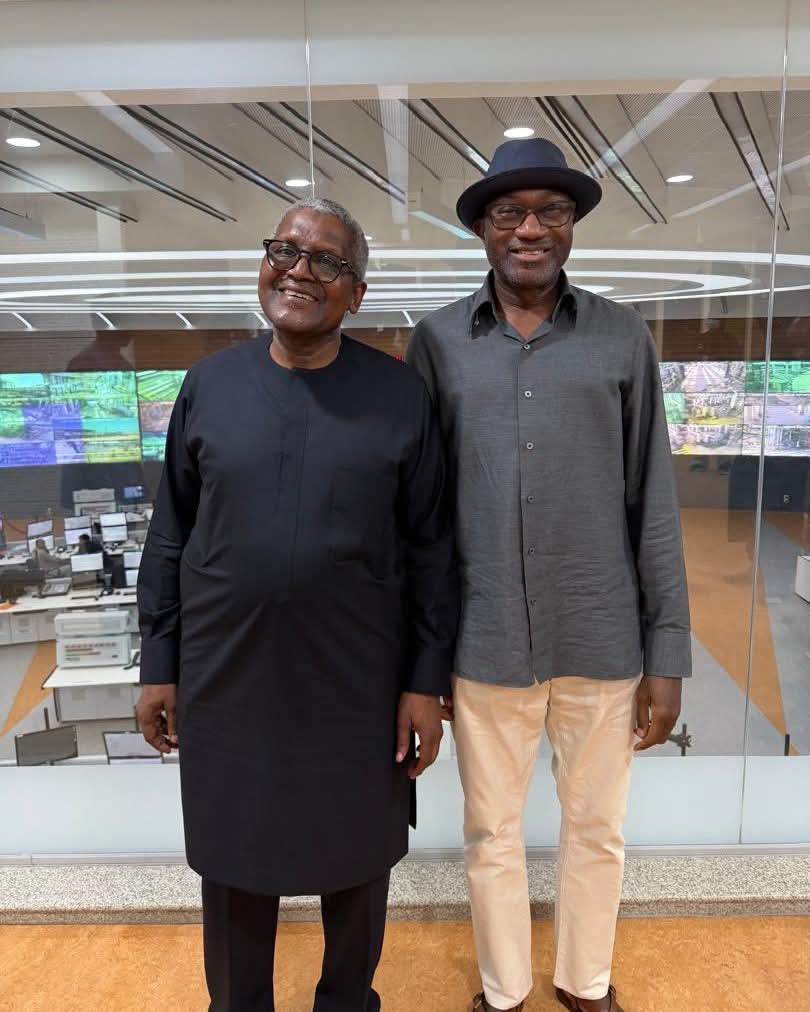
Nigerian billionaire businessman and philanthropist Femi Otedola paid a high-profile visit to the Dangote Petroleum Refinery in Lekki on February 15, 2026, where he toured the facility alongside its founder, Africa’s richest man Aliko Dangote, and enthusiastically described it as the “8th wonder of the world.”
In a post shared on his official X account and Instagram, accompanied by photos from the visit, Otedola expressed profound admiration for the refinery’s scale, engineering prowess, and economic impact. “Today 15 February 2026, I visited the Dangote Refinery, what I call the 8th wonder of the world,” he wrote. He further highlighted the ongoing expansion, noting that “after successful completion of this expansion project, capacity will increase to 1.4m barrels per day.”
The visit follows closely on the heels of a major operational milestone: On February 12, 2026, the refinery achieved its full designed nameplate capacity of 650,000 barrels per day (bpd), marking a global first for a single-train refinery of this magnitude. This breakthrough came after successful optimization of critical units, including the Crude Distillation Unit (CDU), Motor Spirit (MS) production block, naphtha hydrotreater, isomerization unit, and reformer. Company officials described the achievement as a historic step toward consistent, year-round full-capacity operations, with remaining units entering Phase 2 performance testing shortly thereafter.
Valued at approximately $20 billion, the Dangote Refinery has already transformed Nigeria’s energy landscape by producing high-quality premium motor spirit (petrol), diesel, aviation fuel, and other refined products domestically. This has significantly reduced the country’s reliance on costly fuel imports, easing pressure on foreign exchange reserves and contributing to what analysts call the “Dangote Effect” on stabilizing the naira.
The facility primarily processes Nigerian crude grades such as Bonny Light, Forcados, Qua Iboe, and Amenam, but has increasingly diversified its feedstock to include West African sources. Notably, it has incorporated crude oil from Ghana, with multiple shipments of Sankofa grade reported. The refinery received its first Sankofa cargo in 2025 and a second in late 2025 (arriving in November), each typically around 1 million barrels. This regional sourcing reflects growing energy cooperation in West Africa, allowing the refinery to optimize its crude slate amid global supply shifts, planned maintenance, and efforts to support local production from neighboring producers.
Otedola’s endorsement underscores the refinery’s broader ambitions. In November 2025, Dangote partnered with Honeywell International to supply advanced technology, proprietary catalysts, equipment, and services for a major expansion. The project, estimated to cost billions and target completion around 2028, aims to double capacity to 1.4 million bpd by adding a second single-train unit. This would position the facility as the world’s largest petroleum refinery overall, while boosting petrochemical output—including polypropylene and linear alkyl benzene for detergents—and further enhancing Africa’s energy self-sufficiency, job creation, and export potential.
Industry observers view the milestone and high-profile support from figures like Otedola as signals of Nigeria’s push toward greater energy independence and economic resilience. The refinery’s success is expected to save billions in annual import costs, strengthen regional supply chains, and inspire similar large-scale projects across the continent.
Femi Otedola hails Dangote Refinery as 8th wonder of the world during landmark tour, spotlights path to 1.4million bpd capacity


- Advertisment -