



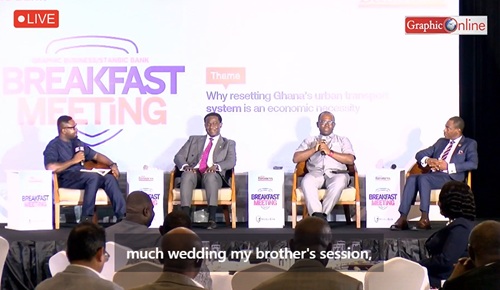
A coalition of transport experts, policymakers, and financial sector leaders has issued a clarion call for a comprehensive and integrated national strategy to overhaul Ghana’s struggling transport system. The consensus was reached at the latest Graphic Business-Stanbic Bank Breakfast Meeting, where the focus was squarely on the theme: “Why resetting Ghana’s urban transport system is an economic necessity.”
Discussants argued that a fragmented approach has long plagued the sector, leading to inefficiency, congestion, and lost productivity. They proposed a unified framework that seamlessly coordinates road, rail, maritime, and air transport to create a cohesive network that serves the needs of commuters and businesses alike.
A key point of discussion was the urgent need to move beyond the nation’s heavy reliance on road transport.
The Case for an Integrated Network
Associate Professor Enoch F. Sam, a transport geography expert from the University of Education, Winneba (UEW), emphasized that a true reset means integrating all modes of transport. He pointed out that while roads are overburdened, other viable options such as rail, water, and even non-motorized transport like cycling and walking are vastly underutilized.
“We should implement an integrated transport system that can coordinate all modes — private cars, public transport, cycling, walking, rail, water and air — so people can move efficiently and safely, no matter their choice,” Prof. Sam stated.
He proposed that bulky and hazardous goods currently clogging roadways could be shifted to rail, thereby freeing up road space for passenger travel and reducing congestion. However, he stressed that any effective reform must be rooted in empirical evidence. “Without evidence-based planning and coordination of road, rail, air and water transport, efforts to improve productivity, reduce travel time and build a resilient urban transport system would remain fragmented and ineffective,” he warned.
Echoing this sentiment, Eric Tetteh-Addison, Deputy Director of Policy and Planning at the Ministry of Transport, acknowledged that previous fragmentation, with multiple ministries overseeing different transport aspects, had hindered progress. He noted that the government’s recent restructuring of ministries is a deliberate step to foster better cohesion between transport services and infrastructure development.
Unlocking Private Capital and Political Will
From a financial perspective, the discussion highlighted that transformation requires more than just new buses and roads. Isaac Simpson, Head of Financial Advisory and Equity Capital Markets at Stanbic Bank Ghana, asserted that sustainable change hinges on a strong partnership between political will and private investment.
“The solution requires more than expanding roads and adding buses, but adopting a broader ecosystem approach that addressed urbanisation, infrastructure gaps and commercial planning,” Mr. Simpson explained. “Until we have that political will and the private capital willing to support it, we will continue to struggle with these transport challenges.”
While acknowledging the availability of financing options such as infrastructure bonds, pension funds, and climate-focused investments, Mr. Simpson stressed that investor confidence depends on effective regulation and transparent revenue systems. He cited an international example from Abidjan, where a new bridge slashed commute times from 90 minutes to just 15, dramatically boosting economic efficiency, as a testament to the power of well-planned infrastructure investment.
Government’s Path Forward
Mr. Tetteh-Addison assured participants that the government is already taking steps to address these structural issues. He announced that the Ministry of Transport is in the process of reviewing and harmonizing policies across the sector to ensure better coordination and service delivery.
He explained that the ministry is actively reviewing key regulations governing transport services, with implementation expected to produce more visible and lasting improvements for the Ghanaian public. The goal, he noted, is to move beyond temporary fixes and establish a resilient, efficient, and integrated transport system that can effectively support the country’s economic growth and urban development for decades to come.
The Graphic Business-Stanbic Bank Breakfast Meeting is a regular policy dialogue series designed to facilitate discussions on critical economic issues and influence policy for a more conducive business environment in Ghana.

