



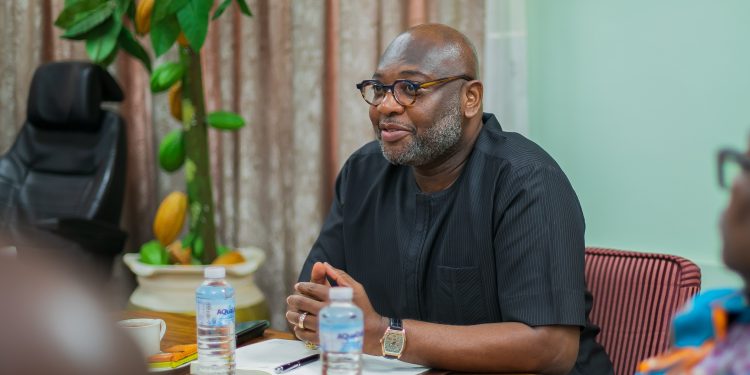
The Ghana Cocoa Board (COCOBOD) is still grappling with the financial consequences of a borrowing decision taken nearly a decade ago to shield farmers from global price shocks, its Chief Executive Officer, Dr. Randy Abbey, has disclosed.
Speaking to journalists on the sidelines of a ceremony to honour three Ghanaian cocoa farmers recognised at the 2025 Cacao of Excellence Awards in Amsterdam, Dr. Abbey revealed that the decision to maintain producer prices through borrowing in 2017 continues to weigh heavily on the sector, with annual repayments now totalling GH¢2.6 billion.
“When global cocoa prices fell sharply in 2017, neighbouring Côte d’Ivoire reduced its producer price by about 40 percent. Ghana, however, chose to maintain prices by issuing COCOBOD bills to raise funds,” Dr. Abbey explained.
He noted that while both local and international investors subscribed to the bills, the cost of servicing that debt has proven significant and enduring.
“For three years, there was no increase in cocoa producer prices. The interest payments on these bills were effectively borne by farmers,” he stated.
The situation deteriorated further in 2022 when COCOBOD and the government were unable to service both the principal and interest on the bills, leading to their inclusion in Ghana’s domestic debt restructuring programme.
“As a result, the bills were restructured and investors who held them suffered haircuts,” Dr. Abbey said.
The COCOBOD CEO provided a stark breakdown of the current repayment burden: approximately GH¢300 million is paid every March, with an additional GH¢2.3 billion due in August.
“In total, that is GH¢2.6 billion each year—drawn from cocoa revenues, effectively from farmers,” he explained.
Dr. Abbey emphasised that the situation serves as a cautionary tale about the long-term risks associated with borrowing to sustain producer prices during periods of market volatility.
“Those decisions were taken nine years ago, and today we are still dealing with the consequences,” he said.
The revelation comes as Ghana seeks to stabilise its cocoa sector, which remains a critical pillar of the national economy. The debt servicing obligations, drawn directly from cocoa revenues, represent a significant drain on resources that could otherwise support productivity enhancements and farmer welfare initiatives.
Meanwhile, the ceremony that prompted Dr. Abbey’s remarks celebrated excellence in Ghana’s cocoa sector, with three farmers receiving honours at the prestigious Cacao of Excellence Awards in Amsterdam on February 20, 2025.
Mr. Isaac Nyampong from Okorekrom in the Asante Akim South District received the Gold Award, while Mr. Isaac Asirifi Darko from Akim Osiem in the Abuakwa North Municipality and Mr. Otu Kabu David from Kpone Praso in the Asante Akim South District both received Silver Awards.
The Cacao of Excellence Programme, an initiative by the Alliance of Bioversity International and CIAT, recognises exceptional quality cocoa beans from across the globe, bringing together leading sensory experts and key players in the international chocolate industry to evaluate beans based on flavour complexity and overall quality.

