



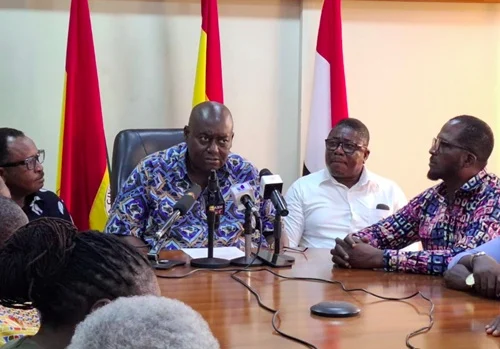
The Civil and Local Government Staff Association, Ghana (CLOGSAG), has firmly rejected a proposal by the Constitution Review Committee to establish the Controller and Accountant General’s Department (CAGD) as an independent body separate from the Ministry of Finance.
Addressing a press conference in Accra on Wednesday, the association argued that the CAGD serves as an implementing arm of the Finance Ministry and must remain under its administrative oversight to guarantee effective coordination in public financial management.
Isaac Bampoe Addo, Executive Secretary of CLOGSAG, emphasised that the department plays a critical role in executing government accounting functions, controlling payments, and managing treasury operations on behalf of the ministry.
“As part of the executive machinery responsible for implementing fiscal policy, the CAGD should remain administratively situated within the Ministry of Finance rather than be structurally separated into an independent constitutional body,” he stated.
Daniel Appiah, Secretary of CLOGSAG’s internal review committee, noted that the Constitution Review Committee failed to provide adequate justification for the proposed change.
“The Controller and Accountant General’s Department is an implementing agency of the Ministry of Finance. Once you make it independent, you introduce another layer of bureaucracy,” he explained.
Mr Appiah warned that elevating the department to constitutional status could create institutional confusion, weaken coordination between government financial institutions, and potentially delay salary processing and other public payments.
“If there are strong reasons why this will enhance prudent public financial management, we are open to discussion. But we did not find any in the committee’s report,” he added.
Alternative proposal
Rather than separating the CAGD from the Finance Ministry, CLOGSAG called for the creation of an Independent Fiscal Responsibility Council entrenched in the Constitution to oversee public financial management and curb excessive government spending.
The association warned that establishing such a body solely through an Act of Parliament would leave it vulnerable to suspension, citing the suspension of the Fiscal Responsibility Act during the COVID-19 pandemic as a cautionary example.
“If it is entrenched in the Constitution, it will not be easy for any government to suspend it at will,” Dr Appiah said, adding that a constitutionally backed fiscal council would provide stronger safeguards against fiscal indiscipline.
Wider concerns
Beyond the CAGD proposal, CLOGSAG raised objections to other recommendations from the Constitution Review Committee concerning public service governance.
The association rejected proposals that would grant the Council of State powers to recruit, vet, or make binding nominations for appointments to constitutional bodies and senior public service positions, including the Head of the Civil Service and the Controller and Accountant General.
CLOGSAG maintained that such responsibilities should remain with the governing councils of the respective services in consultation with the Public Services Commission, arguing this would protect merit-based appointments and ensure institutional continuity.
The association also recommended amending Article 197 of the Constitution to replace the word “may” with “shall”, a change it said would compel the Public Services Commission to issue binding regulations governing public service operations.
Additionally, it criticised proposals that would make the election of Metropolitan, Municipal and District Chief Executives dependent on economic viability or population thresholds, warning that tying democratic participation to such criteria could undermine equal political rights.
While acknowledging the extensive work undertaken by the Constitution Review Committee, CLOGSAG urged it to reconsider proposals that could weaken institutional coherence or create administrative fragmentation within Ghana’s public service system.

