



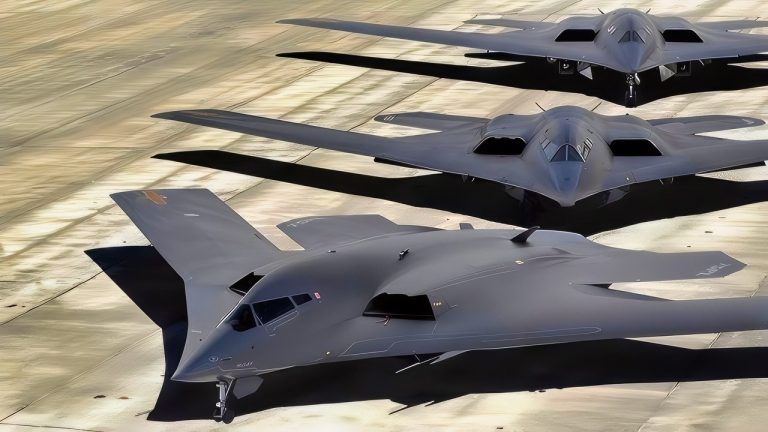
China’s Long-Awaited Stealth Bomber, the H-20, Nears Public Debut, Signaling Strategic Shift
A new report from defense analysts indicates that China’s development of the H-20 strategic stealth bomber is progressing, with a public reveal expected in the coming years. The aircraft is positioned to fundamentally expand China’s military reach, completing its nuclear triad and posing new challenges to U.S. defense posture in the Pacific.
The H-20, under development by the state-owned Xi’an Aircraft Industrial Corporation, is designed as a flying-wing, subsonic aircraft emphasizing stealth, long range, and a heavy internal payload. Analysts assess it as a direct analog to the U.S. Air Force’s B-2 Spirit and forthcoming B-21 Raider bombers.
While specifications remain classified, open-source assessments estimate an intercontinental range exceeding 10,000 kilometers (6,200 miles) and a combat radius of approximately 5,000 kilometers (3,100 miles). The bomber is projected to carry a variety of ordnance, including nuclear gravity bombs, air-launched cruise missiles, and hypersonic weapons, with a focus on anti-ship capabilities.
“The H-20 represents China’s transition from a regional power to a global strategic player,” said Harrison Kass, a senior defense writer who authored the analysis. “Its primary mission is to penetrate advanced air defenses and threaten assets that were previously considered secure sanctuaries.”
Currently, China’s bomber fleet relies on modernized H-6 variants, a design originating in the 1950s. While long-range, these non-stealth aircraft lack the penetration capability against modern integrated air defenses operated by near-peer competitors. The H-20 is intended to solve this vulnerability, providing the People’s Liberation Army Air Force with a survivable platform for both nuclear and conventional deep-strike missions.
The operational introduction of the H-20 would have significant strategic implications. U.S. bases in Guam, Japan, Okinawa, and the Philippines would fall within its potential combat radius, complicating American basing and logistics. Furthermore, with aerial refueling, the bomber’ reach could extend across the Indo-Pacific and beyond, challenging U.S. carrier strike groups with a new layer of long-range, stealthy maritime strike capability.
For China, the bomber completes its nuclear triad—land-based missiles, submarine-launched missiles, and now an air-based leg—enhancing the survivability and credibility of its nuclear deterrent. The project also showcases China’s advancing capabilities in aerospace design, composite manufacturing, and low-observable technology.
Military observers note that while a public unveiling may be imminent, full integration of the H-20 into operational service and the development of supporting doctrines will likely take additional years. Nevertheless, its eventual deployment is poised to alter the balance of power in the Indo-Pacific, marking a new chapter in great-power competition.

