



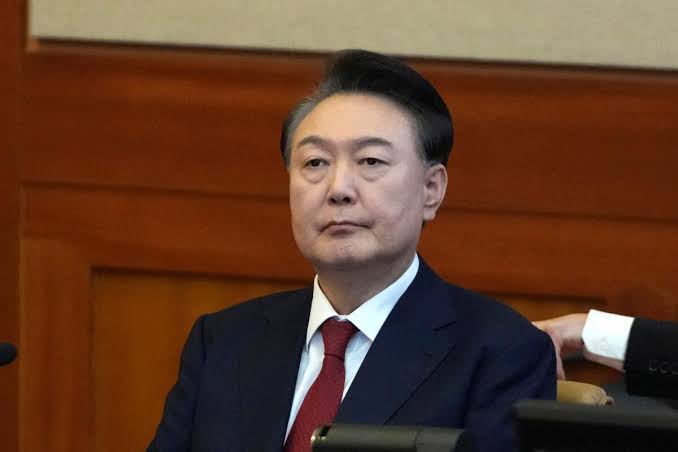
In a historic verdict that closes one of the darkest chapters in the nation’s modern political history, a South Korean court on Thursday sentenced former President Yoon Suk Yeol to life in prison for leading an insurrection. The conviction stems from his botched and short-lived imposition of martial law in December 2024, an act that plunged the country into chaos and threatened to unravel decades of democratic progress.
The ruling by the Seoul Central District Court marks the first time in 30 years that a South Korean leader has been convicted of insurrection, a charge from which a sitting president holds no immunity. The 65-year-old former president was found guilty of orchestrating a rebellion by dispatching armed soldiers to the National Assembly with the intent of paralyzing the government.
A Night of Chaos
On December 3, 2024, Yoon stunned the nation with a late-night televised address, declaring martial law and alleging that “anti-state forces” within the opposition were sympathetic to North Korea. Within hours, heavily armed soldiers descended on the parliament building via helicopter, attempting to storm the chamber where lawmakers were hastily gathering to vote down the decree.
The scenes of citizens and parliamentary aides barricading doors with furniture, fighting to repel elite soldiers, were broadcast live around the world, evoking dark memories of the country’s authoritarian past. Lawmakers managed to force their way into the chamber and unanimously voted to block the declaration just six hours later, forcing Yoon to reverse course.
The Court’s Ruling
In delivering the sentence, presiding judge Ji Gwi-yeon stated that the evidence clearly showed Yoon’s intent was not merely to issue a warning, but to seize control of the legislature.
“It is clear that the defendant’s intention in declaring martial law was to paralyze the National Assembly for a significant period,” Judge Ji said. He cited the military decree’s language and the attempted arrest of key political figures, including the opposition leader and Yoon’s own party chief, as proof of a premeditated insurrection.
“The very act of dispatching armed soldiers to the parliament building and transporting them by helicopter constitutes acts of insurrection,” the judge added, emphasizing the “grave threat” the actions posed to the constitutional order.
Co-Conspirators Sentenced
Alongside Yoon, the court found former Defense Minister Kim Yong-hyun guilty of playing a major role in the insurrection, sentencing him to 30 years in prison. Kim had previously admitted to ordering troops to enact martial law. Four other former military and police officials received sentences ranging from three to 18 years.
Prosecutors had sought the death penalty for Yoon, a largely symbolic request given that South Korea has not carried out an execution in decades. In their closing arguments, they argued that the former president had shown no remorse and that his actions inflicted wounds on the nation that “are beyond description.”
A Defiant Response and Public Reaction
Yoon, a former top prosecutor who had denied all charges, was not present for the verdict reading. His legal team released a statement criticizing the ruling as inconsistent and marred by “procedural violations.”
“You may be able to deceive the public for a while,” the statement read, vowing to fight “distortion and lies” and appeal the decision.
Outside the courthouse, a crowd of Yoon supporters gathered, watching the proceedings on a large screen. Meanwhile, citizens who experienced the night of martial law firsthand welcomed the verdict.
Song Hwa, who rushed to the National Assembly with her husband on the night of the declaration, called it “an extremely important decision” that sends a powerful message. Cho Kuk, leader of the liberal Rebuilding Korea Party, praised the ruling as a testament to the resilience of the nation’s democracy. “South Korea’s experience shows that the power to protect and recover democracy lies within the people,” he said.
A Legacy of Legal Turmoil
Yoon’s downfall was swift. He was impeached just 11 days after the martial law decree and formally removed from office four months later. In January 2025, he became the first sitting South Korean president to be arrested after a weeks-long standoff with authorities at his residence.
Thursday’s life sentence adds to a growing list of legal troubles. Last month, Yoon was sentenced to five years in prison for obstructing his own arrest and abusing power. He also faces separate charges related to allegedly deploying drones to provoke a conflict with North Korea as a pretext for martial law.
His wife, Kim Keon Hee, is currently serving a one-year-and-eight-month sentence for bribery in an unrelated case.
Several key allies have also been convicted. Former Prime Minister Han Duck-soo was sentenced to 23 years in prison last month, and former Interior Minister Lee Sang-min received a seven-year sentence last week for their roles in the insurrection.
Yoon’s life sentence is the most severe penalty handed to a South Korean leader since 1996, when former dictator Chun Doo-hwan was convicted for his role in a 1979 military coup and the 1980 Gwangju massacre. Chun was initially sentenced to death, a penalty later commuted to life in prison before he was pardoned.
Yoon has the right to appeal Thursday’s ruling.

