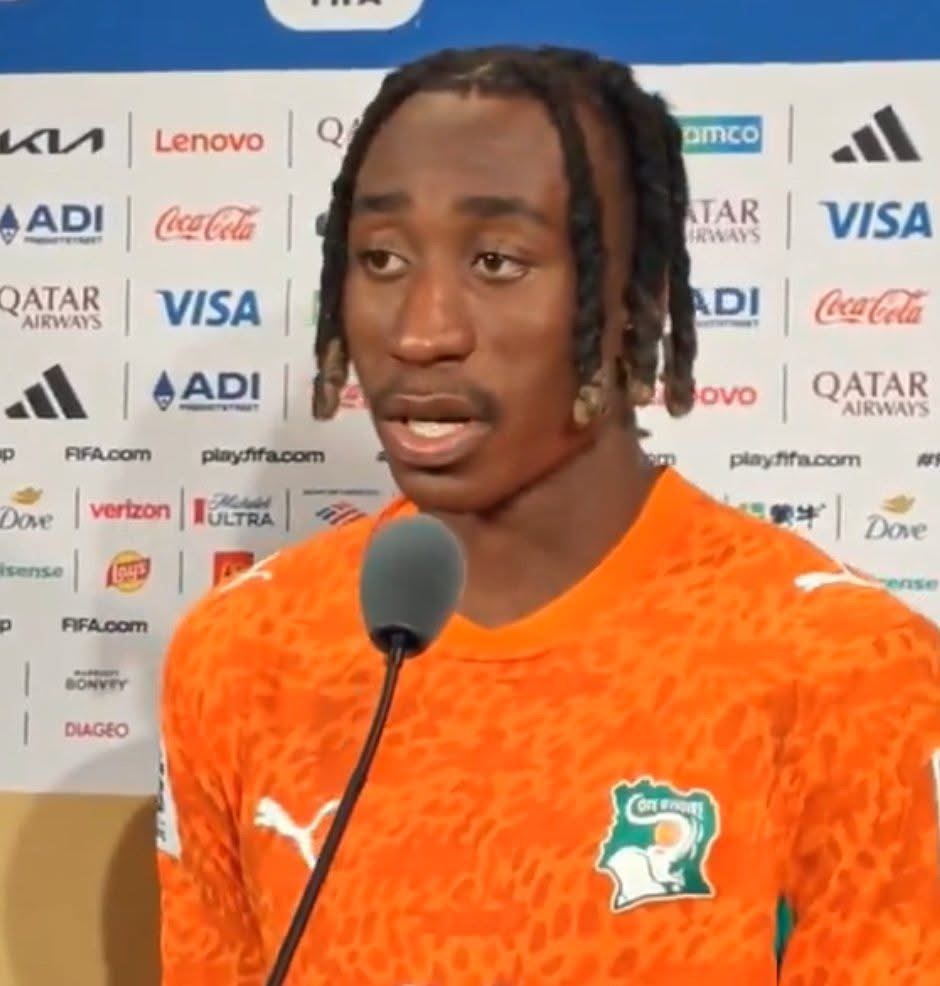
For 89 minutes at Lincoln Financial Field, Yan Diomande tormented Ecuador’s defence with his blistering pace, fearless dribbling and relentless creativity. By the time the final whistle confirmed Ivory Coast’s dramatic 1-0 victory – sealed by Amad Diallo’s 90th‑minute strike – the 19-year-old had been named Player of the Match, created five chances, and become the first teenager in Ivorian history to feature in a World Cup.
Yet when he faced the media afterwards, the RB Leipzig winger offered no triumphant boast about his on‑field exploits. Instead, Diomande delivered a raw, unflinching confession.
“I’ve been getting criticized lately,” he said. “But people do NOT understand what’s going on off the pitch. Honestly, I’ve had tough moments with my family, my mom. And I understand. They’re right to judge me – I’m paid to play football.”
Those words, spoken with a mixture of vulnerability and defiance, lifted the curtain on a personal struggle that has run parallel to Diomande’s meteoric rise – a rise that has already made him a transfer target for Liverpool at a reported fee exceeding €130 million.
From Abidjan’s streets to Bundesliga stardom
Born in the Sicogi neighbourhood of Abidjan on 14 November 2006, Diomande grew up without a father and endured a childhood marked by poverty and instability. His mother, the anchor of his world, suffered from multiple health problems, and the family simply could not afford football boots.
“My dad left and he went to France. We didn’t have a good situation at home, so I decided to go away to play football,” he explained in a previous interview with RB Leipzig media.
That escape led him first to a local academy in Ivory Coast – where a mentor named Bamba bought boots for him and 40 other young players – and then, at just 15, to a lonely journey across the Atlantic. Arriving in Florida without any family members and speaking only French, Diomande enrolled at the DME Academy in Daytona Beach, where he grappled with unfamiliar customs, what he described as “unhealthy” American food, and the loneliness of being separated from everyone he loved.
“Really far away from your family, from your friends, and from the people you love, and I didn’t speak English before, so it was really difficult for me, but that was a great experience,” he recalled.
He learned English on Duolingo. He adapted. And he thrived, leading his semi‑professional team to a national title before making his professional debut for Leganés in Spain – against Real Madrid, no less. A move to RB Leipzig followed, and Diomande exploded onto the Bundesliga scene: 12 goals and 8 assists in 33 appearances, the league’s Rookie of the Season award, and a hat‑trick that made him the second‑youngest player in Bundesliga history to achieve the feat.
Sister’s death and a promise to his mother
But behind the goals and the highlight reels, grief has lingered. Diomande’s sister died suddenly before he moved to Spain, a loss that still brings him to tears.
“My dream was making her happy and proud, but I can’t see her today,” he once said. Another image – of him celebrating his first professional goal for Leganés – serves as a permanent, painful reminder of that promise. His mother, he has said repeatedly, remains his motivation. Once he earned his first major salary at Leipzig, his priority was immediate: “I’ve got money from Leipzig a lot to help my family, to bring my family here, take care of them.”
A performance that silenced the doubters
Against Ecuador, Diomande delivered a performance that made a mockery of any recent criticism. He created five chances – only two Ivorian players in World Cup history have ever created more. He completed dribbles with a near‑55% success rate – the best of any winger in Europe this season – and tormented Arsenal defender Piero Hincapié, beating him repeatedly on the outside before flashing dangerous crosses into the box.
After the match, Diomande initially tried to flee the media zone, joking with French journalists: “I’ve already spoken ten times, it’s not my job to speak!” But when he finally settled, the humour gave way to honesty.
A different kind of victory
Ivory Coast’s win was historic in its own right: the nation’s first World Cup victory since 2014, its first ever triumph over a South American opponent, and Africa’s first win of the 2026 tournament. But for Diomande, the night carried a deeper significance.
In acknowledging that the fans who doubted him have a right to judge – “I’m paid to play football” – Diomande displayed a maturity that belies his 19 years. For a young man who left home as a teenager, who learned English on a phone app while his family remained half a world away, who buried a sister and nursed an ailing mother, simply standing on that pitch was a victory of its own.
Now, with Germany awaiting on Saturday in Toronto, Diomande knows the scrutiny will only intensify. But he has already proven something more important than his dribbling success rate or his transfer value: he is still standing, still fighting, and still playing for more than just the millions.
Reporting from Philadelphia. Additional reporting by The Associated Press, The Athletic, and Bundesliga.com.