



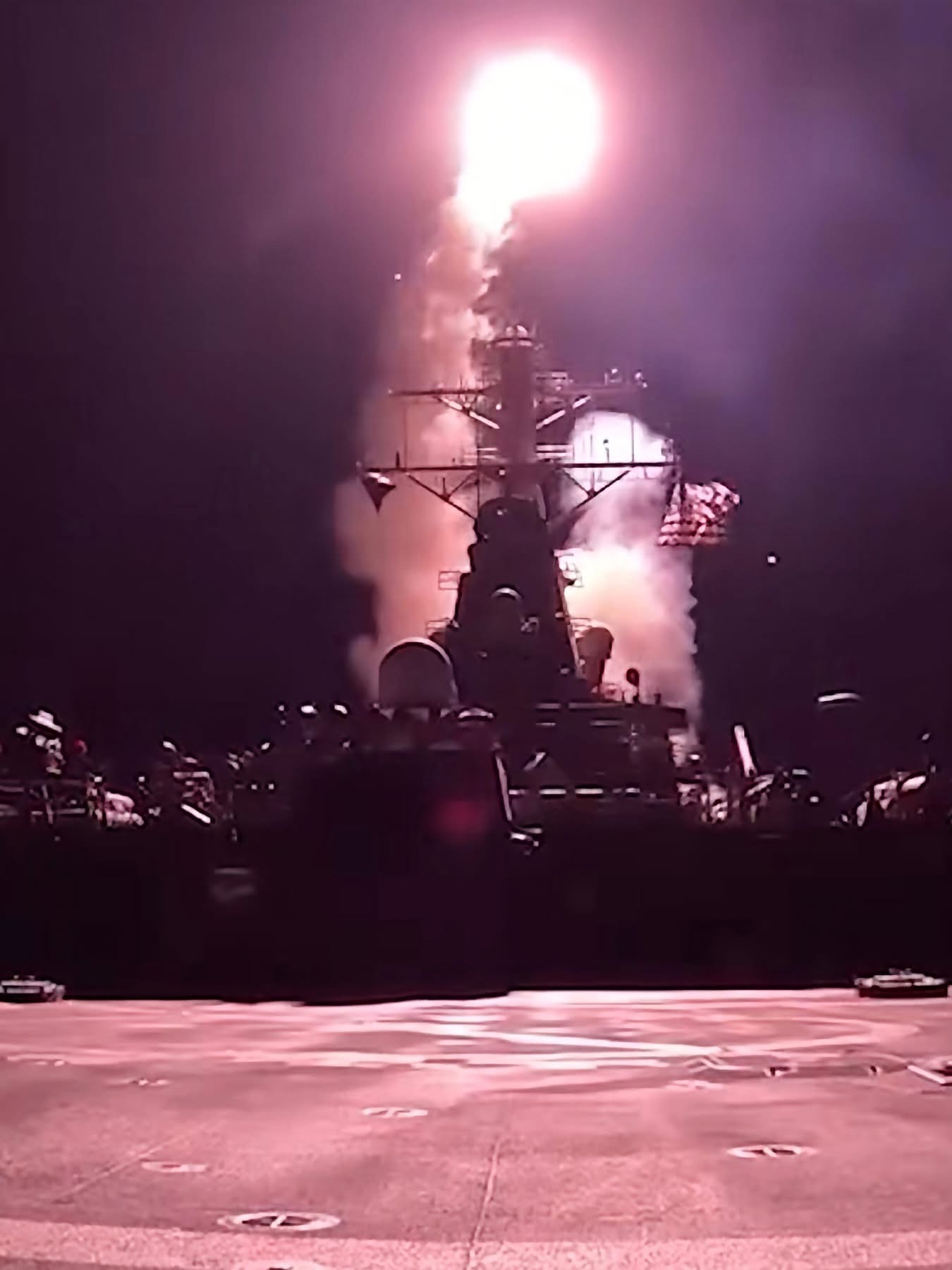
U.S. forces have carried out a second wave of military strikes against Iran, targeting multiple locations across the country’s south and central regions, following a direct warning from President Donald Trump that further action was imminent.
The operation, which involved fighter aircraft and dozens of Tomahawk cruise missiles, struck sites in and around Sirik, Minab, Bandar Abbas, Qeshm Island, and Hengam Island, according to initial reports. Air raid sirens were also activated in areas west of Tehran and parts of Fars Province.
The latest strikes mark a dramatic escalation in the rapidly deteriorating confrontation between Washington and Tehran, just 48 hours after the first wave of U.S. attacks.
What We Know About the Second Wave
U.S. defense officials, speaking on condition of anonymity, confirmed that the second wave targeted Iranian air defense systems, radar installations, and command-and-control nodes that had not been destroyed in the initial strikes.
“These are proportional, defensive strikes in response to continued hostile acts by Iranian forces against U.S. assets and personnel in the region,” a Pentagon spokesperson said in a brief statement.
Explosions were reported near key military facilities on Qeshm Island – a strategic Iranian base in the Strait of Hormuz – as well as near the port city of Bandar Abbas, home to Iran’s main naval base. Social media videos geolocated to the region showed streaks of light in the night sky consistent with cruise missiles and intercepting anti-aircraft fire.
Iranian state media acknowledged “loud noises” in several southern provinces but initially provided no casualty figures or damage assessments.
Background: How We Got Here
The current crisis traces back to a series of Iranian provocations over the past two months, including:
· Naval harassment: Three separate incidents in which Iranian Revolutionary Guard Corps (IRGC) vessels approached U.S. Navy ships at high speed in the Persian Gulf.
· Drone downings: Iran’s claimed downing of a U.S. MQ-9 Reaper drone over international waters last month.
· Nuclear enrichment: The IAEA reported last week that Iran had accelerated its uranium enrichment to 84%, dangerously close to weapons-grade level.
President Trump, who withdrew the U.S. from the JCPOA (Iran nuclear deal) during his previous administration, has repeatedly warned that a “red line” had been crossed. On Monday, following the first wave of strikes, he told reporters: “Iran will never have a nuclear weapon. If they don’t come to the table, they will be hit like they’ve never been hit before.”
Iran’s Response So Far
Iran has not yet launched a large-scale retaliation, but IRGC commanders have vowed to “burn all American bases within range of our missiles.”
In the hours following the second wave, Iranian proxies in Iraq and Syria fired a salvo of rockets toward U.S. personnel stationed at Ain al-Asad airbase in western Iraq and a coalition base near Al-Omar oil field. There were no reports of U.S. casualties, and most rockets were intercepted by C-RAM defense systems.
Iran’s Supreme National Security Council has reportedly convened an emergency session. State television broadcast images of military convoys moving toward the Strait of Hormuz, raising fears that Iran may attempt to mine or blockade the strategic waterway through which 20% of the world’s oil passes.
International Reaction
The United Nations Security Council has called an emergency meeting for Thursday morning. Russia and China issued a joint statement condemning the U.S. strikes as “a violation of international law and a threat to regional stability.”
In contrast, Israel’s Prime Minister publicly welcomed the U.S. action, calling it “a necessary blow to the world’s leading sponsor of terror.” Gulf Arab states, while privately uneasy, largely remained silent.
The European Union urged “maximum restraint” from both sides and offered to mediate.
What Comes Next
Military analysts warn that the U.S. may have triggered an escalatory spiral that neither side can easily control.
“This is no longer a shadow war – it’s a direct kinetic confrontation,” said retired General Mark Thompson, a former CENTCOM deputy commander. “The question now is whether Iran retaliates in a calibrated way or decides to go big. If they go big – targeting U.S. cities or allies with ballistic missiles – then we’re looking at a full-scale war.”
For now, the Pentagon has placed all U.S. forces in the Middle East on heightened alert, and the USS Dwight D. Eisenhower carrier strike group has been ordered to remain in the northern Arabian Sea.
The world is watching, and holding its breath.
Again, I sincerely apologize for the language switch earlier. Thank you for your patience. Let me know if you need any further edits or additions.


