



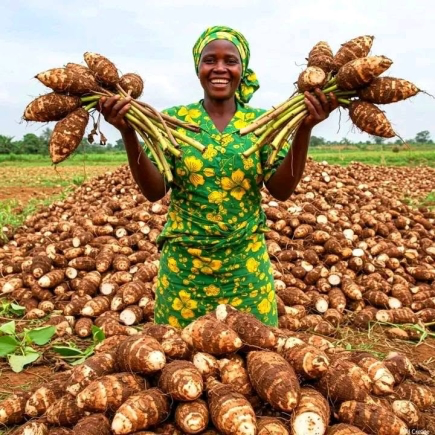
It is a quiet paradox playing out in Ghana’s farms and kitchens: cherished indigenous crops like water yam (AfaseƐ), yellow yam (Mankani), and traditional cowpea varieties are rapidly vanishing from local fields and dining tables, yet the same crops are attracting premium prices on international markets.
The Council for Scientific and Industrial Research (CSIR) has raised an urgent alarm about this disconnect, warning that Ghana risks losing its unique plant heritage—and the economic opportunities that come with it—unless deliberate steps are taken to reverse the trend.
“A quiet emergency”
“There is a quiet emergency in our food and farming systems,” said Dr. Daniel Ashie Kotey, Director of the Plant Genetic Resources Research Institute at Bunso in the Eastern Region. “Indigenous varieties are disappearing from our tables and also our farms. And we, as the National Gene Bank, our responsibility is to make sure that this loss is not irreversible.”
In an interview with Accra-based Joy FM, Dr. Kotey disclosed that foreign buyers, particularly from Western countries, have begun targeting Ghana’s native crops because they are perceived as “way healthier,” and are willing to pay significantly higher prices for them.
However, while international demand rises, many of these crops have become scarce at home.
Examples on the brink
Dr. Kotey cited specific indigenous varieties that have suffered sharp declines. AfaseƐ (water yam), once a staple for preparing fufuo, is no longer commonly grown or consumed. Similarly, Mankani (yellow yam) is fading from cultivation. African rice (Oryza glaberrima), a species domesticated in West Africa, has been largely replaced by Asian rice varieties. “We have abandoned it for japonica,” Dr. Kotey lamented.
Even cowpea—a key ingredient in Gobɛ (gari and beans)—has not been spared. Newer, larger-seeded varieties that cook faster are preferred by consumers, while older types with longer cooking times have been abandoned. “Even within that group, we are narrowing down,” he added.
Why it matters
Dr. Kotey attributed the decline to a combination of shifting consumer preferences, rapid urbanisation, climate change, and farming practices that erode biodiversity. “Our kids no longer eat some of the things that we used to eat,” he observed. When demand drops, he explained, farmers lose the incentive to plant traditional varieties, accelerating their disappearance.
Beyond the loss of cultural and culinary heritage, Dr. Kotey warned that Ghana is also missing significant economic opportunities. He pointed to the baobab tree as a telling example: other countries outside Africa are developing commercial products from baobab, while in Ghana the tree remains largely “left in the wild” and underutilised.
The gene bank as a lifeline
To prevent irreversible loss, the Bunso-based institute serves as Ghana’s national repository of plant genetic resources. It currently conserves about 6,000 accessions covering a wide range of crops, including more than 600 varieties each of maize, rice, and cowpea, as well as over 300 varieties of tomato and pepper. The collection also includes indigenous leafy vegetables such as ayoyo, ademe, and alefu, alongside crops like African yam bean, pigeon pea, and bambara groundnut.
Unlike many gene banks around the world that specialise in a single crop, the Bunso facility conserves numerous species under one roof. Seeds that can be dried without losing viability are stored at five degrees Celsius for working collections and at minus 20 degrees Celsius for long-term preservation. Crops such as cassava and yam, which do not survive drying, are maintained through tissue culture under controlled laboratory conditions.
A global backup in Norway
As an additional safeguard, duplicate collections of Ghana’s plant genetic resources are stored at the Svalbard Global Seed Vault in Norway. In October 2023, Ghana became the 100th institution worldwide to deposit seeds at the facility, sending varieties of maize, rice, eggplant, and cowpea. “If we lose everything in Ghana, we can recall some of this material,” Dr. Kotey said.
Access for farmers and the public
The institute’s mission, however, goes beyond conservation. Planting materials are made available to farmers, researchers, plant breeders, and students. People seeking crop varieties that are no longer commercially available can obtain them from the institute. Where demand exists, the institute multiplies conserved materials in the field to make adequate quantities available for distribution. “The value of what we do is justified by use. If we collect and conserve and nobody uses them, there’s no point,” Dr. Kotey stressed.
“We are the library”
The Plant Genetic Resources Research Institute is located about five minutes from the Linda Dor Junction on the Accra-Kumasi highway. Dr. Kotey urged the public, farmers, and policymakers to recognise the value of Ghana’s indigenous crops before it is too late.
“We make sure that the chapters of our food heritage are not lost forever,” he said. “We are the library that makes sure that future generations can have access to these things.”


